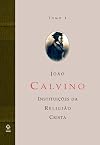
Institutes of the Christian Religion, Volume 1
by John Calvin
Institutes of the Christian Religion (1)
On This Page
Description
English translation of the monumental statement of reformation faith.Tags
Recommendations





Member Reviews
I would urge anyone who is interested in theology to at least dip into this. Calvin is a powerful writer and surprisingly readable. Also, many of the ideas people have about Calvin seem to be from his image in the general culture, not from his writings. In "Institutes," Calvin writes with a pastoral tone, compassionate with human weakness, but stern toward hypocrisy and posers.
As Institutas - Edição Especial com Notas de Estudo é uma tradução da edição francesa de 1541, que por sua vez foi traduzida por João Calvino da edição em latim de 1539. Até à última edição em latim (1559) Calvino continuou acrescentando materiais e alterando o arranjo do conteúdo. O mérito dessa Edição Especial (apesar de incompleta) é a sua linguagem mais acessível e as notas de estudo. Para orientar o pesquisador incluímos no primeiro volume uma harmonia entre as duas edições, informando o que ambas contém em comum e onde esse material se encontra em cada uma delas. Tradução: Dr. Odayr Olivetti - Coleção em 4 volumes, capa dura colorida;
Total de 1072 páginas em papel Chamois;
Notas para estudo e pesquisa show more elaboradas pelo Dr. Hermisten Maia Pereira da Costa;
Harmonia temática com a Edição Especial traduzida do latim; - Linguagem contemporânea e acessível. show less
Total de 1072 páginas em papel Chamois;
Notas para estudo e pesquisa show more elaboradas pelo Dr. Hermisten Maia Pereira da Costa;
Harmonia temática com a Edição Especial traduzida do latim; - Linguagem contemporânea e acessível. show less
I think this volume is far better than the second part of the Institutes.
I think this volume is far better than the second part of the Institutes.
The translator and associates took great care to preserve the rugged strength and vivedness of Calvin's writing. They have not, however, hesitated to break up overly long sentences to conform to modern English usage, or to render heavy Latinate theological terms in simple language. --back cover
A obra de João Calvino, As institutas da religião cristã, tem sua origem na ala reformada da Reforma Protestante.O livro pretende ser um guia para o estudo das Escrituras, funcionando como guia e comentário a respeito da profundidade de seus significados, que eram normalmente elaborados e complexos.
Feb 17, 2020Portuguese (Brazil)
Ratings
Members
- Recently Added By
Author Information

1,028+ Works 35,768 Members
Born Jean Cauvin in Noyon, Picardy, France, John Calvin was only a boy when Martin Luther first raised his challenge concerning indulgences. Calvin was enrolled at the age of 14 at the University of Paris, where he received preliminary training in theology and became an elegant Latinist. However, following the dictates of his father, he left Paris show more at the age of 19 and went to study law, first at Orleans, then at Bourges, in both of which centers the ideas of Luther were already creating a stir. On his father's death, Calvin returned to Paris, began to study Greek, the language of the New Testament, and decided to devote his life to scholarship. In 1532 he published a commentary on Seneca's De Clementia, but the following year, after experiencing what was considered a sudden conversion, he was forced to flee Paris for his religious views. The next year was given to the study of Hebrew in Basel and to writing the first version of his famous Institutes of the Christian Religion, which he gave to the printer in 1535. The rest of his life-except for a forced exile of three years-he spent in Geneva, where he became chief pastor, without ever being ordained. When he died, the city was solidly on his side, having almost become what one critic called a "theocracy." By then the fourth and much-revised edition of his Institutes had been published in Latin and French, commentaries had appeared on almost the whole Bible, treatises had been written on the Lord's Supper, on the Anabaptists, and on secret Protestants under persecution in France. Thousands of refugees had come to Geneva, and the city-energized by religious fervor-had found room and work for them. Though Calvin was sometimes bitter in his denunciation of those who disagreed with him, intolerant of other points of view, and absolutely sure he was right on the matter of predestination, he was nonetheless one of the great expounders of the faith. From his work the Reformed tradition had its genesis, and from his genius continues to refresh itself. (Bowker Author Biography) show less
Series

Work Relationships
Is contained in
Common Knowledge
- Canonical title
- Institutes of the Christian Religion, Volume 1
- Original title
- Institutes of the Christian religion
- Disambiguation notice
- Volume 1 - Individual volumes should not be combined with the complete set or complete work or with different volumes of the same set.
Classifications
- Genres
- Religion & Spirituality, Nonfiction, History
- DDC/MDS
- 230.42 — Religion Christianity Christianity Protestant churches
- LCC
- BX9420 .I65 — Philosophy, Psychology and Religion Christian Denominations Christian Denominations Protestantism Other Protestant denominations Reformed or Calvinistic Churches
- BISAC
Statistics
- Members
- 719
- Popularity
- 39,220
- Reviews
- 6
- Rating
- (4.43)
- Languages
- 7 — Dutch, English, French, German, Latin, Portuguese (Portugal), Spanish
- Media
- Paper, Ebook
- ISBNs
- 19
- ASINs
- 31