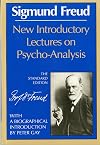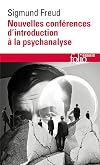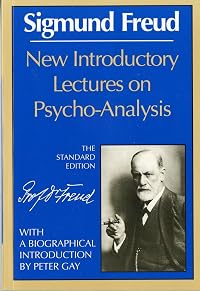
New Introductory Lectures on Psychoanalysis
by Sigmund Freud
On This Page
Description
Freud's early lectures on psychoanalysis treat such topics as dreams, occultism, anxiety, femininity, and instinct.Tags
Recommendations




























Member Reviews
This was a fairly basic collection of Freud's lectures. Overall, they are not as great as some of his other more momentous works. The conclusions that he gives are largely dated and most of the material relates directly back to some of his earlier work.
Even though these are not the most impressive lectures he gives, and are dated, they still offer a glimpse into the inner processes of Freud himself. For that reason, they should not be ignored.
Even though these are not the most impressive lectures he gives, and are dated, they still offer a glimpse into the inner processes of Freud himself. For that reason, they should not be ignored.
Freud's new introductory lectures carry on from, and are supplementary to, his introductory lectures, written 15 years prior to these. Unlike the original lectures, these were never actually delivered as lectures, but they are still written in a lecture style. Because these lectures are supplementary, it is more or less necessary that the reader has read the first volume, or is otherwise acquainted with Freud, as these suppose a familiarity with the earlier material. More diverse and tangential topics are treated in these lectures, including telepathy and femininity, alongside a revision of the more familiar material such as his theory of dreams, and anxiety.
Freud is a consistently interesting writer, and not at all difficult to follow, show more yet there are points where I think he extrapolates towards absolute rules, where only a trend has been observed. Nevertheless, Freud treats psychology with a distinctively scientific approach for the main part, and this is a valuable addition to his original and longer introductory lectures. Perhaps the most important concept that is not present in the earlier series is the distinction between id, ego, and super-ego, which is introduced here. show less
Freud is a consistently interesting writer, and not at all difficult to follow, show more yet there are points where I think he extrapolates towards absolute rules, where only a trend has been observed. Nevertheless, Freud treats psychology with a distinctively scientific approach for the main part, and this is a valuable addition to his original and longer introductory lectures. Perhaps the most important concept that is not present in the earlier series is the distinction between id, ego, and super-ego, which is introduced here. show less
Freud published his "New Introductory Lectures on Psychoanalysis" in 1933, the year in which the Nazis publicly burned his books in Berlin. These lectures (though never intended for delivery) are cast in his lively rhetorical manner of speech and in places they recapitulate his established views (as, for instance, about dreams). But Freud also develops his newer concepts of id, ego, and super-ego as elements in the structure of the mind and explains his more recent conclusions about anxiety and the instincts and about the psychology of women. In addition, he applies his analytical method to such phenomena as telepathy and communism, among a number of subjects of indirect relevance to psychoanalysis.
Tr. James Strachey. Early lectures from Freud that complement his earliest/introductory lectures. Revision of the Theory of Dreams. Dreams and Occultism. The Dissection of the Psychical Personality. Anxiety and Instinctual Life. Femininity. Explanations, Applications and Orientations. The Question of a Weltanschauung.
Indeholder "Forord", "29. Revision af drømmelæren", "30. Drøm og okkultisme", "31. Dissociering af de psykiske personligheder", "32. Angst og driftsliv", "33. Kvindeligheden", "34. Forklaringer - anvendelser - orienteringer", "35. Om en verdensanskuelse". "Index".
Disse 7 forelæsninger blev aldrig holdt for dels havde Freud fået kæbekræft og dels var han ikke længere tilknyttet universitetet med undervisningsforpligtelse. Så han skrev dem direkte til publicering i bogform. De er svært ulæselige på denne afstand i tid og virker som det ene postulat efter det andet.
Disse 7 forelæsninger blev aldrig holdt for dels havde Freud fået kæbekræft og dels var han ikke længere tilknyttet universitetet med undervisningsforpligtelse. Så han skrev dem direkte til publicering i bogform. De er svært ulæselige på denne afstand i tid og virker som det ene postulat efter det andet.
Jun 5, 2011 (Edited)Danish
Ratings
Members
- Recently Added By
Lists

Freud Reading List
7 works; 1 member

How to Read a Book's Recommended Reading List
309 works; 10 members
Author Information

1,428+ Works 51,817 Members
Sigmund Freud was the founder of psychoanalysis, simultaneously a theory of personality, a therapy, and an intellectual movement. He was born into a middle-class Jewish family in Freiburg, Moravia, now part of Czechoslovakia, but then a city in the Austro-Hungarian Empire. At the age of 4, he moved to Vienna, where he spent nearly his entire life. show more In 1873 he entered the medical school at the University of Vienna and spent the following eight years pursuing a wide range of studies, including philosophy, in addition to the medical curriculum. After graduating, he worked in several clinics and went to Paris to study under Jean-Martin Charcot, a neurologist who used hypnosis to treat the symptoms of hysteria. When Freud returned to Vienna and set up practice as a clinical neurologist, he found orthodox therapies for nervous disorders ineffective for most of his patients, so he began to use a modified version of the hypnosis he had learned under Charcot. Gradually, however, he discovered that it was not necessary to put patients into a deep trance; rather, he would merely encourage them to talk freely, saying whatever came to mind without self-censorship, in order to bring unconscious material to the surface, where it could be analyzed. He found that this method of free association very often evoked memories of traumatic events in childhood, usually having to do with sex. This discovery led him, at first, to assume that most of his patients had actually been seduced as children by adult relatives and that this was the cause of their neuroses; later, however, he changed his mind and concluded that his patients' memories of childhood seduction were fantasies born of their childhood sexual desires for adults. (This reversal is a matter of some controversy today.) Out of this clinical material he constructed a theory of psychosexual development through oral, anal, phallic and genital stages. Freud considered his patients' dreams and his own to be "the royal road to the unconscious." In The Interpretation of Dreams (1900), perhaps his most brilliant book, he theorized that dreams are heavily disguised expressions of deep-seated wishes and fears and can give great insight into personality. These investigations led him to his theory of a three-part structure of personality: the id (unconscious biological drives, especially for sex), the superego (the conscience, guided by moral principles), and the ego (the mediator between the id and superego, guided by reality). Freud's last years were plagued by severe illness and the rise of Nazism, which regarded psychoanalysis as a "Jewish pollution." Through the intervention of the British and U.S. governments, he was allowed to emigrate in 1938 to England, where he died 15 months later, widely honored for his original thinking. His theories have had a profound impact on psychology, anthropology, art, and literature, as well as on the thinking of millions of ordinary people about their own lives. Freud's daughter Anna Freud was the founder of the Hampstead Child Therapy Clinic in London, where her specialty was applying psychoanalysis to children. Her major work was The Ego and the Mechanisms of Defense (1936). (Bowker Author Biography) show less
Some Editions
Series
Belongs to Publisher Series
Work Relationships
Is contained in
Common Knowledge
- Canonical title
- New Introductory Lectures on Psychoanalysis
- Original title
- Neue Folge der Vorlesungen zur Einführung in die Psychoanalyse
- Alternate titles*
- Inleiding tot de studie der psycho-analyse
- Original publication date
- 1933
- Canonical LCC
- BF173.F76 1989
*Some information comes from Common Knowledge in other languages. Click "Edit" for more information.
Classifications
- Genres
- Nonfiction, General Nonfiction, Philosophy
- DDC/MDS
- 150.1952 — Philosophy & psychology Psychology Emotions, Relationships, & Family Theory And Instruction Systems, schools, viewpoints Psychoanalytic systems Freudian system
- LCC
- BF173 .F76 — Philosophy, Psychology and Religion Psychology Psychology Psychoanalysis
- BISAC
Statistics
- Members
- 758
- Popularity
- 37,209
- Reviews
- 5
- Rating
- (3.53)
- Languages
- 8 — Danish, English, French, German, Polish, Portuguese, Serbian, Spanish
- Media
- Paper, Ebook
- ISBNs
- 27
- ASINs
- 21