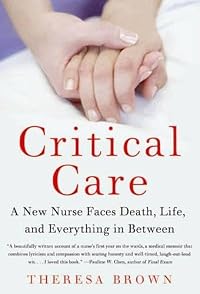
Critical Care: A New Nurse Faces Death, Life, and Everything in Between
by Theresa Brown
On This Page
Description
"At my job, people die," writes Theresa Brown, capturing both the burden and the singular importance of her profession. Brown, a former English professor, chronicles her first year as an R.N. in medical oncology. She illuminates the unique role of nurses in health care, giving us a moving portrait of the day-to-day work nurses do: caring for the person who is ill, not just the illness itself. Brown takes us with her as she struggles to tend to her patients' needs, both physical and show more emotional. Along the way, we see the work nurses do to fight for their patients' dignity, in spite of punishing treatments and an often uncaring hospital bureaucracy. We also see how caring for the seriously ill gives Brown herself a deeper appreciation of what it means to be alive. Ultimately, this is a book about embracing life, whether in times of sickness or health.--From publisher description. show lessTags
Recommendations









Member Recommendations
Member Reviews
I had an extra interest in reading Critical Care, as I underwent cancer treatment in 2008 and thus spent a great deal of time in the oncology ward of the local hospital. I found Theresa Brown's story to be a compelling one, both from the sense of her choosing nursing as a second career and her experiences working with cancer patients. As you might expect from a former university English professor, Brown has a gift for language that made this book very readable despite the difficult subject matter.
I've read a few "cancer memoirs" over the past few years, and found the vast majority of them lacking. This was the only book that dealt with the experience of having cancer that I felt I could really relate to, even when Brown was writing show more about other types of cancer than the one I had. Her thoughtfulness and compassion for her patients also reflects the vast majority of nurses I was lucky enough to have care for me while I was sick.
I've since read several of Brown's op-ed columns in the New York Times, and it's always like getting back in touch with an old friend. I'm glad she's still writing about her experiences with patients and the struggle to find a dignified end to life. show less
I've read a few "cancer memoirs" over the past few years, and found the vast majority of them lacking. This was the only book that dealt with the experience of having cancer that I felt I could really relate to, even when Brown was writing show more about other types of cancer than the one I had. Her thoughtfulness and compassion for her patients also reflects the vast majority of nurses I was lucky enough to have care for me while I was sick.
I've since read several of Brown's op-ed columns in the New York Times, and it's always like getting back in touch with an old friend. I'm glad she's still writing about her experiences with patients and the struggle to find a dignified end to life. show less
 This review was written for LibraryThing Early Reviewers.
Critical Care is a quick and engaging read, providing a glimpse into the everyday activities of a nurse in a busy hospital. Brown’s description and sketches of the people she meets held my interest, and she drops the occasional pearl of a sentence. Her observations on the interaction of her job and her life as a parent and spouse are insightful but never pretentious. She never tries to do too much, focusing on interesting observations on nursing and how it changes her life. The approach serves her well.
A chapter on a personal injury is mimetic: that is, just as Brown’s injury interrupted her own life, her orientation to the unit and her work as a nurse, so the chapter interrupts the reader’s introduction to Brown’s narrative, show more learning of Brown’s observations of nursing. Brown uses the interruption to good effect (both in life and in the narrative). It is an effective break in the narrative and provides an insight useful to her care for patients later.
It must have been difficult raising three kids while at nursing school and then tackling her first clinical job ... and finding time to write about it. But Brown's account is well-paced and thoroughly interesting, and though I imagine she made a few enemies based on her observations of what happens on the floor, Brown makes clear that while physicians and other clinicians make timely and specific interventions for patients, patient care is for the most part undertaken by nurses. Her memoir is helpful in making that point clear to those of us unfamiliar with the everyday operations of a hospital.
One gripe: the title. It’s evident from the text that Brown understands the difference between a medical-surgical unit (such as medical oncology, the floor on which she works) and a critical care unit (such as the surgical ICU to which she transfers one of her patients). Her editor should understand that distinction. Yes, “critical care” is catchy and seems to capture the serious nature of an oncology patient’s illness. But medical oncology simply isn’t critical care. Why not call the book “ER” and tap into the public consciousness of that line of clinical care? (Ignoring for the moment that “ER” is itself inaccurate, the name of a patient bay within an Emergency Department or ED.) Peculiar that a book that otherwise addresses misconceptions in healthcare should perpetuate this one, and in its title. show less
A chapter on a personal injury is mimetic: that is, just as Brown’s injury interrupted her own life, her orientation to the unit and her work as a nurse, so the chapter interrupts the reader’s introduction to Brown’s narrative, show more learning of Brown’s observations of nursing. Brown uses the interruption to good effect (both in life and in the narrative). It is an effective break in the narrative and provides an insight useful to her care for patients later.
It must have been difficult raising three kids while at nursing school and then tackling her first clinical job ... and finding time to write about it. But Brown's account is well-paced and thoroughly interesting, and though I imagine she made a few enemies based on her observations of what happens on the floor, Brown makes clear that while physicians and other clinicians make timely and specific interventions for patients, patient care is for the most part undertaken by nurses. Her memoir is helpful in making that point clear to those of us unfamiliar with the everyday operations of a hospital.
One gripe: the title. It’s evident from the text that Brown understands the difference between a medical-surgical unit (such as medical oncology, the floor on which she works) and a critical care unit (such as the surgical ICU to which she transfers one of her patients). Her editor should understand that distinction. Yes, “critical care” is catchy and seems to capture the serious nature of an oncology patient’s illness. But medical oncology simply isn’t critical care. Why not call the book “ER” and tap into the public consciousness of that line of clinical care? (Ignoring for the moment that “ER” is itself inaccurate, the name of a patient bay within an Emergency Department or ED.) Peculiar that a book that otherwise addresses misconceptions in healthcare should perpetuate this one, and in its title. show less
This review was written for LibraryThing Early Reviewers.Ordinarily, I don't think I would have given this book a second glance, a memoir about a college professor making a mid-life career change to oncological nursing. I'm a bit past mid-life myself, and I don't think I have anything that would qualify as a first career from which to switch (maybe a sixth, seventh or twelfth) so the genre doesn't normally catch my attention. Plus, I'm squeamish about blood and guts, the realization of which in my youth squashed any dreams of a medical career for myself.
However, some six months ago my beloved husband was diagnosed with cancer. Since then, I've spent way too much time in hospitals, medical offices and clinics hanging out with cancer patients and their medical providers. I'm still squeamish, show more but also fascinated by the people who every day are surrounded by the ups and downs and sideways that characterize cancer treatment.
Ms. Brown, who was a professor of English and thus more than competent as a writer, gives her impressions of her first year out of nursing school, including the patients who touched her, her own medical problems, and her frustrations with the dark side of institutional bureaucracy. She makes a powerful statement as to why, for her, the challenges of nursing are more rewarding than those she found teaching. I suppose there's nothing like life and death to put composition and rhetoric in perspective. It certainly has put a lot of things in perspective for me.
I read this book over a couple of days sitting in waiting rooms and treatment rooms while my husband was getting medical tests and chemotherapy. I don't recommend the locales, but I do recommend the book. show less
However, some six months ago my beloved husband was diagnosed with cancer. Since then, I've spent way too much time in hospitals, medical offices and clinics hanging out with cancer patients and their medical providers. I'm still squeamish, show more but also fascinated by the people who every day are surrounded by the ups and downs and sideways that characterize cancer treatment.
Ms. Brown, who was a professor of English and thus more than competent as a writer, gives her impressions of her first year out of nursing school, including the patients who touched her, her own medical problems, and her frustrations with the dark side of institutional bureaucracy. She makes a powerful statement as to why, for her, the challenges of nursing are more rewarding than those she found teaching. I suppose there's nothing like life and death to put composition and rhetoric in perspective. It certainly has put a lot of things in perspective for me.
I read this book over a couple of days sitting in waiting rooms and treatment rooms while my husband was getting medical tests and chemotherapy. I don't recommend the locales, but I do recommend the book. show less
This review was written for LibraryThing Early Reviewers.Critical Care is Theresa Brown's account of her first year as a nurse, after making a mid-life career change. (She was previously an English professor who taught writing, so she does know how to write.) Brown brings us the tremendous highs and lows and the absolute minutiae of nursing.
This arrived on a Saturday, and I didn't mean to start reading it right away -- I had another book I needed to read stat for a book discussion group. But I peeked inside the cover and was soon reading away. I fretted when I found myself with time on my hands on Sunday, wishing I had the book with me. I read a chapter during my lunch break on Monday. And, as soon as I got home from work, I finished it.
Obviously, I found it engrossing. It also had its gross show more aspects. A whole chapter about "poop" -- surprisingly interesting. And the story of her first "Condition A" -- what they call it at her hospital when a patient experiences sudden, unexpected cardiac arrest -- came complete with a massive respiratory hemorrhage, the details of which could give a squeamish reader nightmares.
But this is the stuff of nursing, along with dispensing meds and charting and all the other details of work in a medical oncology unit. In one chapter, the details of her work briefly became tedious. Yet, she achieved exactly what (I believe) she set out to do in that chapter -- demonstrating effectively the conflicting demands and details which occupy much of a nurse's typical shift at work.
The danger of all memoirs is that they are "I" centered upon the writer, and can become self-serving. Brown doesn't pretend to be "the expert" in all things medical. She admits to the steep learning curve at work which left her, at times, feeling totally insecure. I think she does come across, sometimes, as a little too good to be true. I'm sure she often goes the extra mile for her patients as she indicates, but everyone has a day now and then when they just have to do the job that's there, without heroic efforts.
In the end, the book left me feeling a bit depressed. The nature of her work in oncology means that many of her patients wind up dead. And her total lack of religious belief means that she sees that as "The END." How depressing to see death as the end, rather than the gateway to eternal life!
I couldn't stand to do the work she does, with that viewpoint. But Brown obviously sees it as her mission to make what time her patients have as comfortable as possible, and to do all that she can to help her patients live in as long and healthy a way as possible. She takes seriously her role as patient advocate. I think she genuinely cares about people. And that made me care about the patients about whom she was writing -- which is probably why the book was so hard to put down, and what made the book a worthwhile read. show less
This arrived on a Saturday, and I didn't mean to start reading it right away -- I had another book I needed to read stat for a book discussion group. But I peeked inside the cover and was soon reading away. I fretted when I found myself with time on my hands on Sunday, wishing I had the book with me. I read a chapter during my lunch break on Monday. And, as soon as I got home from work, I finished it.
Obviously, I found it engrossing. It also had its gross show more aspects. A whole chapter about "poop" -- surprisingly interesting. And the story of her first "Condition A" -- what they call it at her hospital when a patient experiences sudden, unexpected cardiac arrest -- came complete with a massive respiratory hemorrhage, the details of which could give a squeamish reader nightmares.
But this is the stuff of nursing, along with dispensing meds and charting and all the other details of work in a medical oncology unit. In one chapter, the details of her work briefly became tedious. Yet, she achieved exactly what (I believe) she set out to do in that chapter -- demonstrating effectively the conflicting demands and details which occupy much of a nurse's typical shift at work.
The danger of all memoirs is that they are "I" centered upon the writer, and can become self-serving. Brown doesn't pretend to be "the expert" in all things medical. She admits to the steep learning curve at work which left her, at times, feeling totally insecure. I think she does come across, sometimes, as a little too good to be true. I'm sure she often goes the extra mile for her patients as she indicates, but everyone has a day now and then when they just have to do the job that's there, without heroic efforts.
In the end, the book left me feeling a bit depressed. The nature of her work in oncology means that many of her patients wind up dead. And her total lack of religious belief means that she sees that as "The END." How depressing to see death as the end, rather than the gateway to eternal life!
I couldn't stand to do the work she does, with that viewpoint. But Brown obviously sees it as her mission to make what time her patients have as comfortable as possible, and to do all that she can to help her patients live in as long and healthy a way as possible. She takes seriously her role as patient advocate. I think she genuinely cares about people. And that made me care about the patients about whom she was writing -- which is probably why the book was so hard to put down, and what made the book a worthwhile read. show less
This review was written for LibraryThing Early Reviewers.This book covers the experiences of a newly minted second-career nurse in an oncology ward in a hospital. Well written (the author was an English professor in her life before nursing), this book vividly conveys the highs, lows, and, let's face it, shit, involved in nursing. I'm not being crude in that last sentence - feces is actually the subject of an entire chapter in the book, and apparently something that nurses deal with on a regular enough basis that it takes on a life all its own. Brown's empathy (and ability to deal with bodily fluids) is why she is such a good nurse. This book, however, does not paint too rosy a picture - Brown is, after all, a nurse in an oncology ward, so the vast majority of her patients die. They die on the show more ward, or they die months later, but sooner or later most of them die. The few 'survivors' are mere footnotes, because the living inhabit the space outside of these pages. An interesting look at the nursing profession. show less
This review was written for LibraryThing Early Reviewers.Don't read this book while eating, it might make you a little queasy. And maybe read it by yourself, because there might be tears.
Last time I read a medical memoir, I cringed at how the author repeatedly dehumanized patients. When I reviewed that book, I had to go back and find the offending passages and it took me some time to flip through to them. Not wanting to do that again, I started reading this book pencil in hand, ready to underline and dog-ear where necessary.
This book, however, remains unscathed.
Theresa Brown has given us an inside look as the nursing profession, and shown most of herself and most of her colleagues to be competent, compassionate people. I was able to enjoy this book -- squick out moments aside -- without show more fearing for the humanity of anyone who finds themselves in this nurse's care. Brown has also leveraged her previous occupation (English professor) into the creation of tidily written prose.
If schools of nursing are in the habit of assigning such things,this book would be a wonderful educational asset. I shall certainly recommend Critical care to anyone I know who is considering becoming a nurse. Thumbs up. show less
Last time I read a medical memoir, I cringed at how the author repeatedly dehumanized patients. When I reviewed that book, I had to go back and find the offending passages and it took me some time to flip through to them. Not wanting to do that again, I started reading this book pencil in hand, ready to underline and dog-ear where necessary.
This book, however, remains unscathed.
Theresa Brown has given us an inside look as the nursing profession, and shown most of herself and most of her colleagues to be competent, compassionate people. I was able to enjoy this book -- squick out moments aside -- without show more fearing for the humanity of anyone who finds themselves in this nurse's care. Brown has also leveraged her previous occupation (English professor) into the creation of tidily written prose.
If schools of nursing are in the habit of assigning such things,this book would be a wonderful educational asset. I shall certainly recommend Critical care to anyone I know who is considering becoming a nurse. Thumbs up. show less
This review was written for LibraryThing Early Reviewers.Have you ever found yourself wondering how oncology nurses can handle doing their jobs? It has to be the hardest job in medicine. And, as is learned from Theresa Brown's new memoir, Critical Care - A New Nurse Faces Death, Life, and Everything in Between, you can add the physical stress of working long shifts to the emotional toll of caring for vulnerable patients and their families.
I was originally drawn to this book because I'm intrigued by people who make changes in midlife. In this case, Brown left her position as an academic (professor of literature) to enter nurisng school and ultimately become an RN specializing in oncology. It was interesting to read why she made this decision and the impact it made on her family.
Brown writes show more vividly about her triumphs and struggles to become a fully skilled, professional nurse within the unique work culture of a hospital, and more specifically, a ward on the oncology floor. Did you know that some of the mean girls we encountered in high school later became nursing supervisors? Heads up!
What I found most profound was learning how Ms. Brown's experience with her patients and their families changed her view of life. As she learned to be an effective advocate for her patients, she also found the determination to stand up for herself as a medical professional. And, not surprisingly, she has learned first-hand how quickly your life or someone you love's life can change. Take nothing for granted, or as the author says: buy the piano. show less
I was originally drawn to this book because I'm intrigued by people who make changes in midlife. In this case, Brown left her position as an academic (professor of literature) to enter nurisng school and ultimately become an RN specializing in oncology. It was interesting to read why she made this decision and the impact it made on her family.
Brown writes show more vividly about her triumphs and struggles to become a fully skilled, professional nurse within the unique work culture of a hospital, and more specifically, a ward on the oncology floor. Did you know that some of the mean girls we encountered in high school later became nursing supervisors? Heads up!
What I found most profound was learning how Ms. Brown's experience with her patients and their families changed her view of life. As she learned to be an effective advocate for her patients, she also found the determination to stand up for herself as a medical professional. And, not surprisingly, she has learned first-hand how quickly your life or someone you love's life can change. Take nothing for granted, or as the author says: buy the piano. show less
This review was written for LibraryThing Early Reviewers.Members
- Recently Added By
Author Information

3+ Works 617 Members
Theresa Brown, R.N., received her BSN from the University of Pittsburgh. She is a regular contributor to the New York Times blog, Well and CNN.com. Theresa lives in the Pittsburgh area with her husband, Arthur Kosowsky, their three children, and their dog. Visit the author at www.theresabrownrn.com.
Common Knowledge
- Original publication date
- 2010-06-01
- Dedication
- For M., S., C., & A. and for nurses everywhere.
- Blurbers
- Chen, Pauline W.; Salamon, Julie; Cohen, Elizabeth; Cohen, Richard M.
Classifications
- Genres
- Nonfiction, Biography & Memoir, General Nonfiction
- DDC/MDS
- 616.025092 — Applied Science & Technology Medicine & health Diseases, Allergies, Skin Conditions Pathology; Diseases; Treatment First aid; Emergency; Euthanasia First aid Nursing
- LCC
- RT120 .I5 .B76 — Medicine Nursing Nursing Specialties in nursing
- BISAC
Statistics
- Members
- 250
- Popularity
- 129,321
- Reviews
- 84
- Rating
- (3.65)
- Languages
- English
- Media
- Paper, Audiobook, Ebook
- ISBNs
- 7
- ASINs
- 4