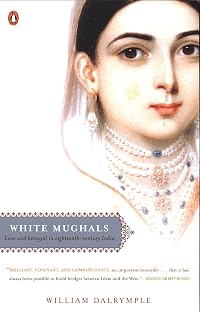
White Mughals: Love and Betrayal in Eighteenth-Century India
by William Dalrymple
On This Page
Description
'White Mughals' is the romantic and ultimately tragic tale of a passionate love affair that transcended all the cultural, religious and political boundaries of its time. James Achilles Kirkpatrick was the British Resident at the court of Hyderabad when he met Khair un-Nissa - 'Most Excellent among Women' - the great-niece of the Prime Minister of Hyderabad. He fell in love with her and overcame many obstacles to marry her, converting to Islam and, according to Indian sources, becoming a show more double-agent working against the East India Company. It is a remarkable story, but such things were not unknown: from the early sixteenth century to the eve of the Indian Mutiny, the 'white Mughals' who wore local dress and adopted Indian ways were a source of embarrassment to successive colonial administrations. Dalrymple unearths such colorful figures as 'Hindoo Stuart', who travelled with his own team of Brahmins to maintain his temple of idols, and Sir David Auchterlony, who took all 13 of his Indian wives out for evening promenades, each on the back of her own elephant. In 'White Mughals', William Dalrymple discovers a world almost entirely unexplored by history, and places at its center a compelling tale of seduction and betrayal. show lessTags
Recommendations







Member Recommendations
Member Reviews
White Mughals by William Darymple
Full confession - I wanted to like this book more than I did. I read Dalrymple's City of the Djinns last year and it was one of my top reads for the year so I made a point of requesting more Dalrymple books for Christmas. White Mughals was by no means a bad book. It just wasn't as enchanting for me as I had hoped.
White Mughals is, in part, the story of the relationship between James Achilles Kirkpatrick, a British resident and high official of the British East Indian Company, and Khair-un-Nissa, a muslim noblewoman. The other part of the book is a detailed explanation of the social and political environment at this stage in India. Ultimately, I found this part more engaging that the love story.
White show more Mughals does a good job of making the point that the division between the English and Indians that characterized late Empire was a product of Victorian sensibilities and that the earlier encounters between the English and Indians were much less separate. Dalrymple's objective here is not to point the sexual contact between the English and Indians (which there was plenty of both before and after the English got a lot more prudish about such things) but rather that genuine love and respect could exist between the two worlds. Kirkpatrick and Khair's relationship is exhibit A to this point.
While serving as the British resident in Hyderbad at a Muslim Mogul court, Kirkpatrick meets and falls for Khair. The two secretly wed and proceed to have two children who are initially raised in Mogul court but are subsequently sent to England for school, never to see their parents again. Dalrymple does a good job of making the point that the marriage between these two people represented a blending of cultures. Kirkpatrick, while undeniably English, took a great interest in Indian culture, especially the Islamic culture of Northern India. He became fluent in the language, arts and courtly culture of where he lived and worked.
Ultimately, White Mughals is written as a tragedy. Kirkpatrick's embrace of the existing culture is juxtaposed with an increasingly puritan and rapacious view of India by the East India Company. Thus, Kirkpatrick is frequently at odds with his superiors over the East India Company's growing territorial expansion and its unfair trade agreements that are pushed on to the Indians at gunpoint. When Kirkpatrick protests, his adversaries use his relationship with Khair and his apparent conversion to Islam as proof that he is a traitor. The reader is left with the sense that Kirkpatrick is being dragged back by a receding tide against which he cannot prevail. There is also a sense that the English relationship with India could have gone in a very different relationship and could have been far more collaborative. Instead, we see the flowering of the idea that India and Indians are lesser people and thus properly subjugated by the English. Kirkpatrick sees the transformation of attitudes and attempts to stop the tide but to no avail.
White Mughals is an interesting book about an important inflection point. However, the grander scope of the issues are occasionally drowned in the minute details of the relationship between Kirkpatrick and Khair, making the narrative harder to follow. show less
Full confession - I wanted to like this book more than I did. I read Dalrymple's City of the Djinns last year and it was one of my top reads for the year so I made a point of requesting more Dalrymple books for Christmas. White Mughals was by no means a bad book. It just wasn't as enchanting for me as I had hoped.
White Mughals is, in part, the story of the relationship between James Achilles Kirkpatrick, a British resident and high official of the British East Indian Company, and Khair-un-Nissa, a muslim noblewoman. The other part of the book is a detailed explanation of the social and political environment at this stage in India. Ultimately, I found this part more engaging that the love story.
White show more Mughals does a good job of making the point that the division between the English and Indians that characterized late Empire was a product of Victorian sensibilities and that the earlier encounters between the English and Indians were much less separate. Dalrymple's objective here is not to point the sexual contact between the English and Indians (which there was plenty of both before and after the English got a lot more prudish about such things) but rather that genuine love and respect could exist between the two worlds. Kirkpatrick and Khair's relationship is exhibit A to this point.
While serving as the British resident in Hyderbad at a Muslim Mogul court, Kirkpatrick meets and falls for Khair. The two secretly wed and proceed to have two children who are initially raised in Mogul court but are subsequently sent to England for school, never to see their parents again. Dalrymple does a good job of making the point that the marriage between these two people represented a blending of cultures. Kirkpatrick, while undeniably English, took a great interest in Indian culture, especially the Islamic culture of Northern India. He became fluent in the language, arts and courtly culture of where he lived and worked.
Ultimately, White Mughals is written as a tragedy. Kirkpatrick's embrace of the existing culture is juxtaposed with an increasingly puritan and rapacious view of India by the East India Company. Thus, Kirkpatrick is frequently at odds with his superiors over the East India Company's growing territorial expansion and its unfair trade agreements that are pushed on to the Indians at gunpoint. When Kirkpatrick protests, his adversaries use his relationship with Khair and his apparent conversion to Islam as proof that he is a traitor. The reader is left with the sense that Kirkpatrick is being dragged back by a receding tide against which he cannot prevail. There is also a sense that the English relationship with India could have gone in a very different relationship and could have been far more collaborative. Instead, we see the flowering of the idea that India and Indians are lesser people and thus properly subjugated by the English. Kirkpatrick sees the transformation of attitudes and attempts to stop the tide but to no avail.
White Mughals is an interesting book about an important inflection point. However, the grander scope of the issues are occasionally drowned in the minute details of the relationship between Kirkpatrick and Khair, making the narrative harder to follow. show less
After reading The Last Mughal a few years ago, I wanted to read the prequel of sorts, White Mughals. Eighteenth-century India is an exotic subject (for me) which Dalrymple brings vividly to life across the barrier of time and culture. In this deeply researched history he has read thousands of private letters by British aristocrats who were in the opening stages of establishing English prominence in India (around the same time Napoleon's fleet was defeated in Egypt by Lord Nelson). He shows in detail there was significant cross cultural exchange in India between Christian and Muslim/Hindu, European and Indian. While in the 19th century the British famously kept aloof, in this earlier period it was not uncommon for British to "go native", show more and for their mixed-blood offspring to return to England and successfully merge into society. In this backdrop, the book focuses on a love affair between a teenage Muslim Indian girl and a British aristocrat.
Ultimately I found this an uneven read. In parts I was totally engrossed and it has informed my image of late 18th India (which was a blank slate). For that alone the lush detail makes the book worthwhile. However I bogged down in the excessive detail of private lives in the second half of the book which takes on a kind of soap opera. It just didn't seem that important or worthwhile to learn the chain of events Dalrymple uncovered in these private letters. I can understand why it's worth writing about, but I lost interest. Still I recommend it as unique along with The Last Mughal. I'm looking forward to his upcoming book on the British Afghanistan wars. show less
Ultimately I found this an uneven read. In parts I was totally engrossed and it has informed my image of late 18th India (which was a blank slate). For that alone the lush detail makes the book worthwhile. However I bogged down in the excessive detail of private lives in the second half of the book which takes on a kind of soap opera. It just didn't seem that important or worthwhile to learn the chain of events Dalrymple uncovered in these private letters. I can understand why it's worth writing about, but I lost interest. Still I recommend it as unique along with The Last Mughal. I'm looking forward to his upcoming book on the British Afghanistan wars. show less
White Mughals is the romantic and ultimately tragic tale of a passionate love affair that crossed and transcended all the cultural, religious and political boundaries of its time. James Achilles Kirkpatrick was the British Resident at the court of the Nizam of Hyderabad when in 1798 he glimpsed Kahir un-Nissa—'Most excellent among Women'—the great-niece of the Nizam's Prime Minister and a descendant of the Prophet. Kirkpatrick had gone out to India as an ambitious soldier in the army of the East India Company, eager to make his name in the conquest and subjection of the subcontinent. Instead, he fell in love with Khair and overcame many obstacles to marry her—not least of which was the fact that she was locked away in purdah and show more engaged to a local nobleman. Eventually, while remaining Resident, Kirkpatrick converted to Islam, and according to Indian sources even became a double-agent working for the Hyderabadis against the East India Company. It is a remarkable story, involving secret assignations, court intrigue, harem politics, religious and family disputes. But such things were not unknown; from the early sixteenth century, when the Inquisition banned the Portuguese in Goa from wearing the dhoti, to the eve of the Indian mutiny, the 'white Mughals' who wore local dress and adopted Indian ways were a source of embarrassments to successive colonial administrations. William Dalrymple unearths such colourful figures as 'Hindoo Stuart', who travelled with his own team of Brahmins to maintain his temple of idols, and who spent many years trying to persuade the memsahibs of Calcutta to adopt the sari; and Sir David Ochterlony, Kirkpatrick's counterpart in Delhi, who took all thirteen of his wives out for evening promenades, each on the back of their own elephant. In White Mughals, William Dalrymple discovers a world almost entirely unexplored by history, and places at its centre a compelling tale of love, seduction and betrayal. It possesses all the sweep and resonance of a great nineteenth-century novel, set against a background of shifting alliances and the manoeuvring of the great powers, the mercantile ambitions of the British and the imperial dreams of Napoleon. White Mughals, the product of five years' writing and research, triumphantly confirms Dalrymple's reputation as one of the finest writers at work today. show less
For the last few months -- I've been reading/listening to William Dalrymple a lot to understand Indian history.
He did answer my peculiar questions about India before Independence. My questions were geared towards lifestyle of people, economic status, military. Pardon me for injecting my personal opinion and my reading background.
I do remember the first and second generation orientalists eg: Sir William Jones, falling in love with Bengal et culture of India. They would be 'Indianized.' It makes sense that political opinion, academic opinion changed after 1840's. The English took a more imperialistic attitude towards India.
An Excellent book that gives a real picture of Hyderabad through relationship of James and Khair.
I think growing show more up in Tamil Nadu, India, the history that I was fed in High-school was contrary to a realist perspective and shoddy in content. I must say, I am embarrassed.
Overall, I recommend this to anyone interested in Indian History, Hyderabad, Life in India before 1850's
Deus Vult,
Gottfried show less
He did answer my peculiar questions about India before Independence. My questions were geared towards lifestyle of people, economic status, military. Pardon me for injecting my personal opinion and my reading background.
I do remember the first and second generation orientalists eg: Sir William Jones, falling in love with Bengal et culture of India. They would be 'Indianized.' It makes sense that political opinion, academic opinion changed after 1840's. The English took a more imperialistic attitude towards India.
An Excellent book that gives a real picture of Hyderabad through relationship of James and Khair.
I think growing show more up in Tamil Nadu, India, the history that I was fed in High-school was contrary to a realist perspective and shoddy in content. I must say, I am embarrassed.
Overall, I recommend this to anyone interested in Indian History, Hyderabad, Life in India before 1850's
Deus Vult,
Gottfried show less
I liked this. It's the story of a left-handed relationship in Mughal India between a high-ranking Mughal lady and the British representative of the East India Company. He may or may not have married her, but in European terms, the relationship was morganatic and hence not recognised by British society in India (which is rather ironic, given Richard Wellesley's relationship with a French actress back in England).
I recall reading 'Vanity Fair' many years ago- one character, Mr Sedley, was a returned official from India, who brought with him a fondness for all things from the Sub-Continent. How to square the enthusiasm of the late 18th century with the very differently minded 'colonials' we meet in later works- hard-bitten, scornful and determined to preserve a huge distance between themselves and the 'natives'?
This biography of the British Resident at the court of Hyderabad is a pretty massive, all-encompassing work. Although the blurb talks of his love affair with a muslim noblewoman - and that is the thread that brings it all together- the author has done a huge amount of research on every aspect of Indian life. The reader thus encounters the show more Nizam (local ruler) - whose court has just as much plotting and intrigue as any in the West, attends festivals and battles. The French play a not insignificant part- with Napoleon setting his cap at world domination, and his troops in India seeking to cosy up to Indian rulers, the Brits need to maintain the favoured position.
Our hero, James Kirkpatrick, manages to maintain an equable relationship as go-between for the Moghul king and the East India company But as nasty Richard Wellesly (brother of the later Duke of Wellington) assumes control, the friendly, mutually respectful relations start to morph into what we later associate with colonialism - British staff increasingly pressured to stop wearing Indian garb, avoid mixed marriage etc, , and culminating { with the "wholesale arrival of the memsahibs, the rise of Evangelical Christianity and the moral certainties it brought) in a complete gulf between the two nations. None of which bodes well for the highly controversial romance - and eventual marriage- of Kirkpatrick and Khair un-Nissa...The love story is very sad, though has a heartwarming postscript..
Quite a demanding read- I only really got into it after first 200 pages- but very informative and pretty good read. show less
This biography of the British Resident at the court of Hyderabad is a pretty massive, all-encompassing work. Although the blurb talks of his love affair with a muslim noblewoman - and that is the thread that brings it all together- the author has done a huge amount of research on every aspect of Indian life. The reader thus encounters the show more Nizam (local ruler) - whose court has just as much plotting and intrigue as any in the West, attends festivals and battles. The French play a not insignificant part- with Napoleon setting his cap at world domination, and his troops in India seeking to cosy up to Indian rulers, the Brits need to maintain the favoured position.
Our hero, James Kirkpatrick, manages to maintain an equable relationship as go-between for the Moghul king and the East India company But as nasty Richard Wellesly (brother of the later Duke of Wellington) assumes control, the friendly, mutually respectful relations start to morph into what we later associate with colonialism - British staff increasingly pressured to stop wearing Indian garb, avoid mixed marriage etc, , and culminating { with the "wholesale arrival of the memsahibs, the rise of Evangelical Christianity and the moral certainties it brought) in a complete gulf between the two nations. None of which bodes well for the highly controversial romance - and eventual marriage- of Kirkpatrick and Khair un-Nissa...The love story is very sad, though has a heartwarming postscript..
Quite a demanding read- I only really got into it after first 200 pages- but very informative and pretty good read. show less
This is a great read - the story of a love affair between an English officer in the East India company and a high born muslim woman in Hyderabad around 1800. The author uses the love story to highlight the broader history of Europeans in India at the time. In particular he makes clear that the Victorian era image that has come down to us (the British in India dressing for dinner in the tropics to eat roast beef) applies to a later era. There was an earlier era where the relationship between the British and the Indian ruling class was more ambiguous, where a number of the British were captivated by the culture and learning (and the women) of the world in which they lived.
While I loved the book, there were minor irritations. The events of show more the lead characters are interspersed with the broader historical narrative. I got a little annoyed by the overuse of the hanging moment - the main characters would be at a dramatic turning point, and would be left hanging, while the next chapter starts with banal background to the broader history. I can see that the device would be tempting for the author, I found it overused by the end.
Read Dec 2016 show less
While I loved the book, there were minor irritations. The events of show more the lead characters are interspersed with the broader historical narrative. I got a little annoyed by the overuse of the hanging moment - the main characters would be at a dramatic turning point, and would be left hanging, while the next chapter starts with banal background to the broader history. I can see that the device would be tempting for the author, I found it overused by the end.
Read Dec 2016 show less
Members
- Recently Added By
Lists

All Things India
95 works; 21 members

Read These Too
458 works; 9 members

Most Popular Books Tagged India
36 works; 5 members

History: Asia
103 works; 1 member

Non-Fiction Worth Reading
1,025 works; 264 members
Author Information

37+ Works 12,607 Members
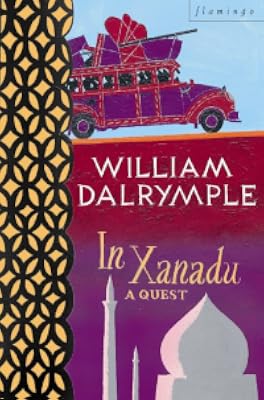
William Dalrymple wrote the highly acclaimed British best-seller In Xanadu when he was twenty-two. It won the 1990 Yorkshire Post Best First Work Award and a Scottish Arts Council Spring Book Award; it was also shortlisted for the John Llewelyn Rhys Memorial Prize. His second book, City of Djinns, won the 1994 Thomas Cook Travel Book Award and the show more Sunday Times Young British Writer of the Year Award. From the Holy Mountain was awarded the Scottish Arts Council Autumn Book Award for 1997; it was also shortlisted for the 1998 Thomas Cook Award, the John Lewelyn Rhys Memorial Prize, and the Duff Cooper Prize. A collection of his essays on India, The Age of Kali, was published in 1998. Dalrymple is a fellow of the Royal Society of Literature and of the Royal Asiatic Society and in 2002 was awarded the Mungo Park Medal by the Royal Scottish Geographic Society for his "outstanding contribution to travel literature." He is married to the artist Olivia Fraser, and they have three children. They now divide their time between London and Delhi show less
Some Editions
Awards and Honors
Awards
Notable Lists
Work Relationships
Common Knowledge
- Canonical title
- White Mughals: Love and Betrayal in Eighteenth-Century India
- Original publication date
- 2002-03-01
- People/Characters
- James Kirkpatrick; Khair un-Nissa; Warren Hastings; Richard Wellesley, 1st Marquess Wellesley
- Important places
- Hyderabad, Telangana, India; India; British India; Mughal Empire
- Important events
- British Raj
- Related movies
- White Mughals (IMDb)
- Dedication
- For Sam and Shireen Vakil Miller and Bruce Wannell
- First words
- On 7 November 1801, under conditions of the greatest secrecy, two figures were discreetly admitted to the gardens of Government House in Madras.
- Last words
- (Click to show. Warning: May contain spoilers.)But they have met and mingled in the past; and they will do so again.
Classifications
Statistics
- Members
- 1,441
- Popularity
- 16,416
- Reviews
- 19
- Rating
- (3.92)
- Languages
- English, French, Italian
- Media
- Paper, Ebook
- ISBNs
- 18
- UPCs
- 2
- ASINs
- 10