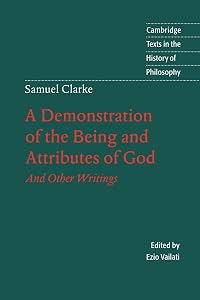
A Demonstration of the Being and Attributes of God And Other Writings (Cambridge Texts in the History of Philosophy)
by Samuel Clarke
On This Page
Description
Samuel Clarke was by far the most gifted and influential Newtonian philosopher of his generation, and A Demonstration of the Being and Attributes of God, which constituted the 1704 Boyle Lectures, was one of the most important works of the first half of the eighteenth century, generating a great deal of controversy about the relation between space and God, the nature of divine necessary existence, the adequacy of the Cosmological Argument, agent causation, and the immateriality of the soul. show more Together with the other texts presented in this edition, it also provides the best introduction to Clarke's philosophical views, which, in addition to their intrinsic interest, are historically important for the light they shed both on the philosophical positions within the Newtonian circle and on the exchange between Clarke and Leibniz, the most famous philosophical controversy of the eighteenth century. show lessTags
Recommendations







Members
- Recently Added By
Author Information

89+ Works 302 Members
Born at Norwich, England, the son of the parliamentary representative from that district, Samuel Clarke studied at Caius College, Cambridge University. There he became acquainted with the natural philosophy of Isaac Newton, whose friend and associate he became. Clarke produced a Latin translation of Newton's optics and an improved Latin version of show more Rohault's System of Natural Philosophy, the standard Cartesian textbook on physics, to which he appended critical notes reflecting the Newtonian standpoint. An Anglican priest, Clarke held a number of ecclesiastical positions, including chaplain to Queen Anne. His chief philosophical work is A Discourse Concerning the Being and Attributes of God, a redaction of the Boyle lectures he gave twice in 1704 and 1705. In the first set of lectures, Clarke advances the most influential modern version of the cosmological argument for God's existence. He is generally thought to have been the model for the dogmatic rationalist theologian Demea in Hume's Dialogues Concerning Natural Religion. The second set of lectures sets forth a naturalistic theory of ethics, providing a basis for moral principles independently of the divine will in the natural fitness or unfitness between things, for example, between a human being and certain types of action). When Caroline, Princess of Wales, proposed to sponsor a correspondence between Gottfried Leibniz and the Newtonians on questions of physics and natural religion, Newton selected Clarke as the philosopher best suited to represent the English side of the controversy. The result was a highly influential series of epistolary exchanges, which came to an end only with the death of Leibniz in 1716. (Bowker Author Biography) show less
Series
Belongs to Publisher Series
Classifications
- Genres
- Nonfiction, Religion & Spirituality, Philosophy, History, General Nonfiction
- DDC/MDS
- 212.1 — Religion Philosophy & theory of religion Existence of God, ways of knowing God, attributes of God Existence/Nonexistence of God
- LCC
- BR100 .C542 — Philosophy, Psychology and Religion Christianity Christianity
- BISAC
Statistics
- Members
- 41
- Popularity
- 703,220
- Languages
- English
- Media
- Paper, Ebook
- ISBNs
- 4