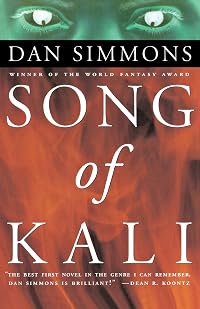
Song of Kali
by Dan Simmons
On This Page
Description
Blood will curdle in Calcutta! In the most crime-ridden city, nightmares become real and evil is defined by frightening occurrences. When an American family finds themselves encircled by the terrors of this land, lurid events befall them and life takes on a new meaning--death.Tags
Recommendations







Member Recommendations
Member Reviews
An incredibly subtle horror story; a journalist goes to Calcutta to track down a missing poet laureate, together with his Indian wife and their daughter.
Confusion and culture shock blend into a sense of overwhelming threat, as the interactions with the underworld and Kali worshippers increases.
There are scenes which are so vividly painted you feel you are living through them, the airport scene where (partial spoiler) they are reunited with their kidnapped daughter is truly haunting.
And at the end, you are never quite sure how much supernatural, and how much human manipulation was going on through the events; I read it as a parable on man's inhumanity to man more than anything "horror" in tone.
Confusion and culture shock blend into a sense of overwhelming threat, as the interactions with the underworld and Kali worshippers increases.
There are scenes which are so vividly painted you feel you are living through them, the airport scene where (partial spoiler) they are reunited with their kidnapped daughter is truly haunting.
And at the end, you are never quite sure how much supernatural, and how much human manipulation was going on through the events; I read it as a parable on man's inhumanity to man more than anything "horror" in tone.
A college professor, with his Indian wife and child in tow, travels to Calcutta to receive a manuscript from a Bengali poet who has resurfaced after being missing for a decade. Does that sound interesting? Well, the protagonist/narrator begins his tale by admitting that he has pleasurable fantasies about the city and its inhabitants being incinerated and the revelation on page 113 so horrified me that I stopped reading the book for a decade. Simmons made Calcutta and its culture the true monster in his story. I was disgusted, horrified, and enthralled by his description of the city, but I also felt guilty, for I had to wonder if disliking a place so openly made the author racist.. I found the ultimate scene of horror devasting and show more appreciated the closing chapters devoted to recovery. A modern classic. show less
What an exceptional book within the horror genre - a true masterpiece and extremely hard to put down.
The problem with reviewing it is that it is hard to comment without 'spoiling'. To appreciate it you have to cast your mind back to the period when, and the places where, it was formed in the mind of Dan Simmons as a young American liberal and literary intellectual - in the India and the US of the late 1970s and the early 1980s, just as the former looked like an intractable social problem of never-ending poverty and consequent cruelty and the latter was still in or emerging (just) from a recession similar to the one that we are now entering.
The book could not be written now. The South Asia of that period of hopelessness has been replaced show more by a vibrant, expansive India (though let us see what the recession brings) and the despair has shifted to a declining West. The book is filled with a vision of the teeming filthy hordes of Calcutta that would be regarded as insulting, almost racist today. In that sense, this book is oddly much closer to the imperial adventure tales of the thuggees of the Raj than it is to our 'modern' world only 25 years on.
There is also an undercurrent of despair at the Holocaust and nuclear destruction that somehow has also become attenuated - Rwanda and Srebenica have not normalised the horrors of the 1940s but, as the survivors of older horrors die of natural causes, modern small genocides seem more managable to liberals - if only the UN could get its act together. Such massacres are no longer placed in that category of all-encompassing global existential evil that excites hopelessness - like Calcutta does to Simmons' narrator.
Similarly, the war on terror is scary but the opponents are gangsters not the corporatised mass murdering bureaucrats of competing ideologies. Gangsters, despite Simmons' hero's experience, are very bad but not capable (or are they?) of destroying the world. Maybe that is the one doubt that nags at us tweenty five or so years on - that maybe gangsters, terrorists and insurgents can bring the Kali Yuga to pass.
And this is the point of the book - it is not pure psychological horror nor is it the horror of monsters and demons but it is something different again, a novel of cultural horror of its own time and place with elements of both. I do not recall the phrase Kali Yuga being used but that is what it is about - a deeply conservative sense that the Age of Kali was upon us.
And it is beautifully and clearly written with scarcely a wasted word - indeed, my heart sank in the first few pages because I thought I might be lumbered with that great American literary vice, the egoistic first person story that slows down the story with precise and self-indulgent description of place and sentiment. I was very wrong. The prose is, well, perfect.
Simmons takes the standard literary model and subverts it into a narrative that works precisely because we can see a highly cultured but often weak and often dim 'one-of-us' be out-manouevred and out-classed by a cunning underclass of consummate brutality. It is a novel about crime and criminality as much as it a novel of horror - and the horror is visceral because it is real, the filth, the mortuary, the decay of the human body, the disease, the fear of the dark, of monsters ... and the last chapters will shred you if you know anything of love. There is even a skilled irony as the 'hero' notes the difference between his position and would happen in a movie about his position.
This is a masterpiece that might be read as a companion piece to Ligotti - http://www.goodreads.com/book/show/2452401.Teatro_Grottesco - and King's The Stand - http://www.goodreads.com/book/show/149267.The_Stand . It does offer some small hope in a way that Ligotti does not (I cannot say more without spoiling the tale) and it is much better than The Stand (written around the same period as Simmons' book), if only because it is more 'real', but all three are explorations of the dark side of the condition of humanity from a uniquely American perspective.
The sense of decay and of impending evil that was felt by some in the age of Jimmy Carter may be coming around again but these books may also be read to show that such fears are both reasonable but also exaggerated and that, unless one's philosophical back is broken like Ligotti's, the dark may, again, be replaced by the light. Perhaps we are not, in fact in the Kali Yuga but only in a simulacrum of it that will pass in its due time. show less
The problem with reviewing it is that it is hard to comment without 'spoiling'. To appreciate it you have to cast your mind back to the period when, and the places where, it was formed in the mind of Dan Simmons as a young American liberal and literary intellectual - in the India and the US of the late 1970s and the early 1980s, just as the former looked like an intractable social problem of never-ending poverty and consequent cruelty and the latter was still in or emerging (just) from a recession similar to the one that we are now entering.
The book could not be written now. The South Asia of that period of hopelessness has been replaced show more by a vibrant, expansive India (though let us see what the recession brings) and the despair has shifted to a declining West. The book is filled with a vision of the teeming filthy hordes of Calcutta that would be regarded as insulting, almost racist today. In that sense, this book is oddly much closer to the imperial adventure tales of the thuggees of the Raj than it is to our 'modern' world only 25 years on.
There is also an undercurrent of despair at the Holocaust and nuclear destruction that somehow has also become attenuated - Rwanda and Srebenica have not normalised the horrors of the 1940s but, as the survivors of older horrors die of natural causes, modern small genocides seem more managable to liberals - if only the UN could get its act together. Such massacres are no longer placed in that category of all-encompassing global existential evil that excites hopelessness - like Calcutta does to Simmons' narrator.
Similarly, the war on terror is scary but the opponents are gangsters not the corporatised mass murdering bureaucrats of competing ideologies. Gangsters, despite Simmons' hero's experience, are very bad but not capable (or are they?) of destroying the world. Maybe that is the one doubt that nags at us tweenty five or so years on - that maybe gangsters, terrorists and insurgents can bring the Kali Yuga to pass.
And this is the point of the book - it is not pure psychological horror nor is it the horror of monsters and demons but it is something different again, a novel of cultural horror of its own time and place with elements of both. I do not recall the phrase Kali Yuga being used but that is what it is about - a deeply conservative sense that the Age of Kali was upon us.
And it is beautifully and clearly written with scarcely a wasted word - indeed, my heart sank in the first few pages because I thought I might be lumbered with that great American literary vice, the egoistic first person story that slows down the story with precise and self-indulgent description of place and sentiment. I was very wrong. The prose is, well, perfect.
Simmons takes the standard literary model and subverts it into a narrative that works precisely because we can see a highly cultured but often weak and often dim 'one-of-us' be out-manouevred and out-classed by a cunning underclass of consummate brutality. It is a novel about crime and criminality as much as it a novel of horror - and the horror is visceral because it is real, the filth, the mortuary, the decay of the human body, the disease, the fear of the dark, of monsters ... and the last chapters will shred you if you know anything of love. There is even a skilled irony as the 'hero' notes the difference between his position and would happen in a movie about his position.
This is a masterpiece that might be read as a companion piece to Ligotti - http://www.goodreads.com/book/show/2452401.Teatro_Grottesco - and King's The Stand - http://www.goodreads.com/book/show/149267.The_Stand . It does offer some small hope in a way that Ligotti does not (I cannot say more without spoiling the tale) and it is much better than The Stand (written around the same period as Simmons' book), if only because it is more 'real', but all three are explorations of the dark side of the condition of humanity from a uniquely American perspective.
The sense of decay and of impending evil that was felt by some in the age of Jimmy Carter may be coming around again but these books may also be read to show that such fears are both reasonable but also exaggerated and that, unless one's philosophical back is broken like Ligotti's, the dark may, again, be replaced by the light. Perhaps we are not, in fact in the Kali Yuga but only in a simulacrum of it that will pass in its due time. show less
Wow. This book was a lot better than I remember. I remember it being a pulpy '80s horror book that I read along with all the other pulpy horror books from that era. But it wasn't. Simmons is a talented writer.
The complaints in the reviews about the book's stereotypes of India and of Calcutta in particular are kind of bizarre. Tell me, what were the slums of Calcutta like in the 1970s and 1980s? Do you know? Perhaps you lived it, in which case, please tell me. I'm sure that there were good areas (as the book carefully describes), but this book is set in the slums of Calcutta specifically.
What stood out to me was the portrait of an ugly American in the midst of immense suffering thinking only of his own comfort - At first. Slowly having show more his eyes pried open to the way the world works when you live an existence with no power. The phrase violence is power should resonate with people right now for a lot of different reasons. He pays a very heavy price for his ignorance and arrogance. (And I adore his wife for her quiet strength. She's fantastic, even through her anger and his mistakes.) show less
The complaints in the reviews about the book's stereotypes of India and of Calcutta in particular are kind of bizarre. Tell me, what were the slums of Calcutta like in the 1970s and 1980s? Do you know? Perhaps you lived it, in which case, please tell me. I'm sure that there were good areas (as the book carefully describes), but this book is set in the slums of Calcutta specifically.
What stood out to me was the portrait of an ugly American in the midst of immense suffering thinking only of his own comfort - At first. Slowly having show more his eyes pried open to the way the world works when you live an existence with no power. The phrase violence is power should resonate with people right now for a lot of different reasons. He pays a very heavy price for his ignorance and arrogance. (And I adore his wife for her quiet strength. She's fantastic, even through her anger and his mistakes.) show less
I believe I've said before that I find Dan Simmons to be really hit-or-miss, and Song of Kali is such a hard miss it might well be some kind of "anti-hit".
Simmons's treatment of Calcutta and Indian culture is deeply prejudiced (at best) and has more than a whiff of orientalism to it. Someone else said in a review that Calcutta is used more as a vehicle for squalor and horrors rather than any attempt at an honest exploration of the place, which is a pretty succinct explanation for my problems with the book.
As far as it winning awards and being described as one of the scariest novels ever written, I'm not sure where the hell that came from. Maybe the literary landscape was just different at the time that this came out, but if you've read show more a couple of horror novels, I don't know what you would find in here that'd be that scary.
This is one of those situations where I see the praise and recommendations for a book, finish it, and immediately go back and make sure I wasn't told to read something else. Certainly a few hours of reading time I'd like back. show less
Simmons's treatment of Calcutta and Indian culture is deeply prejudiced (at best) and has more than a whiff of orientalism to it. Someone else said in a review that Calcutta is used more as a vehicle for squalor and horrors rather than any attempt at an honest exploration of the place, which is a pretty succinct explanation for my problems with the book.
As far as it winning awards and being described as one of the scariest novels ever written, I'm not sure where the hell that came from. Maybe the literary landscape was just different at the time that this came out, but if you've read show more a couple of horror novels, I don't know what you would find in here that'd be that scary.
This is one of those situations where I see the praise and recommendations for a book, finish it, and immediately go back and make sure I wasn't told to read something else. Certainly a few hours of reading time I'd like back. show less
I've felt compelled to finish very few books in a single day. Song of Kali is a proud member of that club now. It was an immensely satisfying book that had a strong narrative and great characterization, not just of people but of one of the greatest cities in the world--Calcutta/Kolkata.
At the center of the book is Calcutta, the city that was described as personifying "evil" before the story even began. Simmons describes the city in detail, especially the squalor and filth that is ubiquitous in any third world country. But it's not just the descriptions that seep down into your consciousness. Simmons's writing takes on a different form, concocting an atmosphere through the pages that was aptly described by one of the characters as show more "miasma". This "miasma" permeates through the pages, getting under your skin and distorting your perception of reality until it shares the same space as the narrator.
Although this book is billed as a horror novel, I'd like to disagree on the label a bit. Only some of the scenes can be described as the "horror" we are used to--gore, violence, monsters, etc. The real horror in this book is the city itself, which takes on a rather terrifying form by the end of the novel. The horror lies in the human perversity, depravity, and poverty that marks the lives of the denizens of the famous city. The horror lies in the fact that the narrator goes through a multitude of trials and tribulations, the best of which has truly horrifying consequences related to fatherhood and family. The horror is also presented through the presence of literature, in fact the whole story is hinged around it, though it's hard to exactly describe how I feel about it.
There's a lot that can be said about such a brilliant novel. I won't keep you any longer. If you're looking for an excellent read, then go out and get this book. You won't regret it. show less
At the center of the book is Calcutta, the city that was described as personifying "evil" before the story even began. Simmons describes the city in detail, especially the squalor and filth that is ubiquitous in any third world country. But it's not just the descriptions that seep down into your consciousness. Simmons's writing takes on a different form, concocting an atmosphere through the pages that was aptly described by one of the characters as show more "miasma". This "miasma" permeates through the pages, getting under your skin and distorting your perception of reality until it shares the same space as the narrator.
Although this book is billed as a horror novel, I'd like to disagree on the label a bit. Only some of the scenes can be described as the "horror" we are used to--gore, violence, monsters, etc. The real horror in this book is the city itself, which takes on a rather terrifying form by the end of the novel. The horror lies in the human perversity, depravity, and poverty that marks the lives of the denizens of the famous city. The horror lies in the fact that the narrator goes through a multitude of trials and tribulations, the best of which has truly horrifying consequences related to fatherhood and family. The horror is also presented through the presence of literature, in fact the whole story is hinged around it, though it's hard to exactly describe how I feel about it.
There's a lot that can be said about such a brilliant novel. I won't keep you any longer. If you're looking for an excellent read, then go out and get this book. You won't regret it. show less
Tightly written, the whole story felt like waiting for the moment when the monster figures out you're in the closet.
Members
- Recently Added By
Lists

Nightmare Magazine's Top 100 Horror Books
100 works; 7 members

Best Horror Mega-List
342 works; 6 members

Jones and Newman's Horror: The 100 Best Books
100 works; 4 members

Fantasy Masterworks
66 works; 5 members

Eldritch Exarch Press - Appendix N
244 works; 1 member
Author Information

144+ Works 69,955 Members
Science fiction writer Dan Simmons was born in East Peoria, Illinois in 1948. He graduated from Wabash College in 1970 and received an M. A. from Washington University the following year. Simmons was an elementary school teacher and worked in the education field for a decade, including working to develop a gifted education program. His first show more successful short story was won a contest and was published in 1982. His first novel, Song of Kali, won a World Fantasy Award, and Simmons has also won a Theodore Sturgeon Award for short fiction, four Bram Stoker Awards, and eight Locus Awards. He is also the author of the Hyperion series, and Simmons and his work have been compared to Herbert's Dune and Asimov's Foundation series. (Bowker Author Biography) show less
Awards and Honors
Series
Belongs to Publisher Series
Common Knowledge
- Canonical title
- Song of Kali
- Original title
- Song Of Kali
- Original publication date
- 1985
- People/Characters
- Robert Luczak; Amrita Luczak; M. Das; M. T. Krishna; Kali; Victoria Carolyn Luczak (show all 12); Abe Bronstein; Mr. Chatterjee; Mr. Gupta; Kamakhya Bharati; Jayaprakesh; Sanjay
- Important places
- Calcutta, India; India
- Dedication
- "For HARLAN ELLISON,
who has heard the song,
And for KAREN and JANE,
who are my other voices" - First words
- Some places are too evil to be allowed to exist.
- Last words
- (Click to show. Warning: May contain spoilers.)There are other songs to be sung.
- Blurbers
- Wilson, F. Paul; Bryant, Edward
- Original language
- English
Classifications
Statistics
- Members
- 1,992
- Popularity
- 10,633
- Reviews
- 67
- Rating
- (3.53)
- Languages
- 13 — Czech, Danish, Dutch, English, Finnish, French, German, Hungarian, Italian, Polish, Portuguese, Spanish, Swedish
- Media
- Paper, Audiobook, Ebook
- ISBNs
- 48
- ASINs
- 12