On This Page
Description
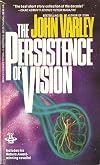
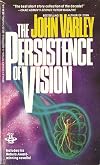
A collection of short stories from "the wildest and most original science fictional mind" (George R.R. Martin) of Hugo and Nebula award-winning author John Varley. The Persistance of Vision collects nine amazing fiction stories--including the Hugo and Nebula award-winning title novella--that could only come from the mesmerizing imagination of one of science fiction's most renowned and respected writers.Tags
Recommendations



























Member Reviews
This is a collection of short stories John Varley wrote in the 70s. Most of them take place in the same universe—the Eight Worlds universe—as his novel, The Ophiuchi Hotline. So those stories make use of memory recordings, cloning, commonplace sex changes, nullfields, AI, and humanity's exile from Earth.
Stories that aren't part of Eight Worlds universe are marked with an *.
"The Phantom of Kansas" - A woman who composes meteorological symphonies can't recall how she crafted her most successful work because she keeps getting murdered. Told not as horror or thriller, but more as a puzzle to be solved. Begs the question: Is sex with your clone considered masturbation?
"Air Raid" * - Someone hijacked the plane! Terrorists? Nope, time show more travelers. This story became the kernel for what would become Varley's novel, Millennium.
"Retrograde Summer" - While swimming on mercury on Mercury, a young man learns about his family's past. It was ok. I didn't care for the details revealed about families in the Eight Worlds series. While I'm not privy to the details of Varley's divorce from his wife, I suspect that this story might've been his way of processing it.
"The Black Hole Passes" - Unrequited love between a self-absorbed, lonely, whiny guy and a tech-savvy woman that goes on for too long. Not sure why she bothers with him. I guess she's bored listening in on the signals coming from 70 Ophiuchi. And then the black hole comes along to make the story interesting.
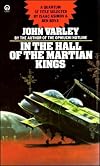
"In the Hall of the Martian Kings" * - A group of astronauts are marooned on Mars. The outcome is very different from The Martian. One of two stories in this collection where Varley explores what sort of society arises when free of the constraints imposed by our contemporary civilization.
"In the Bowl" - Rock hunting on Venus. Would've been better—believable—if the character of Ember was, say, five to ten years older. I have a difficult time believing that an eleven-year-old can have the necessary acumen to be a doctor.
"Gotta Sing, Gotta Dance" - Symbs—human - plant symbiotes that like to float around in space around Saturn—apparently make the best music composers, but need the help of a music producer to get the songs out of their heads. Maybe sex will help.
"Overdrawn at the Memory Bank" - A child's prank leads to protagonist's mind getting trapped inside a computer. Apart from that, it bears no resemblance to the PBS TV movie version that starred Raul Julia.
"The Persistence of Vision" * - In a collapsing America, a drifter wanders into a commune for the deaf-blind. At times, it takes on the tone of an anthropologist who, as he learns more about their society, wants to become accepted as one of the tribe.
There are three stories in this collection where I wish Varley had aged his female characters five to ten years. I don't get Varley's Lolita-esque flirtations with his characters. I know the sexual revolution hit sci-fi authors hard in the 70s, but this seems creepy at best. Fortunately, not a problem in his novels.
The best stories in the bunch are the ones that don't take place in the Eight Worlds universe: "Air Raid," "In the Hall of the Martian Kings," and "The Persistence of Vision." Each of these stories demonstrate how well Varley can craft an interesting story, build a world on a limited word count budget, and solid characters. The Eight Worlds stories all annoyed me in some fashion, leaving me to shake my head. And I couldn't help but put my editor's hat on and note how each story could be better.
Recommended for Varley completists or those with a Jared Diamond level of cultural objectivity.
2.5 stars rounded down for obvious reasons. show less
Stories that aren't part of Eight Worlds universe are marked with an *.
"The Phantom of Kansas" - A woman who composes meteorological symphonies can't recall how she crafted her most successful work because she keeps getting murdered. Told not as horror or thriller, but more as a puzzle to be solved. Begs the question: Is sex with your clone considered masturbation?
"Air Raid" * - Someone hijacked the plane! Terrorists? Nope, time show more travelers. This story became the kernel for what would become Varley's novel, Millennium.
"Retrograde Summer" - While swimming on mercury on Mercury, a young man learns about his family's past. It was ok. I didn't care for the details revealed about families in the Eight Worlds series. While I'm not privy to the details of Varley's divorce from his wife, I suspect that this story might've been his way of processing it.
"The Black Hole Passes" - Unrequited love between a self-absorbed, lonely, whiny guy and a tech-savvy woman that goes on for too long. Not sure why she bothers with him. I guess she's bored listening in on the signals coming from 70 Ophiuchi. And then the black hole comes along to make the story interesting.
"In the Hall of the Martian Kings" * - A group of astronauts are marooned on Mars. The outcome is very different from The Martian. One of two stories in this collection where Varley explores what sort of society arises when free of the constraints imposed by our contemporary civilization.
"In the Bowl" - Rock hunting on Venus. Would've been better—believable—if the character of Ember was, say, five to ten years older. I have a difficult time believing that an eleven-year-old can have the necessary acumen to be a doctor.
"Gotta Sing, Gotta Dance" - Symbs—human - plant symbiotes that like to float around in space around Saturn—apparently make the best music composers, but need the help of a music producer to get the songs out of their heads. Maybe sex will help.
"Overdrawn at the Memory Bank" - A child's prank leads to protagonist's mind getting trapped inside a computer. Apart from that, it bears no resemblance to the PBS TV movie version that starred Raul Julia.
"The Persistence of Vision" * - In a collapsing America, a drifter wanders into a commune for the deaf-blind. At times, it takes on the tone of an anthropologist who, as he learns more about their society, wants to become accepted as one of the tribe.
There are three stories in this collection where I wish Varley had aged his female characters five to ten years. I don't get Varley's Lolita-esque flirtations with his characters. I know the sexual revolution hit sci-fi authors hard in the 70s, but this seems creepy at best. Fortunately, not a problem in his novels.
The best stories in the bunch are the ones that don't take place in the Eight Worlds universe: "Air Raid," "In the Hall of the Martian Kings," and "The Persistence of Vision." Each of these stories demonstrate how well Varley can craft an interesting story, build a world on a limited word count budget, and solid characters. The Eight Worlds stories all annoyed me in some fashion, leaving me to shake my head. And I couldn't help but put my editor's hat on and note how each story could be better.
Recommended for Varley completists or those with a Jared Diamond level of cultural objectivity.
2.5 stars rounded down for obvious reasons. show less
In a post-apocalyptic near-future, a middle-aged drifter roams from commune to commune in the Southwest United States. Each of these groups has its own culture and he stays a while at each, doing whatever he needs (e.g., going nude, praying, chanting “Hare Krishna”) to fit in while he’s there. This works well for him — he stays fed and sheltered and moves on when he’s ready for a change of scenery.
But when he comes across a walled-in settlement in the middle of Native American land, he finds that he can never fit in because the group who lives there are the adult descendents of women who contracted rubella while pregnant. All of these adults are both deaf and blind, though their children are not. At first the drifter is show more fascinated by the ways they’ve developed to get around their “handicap,” but soon he learns that, in their community, he’s the one with the disability because he will never be able to understand their language — a language that is a lot deeper than mere spoken words could ever be.
As someone who spends a lot of time thinking about perception, I was fascinated by a culture that can’t see or hear, and I enjoyed the parts of the story that dealt with how the group overcame their obstacles. Also, the idea that communication without the masks of fake facial expressions and deceptive body language could be more informative than the “normal” methods is appealing. We get a lot of information about someone’s internal state through visual and auditory cues and it’s hard to imagine that tactile methods could compensate for missing this input, but John Varley is suggesting that people who are born blind and deaf might develop these sorts of paranormal abilities when normal sensory input is lacking. It is true that some people who are blind or deaf have sensory abilities that seeing and hearing people don’t have, or at least never realized they have (e.g., blindsight, echolocation). Perhaps Varley’s idea isn’t so far-fetched.
The Persistence of Vision, which won both the Hugo and Nebula awards, will make you think. It will make you consider what kinds of wonderful abilities might be unmasked if you lost some of your “normal” abilities. Would it be worth the price?
I listened to Peter Ganim narrate the audio version produced by Audible Frontiers. It was a great production and I’m pleased to see so many Hugo- and Nebula-awarded stories in their catalog. show less
But when he comes across a walled-in settlement in the middle of Native American land, he finds that he can never fit in because the group who lives there are the adult descendents of women who contracted rubella while pregnant. All of these adults are both deaf and blind, though their children are not. At first the drifter is show more fascinated by the ways they’ve developed to get around their “handicap,” but soon he learns that, in their community, he’s the one with the disability because he will never be able to understand their language — a language that is a lot deeper than mere spoken words could ever be.
As someone who spends a lot of time thinking about perception, I was fascinated by a culture that can’t see or hear, and I enjoyed the parts of the story that dealt with how the group overcame their obstacles. Also, the idea that communication without the masks of fake facial expressions and deceptive body language could be more informative than the “normal” methods is appealing. We get a lot of information about someone’s internal state through visual and auditory cues and it’s hard to imagine that tactile methods could compensate for missing this input, but John Varley is suggesting that people who are born blind and deaf might develop these sorts of paranormal abilities when normal sensory input is lacking. It is true that some people who are blind or deaf have sensory abilities that seeing and hearing people don’t have, or at least never realized they have (e.g., blindsight, echolocation). Perhaps Varley’s idea isn’t so far-fetched.
The Persistence of Vision, which won both the Hugo and Nebula awards, will make you think. It will make you consider what kinds of wonderful abilities might be unmasked if you lost some of your “normal” abilities. Would it be worth the price?
I listened to Peter Ganim narrate the audio version produced by Audible Frontiers. It was a great production and I’m pleased to see so many Hugo- and Nebula-awarded stories in their catalog. show less
Why oh why do these well written short fiction have to be ruined by child marriage! It seem like many male authors, writing in the late 70's have this issue. And, its never women marrying young boys, its always men marrying young girls, all in the name of sexual freedom.
The stories themselves are for the most part, well written. A few odd ideas that seem to pervade stories from this time period, and always in collections, some stories are better than others.
Unfortunately, this was a 4 star rating, until the last story, which had an adult man contemplating marriage (or adoption) to a 12 year old.
The stories themselves are for the most part, well written. A few odd ideas that seem to pervade stories from this time period, and always in collections, some stories are better than others.
Unfortunately, this was a 4 star rating, until the last story, which had an adult man contemplating marriage (or adoption) to a 12 year old.
https://nwhyte.livejournal.com/3547863.html
It's a story set in the near future (the 1990s) in a disintegrating United States; our narrator, trekking across the country, encounters a community in New Mexico where all the adults are blind and deaf, and therefore have access to spiritual enlightenment and ultimately (it appears) physical ascension to another plane of existence. The depiction of a human society made up of people very nearly like most of humanity, but establishing a sort of utopia, is beautifully done, and obviously wowed the voters for both awards. It's an appeal for a better kind of society, and for not looking down on disability.
I have to say that while I agree about not looking down on disability, to portray it as a show more supernaturally liberating experience may not be terribly close to the lived experience of people with disabilities. I can see where Varley is coming from as a literary device, but it doesn't really speak to me.
His narrator is also rather frankly relaxed about sex with underaged teenagers.
A story that has shown its age. show less
It's a story set in the near future (the 1990s) in a disintegrating United States; our narrator, trekking across the country, encounters a community in New Mexico where all the adults are blind and deaf, and therefore have access to spiritual enlightenment and ultimately (it appears) physical ascension to another plane of existence. The depiction of a human society made up of people very nearly like most of humanity, but establishing a sort of utopia, is beautifully done, and obviously wowed the voters for both awards. It's an appeal for a better kind of society, and for not looking down on disability.
I have to say that while I agree about not looking down on disability, to portray it as a show more supernaturally liberating experience may not be terribly close to the lived experience of people with disabilities. I can see where Varley is coming from as a literary device, but it doesn't really speak to me.
His narrator is also rather frankly relaxed about sex with underaged teenagers.
A story that has shown its age. show less
I'm confident I've never read this anthology before, but all the stories seemed familiar. Is it because they've been anthologized so much? Is it because they each have a lot in common with each other? I dunno. They are brilliant, and innovative for their time. But I got tired of tallying all the different kinds of sex & gender explorations that Varley was so very fascinated by. Should be called 'The Visions of Future Sex' or something. Worth reading if you like concept-driven influential SF, but not if you're just looking for an adventure, or for literature, for that matter.
‘La persistencia de la visión’ es una recopilación de relatos de ciencia ficción de John Varley, que mezcla ideas filosóficas y especulativas, con temas emocionales. Teniendo en cuenta que estos cuentos datan de la década de los setenta, resulta extraordinario el saber hacer de Varley para adelantarse en ciertos temas relacionados con el ciberpunk y la posibilidad de duplicar mentes y almacenarlas en ordenadores.
Estos son los seis relatos incluidos en esta edición de Orbis:
La persistencia de la visión (****), donde el protagonista, en su personal peregrinaje, se encuentra una extraña comuna de sordo-ciegos. Interesante relato donde sobresale la concepción del lenguaje.
En el cuenco (***), donde el protagonista, de viaje en show more Venus en busca de unas extrañas piedras, entabla amistad con una niña, Ascua, que acabará ayudándole. Bueno, sin más
Cantad, bailad (***), donde conocemos a una extraño simbionte de vegetal y humano que busca ayuda con su nueva composición musical. Normal.
Perdido en el banco de memoria (***), donde el protagonista, que había introducido su mente en un felino como entretenimiento, se entera de que han perdido su cuerpo y no puede regresar. Buen relato.
En el salón de los reyes marcianos (***), donde un grupo de astronautas en Marte sufre un percance que los obliga a permanecer en el planeta hasta la llegada de ayuda. El relato trata de las interacciones entre ellos, y el descubrimiento de la extraña raza marciana. Buen relato.
El fantasma de Kansas (**), donde la protagonista se entera del robo de memorias de su banco, y del asesinato de algunas de sus copias. Interesante. show less
Estos son los seis relatos incluidos en esta edición de Orbis:
La persistencia de la visión (****), donde el protagonista, en su personal peregrinaje, se encuentra una extraña comuna de sordo-ciegos. Interesante relato donde sobresale la concepción del lenguaje.
En el cuenco (***), donde el protagonista, de viaje en show more Venus en busca de unas extrañas piedras, entabla amistad con una niña, Ascua, que acabará ayudándole. Bueno, sin más
Cantad, bailad (***), donde conocemos a una extraño simbionte de vegetal y humano que busca ayuda con su nueva composición musical. Normal.
Perdido en el banco de memoria (***), donde el protagonista, que había introducido su mente en un felino como entretenimiento, se entera de que han perdido su cuerpo y no puede regresar. Buen relato.
En el salón de los reyes marcianos (***), donde un grupo de astronautas en Marte sufre un percance que los obliga a permanecer en el planeta hasta la llegada de ayuda. El relato trata de las interacciones entre ellos, y el descubrimiento de la extraña raza marciana. Buen relato.
El fantasma de Kansas (**), donde la protagonista se entera del robo de memorias de su banco, y del asesinato de algunas de sus copias. Interesante. show less
The collection Persistence of Vision contains some of Varley's very best short stories. Even over 30 years later, they are still mind-blowingly original.
Members
- Recently Added By
Author Information

Some Editions
Awards and Honors
Series

Belongs to Publisher Series
Gallimard, Folio SF (17)
Dell Books (17311)
ハヤカワ文庫 SF (379)
Goldmann Science Fiction (23382)
Présence du futur (277)
Science Fiction Book Club (3441)
Work Relationships
Is contained in
Contains
Common Knowledge
- Canonical title
- The Persistence of Vision
- Original title
- The Persistence of Vision
- Alternate titles
- In the Hall of the Martian Kings
- Original publication date
- 1978
- First words*
- Il ne faut jamais rien acheter d'occasion dans les banques d'organes.
- Quotations*
- Il est déplaisant de s'apercevoir que ce que l'on considérait jusque là comme des scrupules moraux perdent soudain de leur importance devant un bon paquet d'argent.
- Original language*
- Inglés
- Disambiguation notice
- UK edition has title: In the Hall of the Martian Kings
*Some information comes from Common Knowledge in other languages. Click "Edit" for more information.
Classifications
Statistics
- Members
- 873
- Popularity
- 31,174
- Reviews
- 15
- Rating
- (4.05)
- Languages
- 5 — Dutch, English, French, Japanese, Spanish
- Media
- Paper, Audiobook, Ebook
- ISBNs
- 15
- ASINs
- 10