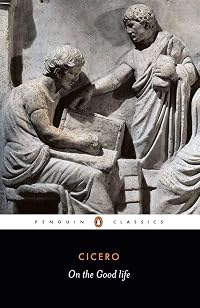
On the Good Life
by Marcus Tullius Cicero
On This Page
Description
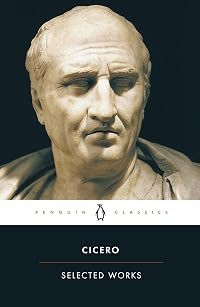
For the great Roman orator and statesman Cicero, 'the good life' was at once a life of contentment and one of moral virtue - and the two were inescapably intertwined. This volume brings together a wide range of his reflections upon the importance of moral integrity in the search for happiness. In essays that are articulate, meditative and inspirational, Cicero presents his views upon the significance of friendship and duty to state and family, and outlines a clear system of practical ethics show more that is at once simple and universal. These works offer a timeless reflection upon the human condition, and a fascinating insight into the mind of one of the greatest thinkers of Ancient Rome. show lessTags
Recommendations







Member Reviews
This is not really one book, but a collection of five pieces by Cicero, the first century BCE Roman politician and orator. Cicero was such a prolific writer that I can imagine any attempt to organize his works thematically is daunting. This volume contains sections from the larger works Discussion at Tusculum, On Duties, On the Orator, and On the State. The treatise Laelius: On Friendship is also included. On one hand, On the Good Life feels rather disjointed, since the reader is constantly ‘satelliting’ into larger works that are already ‘in progress’. On the other hand, this volume efficiently accomplishes its purpose of creating a very accessible introduction to Cicero, which is great for literary newbies like me. Like many show more other titles in the Penguin Classics series, this book was intended as an ‘entry point’ for Cicero, not an exhaustive encyclopedia of all things Cicero (this would require its own dedicated bookshelf). show less
To give Cicero’s writings a rating is somehow otiose and presumptuous.
But I do so as a gesture of recognition and of gratitude, for some of the clearest and best-expressed thought of the last two and a half millennia.
For Cicero’s writings I am profoundly grateful, and I feel a longing to express that publicly together with my admiration.
The introduction and other introductory material by Michael Grant in this edition exceptionally clear and useful.
But I do so as a gesture of recognition and of gratitude, for some of the clearest and best-expressed thought of the last two and a half millennia.
For Cicero’s writings I am profoundly grateful, and I feel a longing to express that publicly together with my admiration.
The introduction and other introductory material by Michael Grant in this edition exceptionally clear and useful.
The famous Roman statesman's writings on a variety of subjects which have been loosely bracketed together as "On the Good Life". I was particularly drawn to his essays on Duties and Friendship, both of which contain thoughts we could well apply to ourselves and find life much happier as a result.
Members
- Recently Added By
Lists

100 Books to Read in a Lifetime (That Are Older Than 200 Years)
415 works; 176 members

Folio Society
831 works; 53 members
Author Information

2,154+ Works 26,801 Members
Born in Arpinum on January 3, 106 B.C., Marcus Tullius Cicero was a Roman orator, writer, and politician. In Rome, Cicero studied law, oratory, philosophy, and literature, before embarking on a political career. Banished from Rome in 59 B.C. for the execution of some members of the Catiline group, Cicero devoted himself to literature. Cicero was show more pardoned by Julius Caesar in 47 B.C., and returned to Rome to deliver his famous speeches, known as the "Philippics," urging the senate to declare war on Marc Antony. Cicero's chief works, written between 46 and 44 B.C., can be classified in the categories of philosophical works, letters, and speeches. The letters, edited by his secretary Tiro, showcase a unique writing style and charm. The most popular work of the period was De Officiis, a manual of ethics, in which Cicero espoused fundamental Christian values half a century before Christ. Cicero was murdered in Formiae, Italy, on December 4, 43 B.C., by Antony's soldiers after the triumvirate of Antony, Lepidus, and Octavius was formed. (Bowker Author Biography) show less
All Editions
Series
Belongs to Publisher Series
Work Relationships
Common Knowledge
- Canonical title
- On the Good Life
- Original publication date
- 44 BCE
- People/Characters
- Marcus Tullius Cicero
- Epigraph
- [None]
- Dedication
- [None]
- First words
- Cicero believed in individual human beings.
Introduction.
Here we are, Brutus, on the fifth and last day of our discussions at Tusculum.
Discussions at Tusculum (V). - Last words
- (Click to show. Warning: May contain spoilers.)Then Africanus vanished; and I awoke from my sleep.
- Original language
- Latin; English
Classifications
- Genres
- Philosophy, Fiction and Literature
- DDC/MDS
- 878.0108 — Literature & rhetoric Latin & Italic literatures Latin miscellaneous writings –500
- LCC
- PA6307 .A2 — Language and Literature Greek language and literature. Latin language and literature Roman literature Individual authors Cicero, Marcus Tullius
- BISAC
Statistics
- Members
- 1,079
- Popularity
- 23,838
- Reviews
- 3
- Rating
- (3.70)
- Languages
- English
- Media
- Paper, Ebook
- ISBNs
- 3
- ASINs
- 9