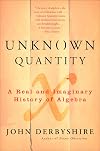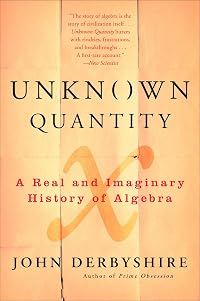
Unknown Quantity: A Real and Imaginary History of Algebra
by John Derbyshire
On This Page
Description
Prime Obsession taught us not to be afraid to put the math in a math book. Unknown Quantity heeds the lesson well. So grab your graphing calculators, slip out the slide rules, and buckle up! John Derbyshire is introducing us to algebra through the ages-and it promises to be just what his die-hard fans have been waiting for. "Here is the story of algebra." With this deceptively simple introduction, we begin our journey. Flanked by formulae, shadowed by roots and radicals, escorted by an show more expert who navigates unerringly on our behalf, we are guaranteed safe passage through even the most treacherous mathematical terrain. Our first encounter with algebraic arithmetic takes us back 38 centuries to the time of Abraham and Isaac, Jacob and Joseph, Ur and Haran, Sodom and Gomorrah. Moving deftly from Abel's proof to the higher levels of abstraction developed by Galois, we are eventually introduced to what algebraists have been focusing on during the last century. As we travel through the ages, it becomes apparent that the invention of algebra was more than the start of a specific discipline of mathematics-it was also the birth of a new way of thinking that clarified both basic numeric concepts as well as our perception of the world around us. Algebraists broke new ground when they discarded the simple search for solutions to equations and concentrated instead on abstract groups. This dramatic shift in thinking revolutionized mathematics. Written for those among us who are unencumbered by a fear of formulae, Unknown Quantity delivers on its promise to present a history of algebra. Astonishing in its bold presentation of the math and graced with narrative authority, our journey through the world of algebra is at once intellectually satisfying and pleasantly challenging. show lessTags
Recommendations


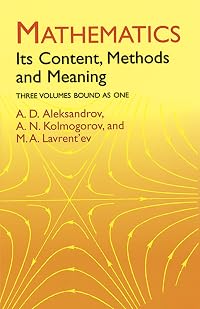
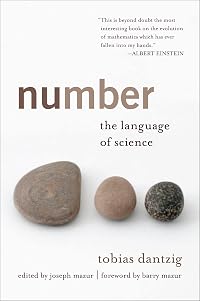
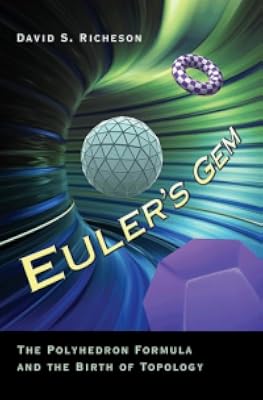
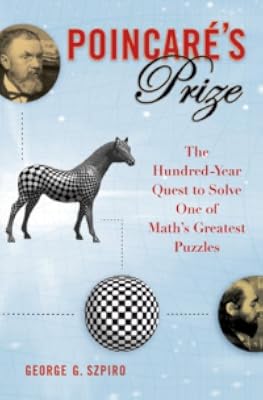
Member Recommendations


Member Reviews
Unknown Quantity is a rare exception: a book about math and math history made accessible to the interested layperson. And Derbyshire doesn't just write about math; he writes about algebra, possibly the most abstract and conceptually challenging branch of theoretical mathematics. By covering the history of algebra over the last 6000 years or so, the book follows how emerging awareness of numbers in ancient Babylonia led to the Greeks, the Renaissance, and the algebra that most people remember (or don't) from high school. Then, in the 17th and 18th centuries, algebra took a sharp turn to the abstract, but Derbyshire makes clear connections to show how it evolved from more representational problems. He challenged me, but he never lost me show more entirely.
Original post on "All The Things I've Lost" show less
Original post on "All The Things I've Lost" show less
Unknown Quantity is the history of algebra from the very beginnings with commerce-related word problems to the present day world of abstract algebras, plural. The author provides some of the necessary background to topic in short chapters on the math itself, as opposed to the history. A fine bibliography is included.
John Derbyshire writes in a clear and precise style. While many of the topics are very advanced (4th year math or grad level), he attempts to present the material so most readers can at least have a vague idea of what is happening. His historical narrative is wonderful!
I really have no bad things to say about this book, except it gave me a headache. The math is in the deep end of the pool in the later chapters. While one show more could skip the sections, the historical narrative would not mean as much without the rudimentary understanding of the math involved.
Overall, I think this book is great. I hesitate to say I love it, because, honestly, it reminded me of how much math I have forgotten and how much I want to learn. show less
John Derbyshire writes in a clear and precise style. While many of the topics are very advanced (4th year math or grad level), he attempts to present the material so most readers can at least have a vague idea of what is happening. His historical narrative is wonderful!
I really have no bad things to say about this book, except it gave me a headache. The math is in the deep end of the pool in the later chapters. While one show more could skip the sections, the historical narrative would not mean as much without the rudimentary understanding of the math involved.
Overall, I think this book is great. I hesitate to say I love it, because, honestly, it reminded me of how much math I have forgotten and how much I want to learn. show less
Unknown Quantity is an interesting volume. Math, and algebra specifically would normally seem to be a pretty dry subject (i ceratinly thought so all through college), however, John Derbyshire has created an incredibly readable history. Reading this will bring back memories of some of the materials you studied in your school days - but presented much more attractively. Part history, part primer (of algebraic concepts), part biography, Derbyshire gives algebra personality - a shifting personality as he examines the key men and woman responsible for the continuous evolution (who would have thought algebra has changed so dramatically in the last 100 years?) of algebra. Althoiugh some of the equations can make your head hurt - this volume is show more worth reading (reminds me of the old saying "Math is fun!") show less
I'm not really sure who the author was considering as the audience for this book. It's too technical at times for a layperson (and even engineers with PhDs apparently) and not detailed enough for the mathematician. Sometimes it's more like a historical biography of mathematicians and other times more like a math textbook. Additionally, the author broke the 4th wall a lot, and while I don't mind when authors do that, he was kind of annoying. He'd interject to say how he loves drawing figures by hand and everybody should, which I think serves no purpose than to be boastful and preachy. That's just one example I can think of out of many.
John Derbyshire's "Unknown Quantity" is a readable, fascinating history of algebra. In the process of teaching the history of the subject, the author cannot but help teach the reader a bit of the substance. Derbyshire is not one of those authors who fears that any equation will reduce his readership. How could he be - he is writing about the study of equations.
I'm not up to the effort to transcribe the most interesting things in the book in algebraic form, so I'll try to put some of the ideas in verbal English. Along the way, I learned that "i" has a rather simple square root, namely [1 over the square root of 2 times (1 over the square root of 2 times i)]. Multiply it out for yourself - it works. Moreover, any number has n nth roots show more that are fairly easy to determine geometrically in the complex plane: they are all the same magnitude, so they all lie equally spaced on a circle around the origin, the radius of which is the module of the real nth root of the original number.
We also learn that "an algebra" is a vector space in which 2 vectors can not only be added, but also multiplied, giving another vector as the result.
Determinants are numbers, but matrices (which look an awful lot like determinants) are merely arrays. Nontheless, matrices can be manipulated in many of the same ways as numbers.
Derbyshire also covers fields, groups, set theory, manifolds, and Riemann spaces. By the end of the book, the material has become dauntingly abstruse. In fact, in writing about a modern algebraist, Alexander Grothendieck, the author confesses, "...I myself cannot understand much of his work" but the comments of several emminent mathematicians "are sufficient to persuade me of his genius."
The book remains an eye-opener for the interested layman with a mathematical bent.
(JAB) show less
I'm not up to the effort to transcribe the most interesting things in the book in algebraic form, so I'll try to put some of the ideas in verbal English. Along the way, I learned that "i" has a rather simple square root, namely [1 over the square root of 2 times (1 over the square root of 2 times i)]. Multiply it out for yourself - it works. Moreover, any number has n nth roots show more that are fairly easy to determine geometrically in the complex plane: they are all the same magnitude, so they all lie equally spaced on a circle around the origin, the radius of which is the module of the real nth root of the original number.
We also learn that "an algebra" is a vector space in which 2 vectors can not only be added, but also multiplied, giving another vector as the result.
Determinants are numbers, but matrices (which look an awful lot like determinants) are merely arrays. Nontheless, matrices can be manipulated in many of the same ways as numbers.
Derbyshire also covers fields, groups, set theory, manifolds, and Riemann spaces. By the end of the book, the material has become dauntingly abstruse. In fact, in writing about a modern algebraist, Alexander Grothendieck, the author confesses, "...I myself cannot understand much of his work" but the comments of several emminent mathematicians "are sufficient to persuade me of his genius."
The book remains an eye-opener for the interested layman with a mathematical bent.
(JAB) show less
Unknown Quantity: A real and imaginary history of Algebra
John Derbyshire
May 28, 2010
The math professor is showing excessively in this survey of the history of algebra. Dr. Derbyshire finds pleasure in math and is too eager to ask the reader to share the pleasure by demonstrating this theorem without further explanation, or checking that conclusion on minimal evidence. It is therefore often hard to follow the very abstruse math. I did enjoy learning about the relationships between solutions to ordinary polynomial equations, group theory, rings and manifolds, and topology, topics I did not think were related. Read quickly, not bad, but sometimes bogging down in unexplained math digressions.
I learned, and enjoyed the proof, that the square show more root of i is (1/sqrt2+1/sqrt2*i) show less
John Derbyshire
May 28, 2010
The math professor is showing excessively in this survey of the history of algebra. Dr. Derbyshire finds pleasure in math and is too eager to ask the reader to share the pleasure by demonstrating this theorem without further explanation, or checking that conclusion on minimal evidence. It is therefore often hard to follow the very abstruse math. I did enjoy learning about the relationships between solutions to ordinary polynomial equations, group theory, rings and manifolds, and topology, topics I did not think were related. Read quickly, not bad, but sometimes bogging down in unexplained math digressions.
I learned, and enjoyed the proof, that the square show more root of i is (1/sqrt2+1/sqrt2*i) show less
John Derbyshire writes a good book! And for those not opposed to learning the history of a concept, and a little of the concept itself, I highly recommend it.
If you make it to at least high school there is a very good chance you will be confronted with the concept of algebra. while you may or may not learn this concept, it is absolutely pervasive in everyday life and, like it or not, if you are over th eage of 13 or so, you use it fairly regularly.
Algebra has developed over thousands of years from the merchant figuring out a procedure to repeatedly assign values to different quantities of the same ingredient, to abstract applications in topology, quantum physics or number theory.
When you read Unknown Quantity, you will learn some show more very interesting history, and by default will learn a little algebra along the way. I would love to see a similar work by Derbyshire on the calculus! show less
If you make it to at least high school there is a very good chance you will be confronted with the concept of algebra. while you may or may not learn this concept, it is absolutely pervasive in everyday life and, like it or not, if you are over th eage of 13 or so, you use it fairly regularly.
Algebra has developed over thousands of years from the merchant figuring out a procedure to repeatedly assign values to different quantities of the same ingredient, to abstract applications in topology, quantum physics or number theory.
When you read Unknown Quantity, you will learn some show more very interesting history, and by default will learn a little algebra along the way. I would love to see a similar work by Derbyshire on the calculus! show less
Members
- Recently Added By
Lists

Penguin Random House
458 works; 4 members
Author Information

14+ Works 1,829 Members
John Derbyshire is a mathematician and linguist by education, a systems analyst by profession, and a celebrated writer in his spare time. His work appears frequently in the National Review and The New Criterion. Born and raised in England, he has made his home in the United States for the past 15 years. He currently lives in Huntington, New York, show more with his wife and two children show less
Series
Belongs to Publisher Series
Common Knowledge
- Original publication date
- 2006
- Dedication
- For Rosie
- First words
- This book is a history of algebra, written for the curious nonmathematician. (Introduction)
- Last words
- (Click to show. Warning: May contain spoilers.)I can't recall whether our pundits and philosophers came to any conclusions about that larger matter, but I feel sure that algebra, at least, has not ended yet.
Classifications
Statistics
- Members
- 597
- Popularity
- 49,045
- Reviews
- 14
- Rating
- (3.66)
- Languages
- English, Italian
- Media
- Paper, Ebook
- ISBNs
- 9
- ASINs
- 4