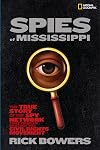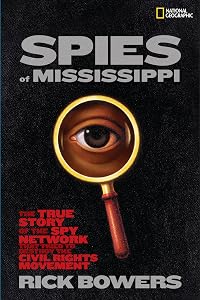
Spies of Mississippi: The True Story of the Spy Network that Tried to Destroy the Civil Rights Movement
by Rick Bowers
On This Page
Description
In the 1950s and 1960s, the Mississippi State Sovereignty Commission compiled secret files on more than 87,000 private citizens in the most extensive state spying program in U.S. history. Its mission: to save segregation.Tags
Recommendations




















Member Reviews
Most of the Civil Rights Movement books I've read are ultimately up-beat in tone. They are, of course, children's books. The specific struggles they address were ultimately won; the Montgomery bus boycott, the removal of segregation. They focus on the courageous people who struggled for freedom and equality.
This book is different. Reading Spies of the Mississippi makes the reader wonder how the Civil Rights movement ever won. How a large group of people, often uneducated, mostly poor, and downtrodden all their lives managed to defeat the government.
The government? Yep. This is the story of the Mississippi State Sovereignty Commission and how, using both white and black informants, detectives, massive government funding, and terrorists, show more it attempted to maintain the status quo: blacks beneath, whites above.
This is not a pretty story. It's not a simple one either. Paper trails, complex political maneuvering, financial corruption, it's all here.
Verdict: The book is text heavy with only a few historical photos and extensive documentation and resources at the end. It's not a casual read for a child interested in history. But it's a great resource for students studying the Civil Rights Movement and for middle school and high school students interested in this time period. The author throws in as much drama as possible to hold his readers' interest, so adults may find some of the language a little over the top, but the convoluted and dark story is fascinating on its own.
ISBN: 978-1426305955; Published January 2010 by National Geographic; Borrowed from the library; Purchased for the library show less
This book is different. Reading Spies of the Mississippi makes the reader wonder how the Civil Rights movement ever won. How a large group of people, often uneducated, mostly poor, and downtrodden all their lives managed to defeat the government.
The government? Yep. This is the story of the Mississippi State Sovereignty Commission and how, using both white and black informants, detectives, massive government funding, and terrorists, show more it attempted to maintain the status quo: blacks beneath, whites above.
This is not a pretty story. It's not a simple one either. Paper trails, complex political maneuvering, financial corruption, it's all here.
Verdict: The book is text heavy with only a few historical photos and extensive documentation and resources at the end. It's not a casual read for a child interested in history. But it's a great resource for students studying the Civil Rights Movement and for middle school and high school students interested in this time period. The author throws in as much drama as possible to hold his readers' interest, so adults may find some of the language a little over the top, but the convoluted and dark story is fascinating on its own.
ISBN: 978-1426305955; Published January 2010 by National Geographic; Borrowed from the library; Purchased for the library show less
Spies of Mississippi describes the creation and goings-on of the "Mississippi State Sovereignty Commission" created in 1956. The "Commission" was, in reality, a publically-funded state office to protect and maintain the institution of segregation. The book is written in dramatic fashion and reads almost like a mystery. The ruthlessness of the schemes that the members dream up is shocking as well as the suffering (including murder) inflicted on African Americans who want only to be treated as equals and on white civil rights workers campaigning on their behalf. It is a great read and would serve as an excellent complement to studies on integration taught in an American history class. It speaks to a topic of great importance to developing show more young adults--equity and justice--and I would think they would really enjoy this book. As testament to that, Bowers includes, in the last chapter “What Happened Next,” the story of the effort by students at Lincolnshire High School in Illinois to clear Clyde Kennard’s name (p. 105). Kennard had been wrongly accused, convicted and imprisoned for theft, was diagnosed with cancer while in prison in Mississippi and died in 1963. The students, along with the Center for Wrongful Convictions at Northwestern University, convinced Kennard’s accuser to recent his testimony and Kennard’s name was cleared. After his death and subsequent vindication, the University of Southern Mississippi named a building in his honor (p. 106). show less
Talk about backwoods Mississippi. This book reveals a lesser-known aspect of the civil rights movement, in which the state of Mississippi worked to destroy the civil rights movement and maintain white supremacy, using an elaborate network of spies and informers, including, sadly, using willing black citizens. It's hard to believe how stubbornly anti-desegration people were back in those days. It hurts to read this book but it's important to know this was part of our history.
The best part of this book is the subject. A government mandated group in Mississippi with the intention to destroy the Civil Rights movement, the dangers of combining ideology and secrecy. It sounds like it should be a thriller, but is non-fiction. I have a fondness for obscure history and this is a bit that probably should be so unknown. The book is wonderfully researched and covers a lot of ground. The only drawback is in the actual writing. It can sometimes be a bit simplistic for the subject and intended teen audience.
Adult Reader Reaction: My reactions ranged from intrigue to disbelief to outrage. I had no knowledge of the Sovereignty Commission or just how outrageously it (and others) misbehaved. I would add this to my "must read" list for all high school students.
Pros: Everyone needs to read this story about anti-Civil Rights activities in the 1950s and 1960s. It will add depth to their understanding of the time.
Read our full review and add yours at The Reading Tub®.
Pros: Everyone needs to read this story about anti-Civil Rights activities in the 1950s and 1960s. It will add depth to their understanding of the time.
Read our full review and add yours at The Reading Tub®.
This is such an interesting subject that deserves much more well-written coverage than it gets from this book. Americans spying on other Americans based on their political beliefs and goals? It's a subject that's just as timely now as in the 50's and 60's. Unfortunately, the book's writing is flat, boring, and one-dimensional. I'd love to find a history book that covers this subject in more multi-dimensional detail, because that book is probably what I'd recommend to a patron instead of this one.
In 1956, Governor J.P. Coleman signed House Bill 880 which created the Mississippi State Sovereignty Commission. It was dedicated to the preservation of segregation: separate laws, schools, facilities and even entrances based on race. It created propaganda, including movies that were supposed to show how segregation was good for society. The commission was funded by the state, answered directly to the governor, and used its resources to spy on people in Mississippi for 20 years. Not all of the commission's agents were white. There were black people who acted as spies for many reasons: some did it because it paid very well, some did it to try to ensure their jobs (like the black school superintendent who didn't want integration because show more it meant that he would lose his job), and some acted as double agents, giving the commission false information. Though the commission never participated directly in acts of violence, it provided information to the Ku Klux Klan which was used in murders, lynchings, assaults and intimidation. By the early 1960's, the commission was regularly providing "watch lists" of names, addresses, and license plate numbers to police and sheriff's departments across the state. Those departments were filled with Klan members, who used the information to terrorize people. The Civil Rights Movement in America wasn't just about overall legal rights -- it was about everyday citizens making choices to act that often put their lives at risk... for things as small as which door to enter the grocery store or which seat to take on the bus, and as enormous as marches and demonstrations that would likely lead to vicious, violent attacks. The spies in Mississippi's Sovereignty commission network made sure of that. Rick Bowers has used interviews of surviving members and spies, the actual files of the commission, photos and other primary source materials to bring this story of abuse of power and utter disregard for individual rights to light. Strong 7th grade readers and up. show less
Members
- Recently Added By
Lists

Mensa for Kids Excellence in Reading Award Program (Nonfiction)
54 works; 4 members
Author Information
3 Works 392 Members
Awards and Honors
Classifications
- Genre
- Nonfiction
- DDC/MDS
- 323.1196 — Society, government, & culture Political science Civil Rights & Liberties/ Human Rights Minority Politics Specific Groups Biography And History African Origin
- LCC
- E185.93 .M6 .B69 — History of the United States United States Elements in the population Afro-Americans
- BISAC
Statistics
- Members
- 242
- Popularity
- 134,421
- Reviews
- 12
- Rating
- (3.39)
- Languages
- English
- Media
- Paper, Audiobook, Ebook
- ISBNs
- 13
- ASINs
- 2