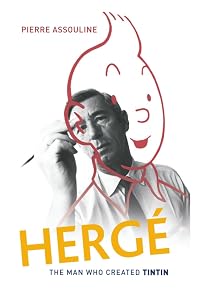
Herge: The Man Who Created Tintin
by Pierre Assouline
On This Page
Description
One of the most beloved characters in all of comics, Tintin won an enormous international following. Yet, despite Tintin's enduring popularity, Americans know almost nothing about his gifted creator, Georges Remi--better known as Hergø. Offering a captivating portrait of a man who revolutionized the art of comics, this is the first full biography of Hergø available for an English-speaking audience. A profound influence on a generation of artists such as Andy Warhol and Roy Lichtenstein, show more the elusive figure of Hergø comes to life in this illuminating biography--a deeply nuanced account that unveils the man and his career as never before. show lessTags
Recommendations








Member Recommendations

Member Reviews
A deeply sad book about a deeply sad man. I came away from this biography of Herge feeling much more ambivalent about him as a person, but I appreciated that Assouline did not feel the need to sugar coat his life. By this account, Herge was not a very nice person in his personal life but managed to pour all his good impulses and traits into the iconic character of Tintin.
In the past I have given Herge a pass for his collaboration during the war since I believed his actions did not in any way bolster the Nazi regime, but reading more details about his time at Le Soir and his continued support of collaborationists, right-wingers, and blackshirts after the war (even if it was just because they were his personal friends) makes me think show more differently. It's no surprise that during these years he turned away from representing political intrigue in the Tintin books and instead produced what I believe are his masterpieces of fantasy-adventure: the Crystal Balls and Unicorn double albums.
However, it is also heartbreaking to read about him as a man who was basically reviled by his beloved country in the wake of the war, but whose creation was adored as a quintessentially innocent symbol of Belgium. His celebrity reputation mixed with his less-than-salubrious personal life and deeply-felt religious and political crises must have put him through absolute torture. That he was able to keep working (however sporadically) despite bouts of clinical depression makes me even more thankful for the wonderful humor and adventure of the Tintin books.
A minor annoyance: the translator sometimes does not change the names of characters that are different in the French/English versions. He also does not use the published English translations when quoting dialogue but performs his own translations from Herge's French text. This results in inconsistencies with the English canon of Tintin and occasional confusion for the reader. (I have noticed that this occurs frequently with scholarly or nonfiction books about Herge/Tintin that have been translated from French.) show less
In the past I have given Herge a pass for his collaboration during the war since I believed his actions did not in any way bolster the Nazi regime, but reading more details about his time at Le Soir and his continued support of collaborationists, right-wingers, and blackshirts after the war (even if it was just because they were his personal friends) makes me think show more differently. It's no surprise that during these years he turned away from representing political intrigue in the Tintin books and instead produced what I believe are his masterpieces of fantasy-adventure: the Crystal Balls and Unicorn double albums.
However, it is also heartbreaking to read about him as a man who was basically reviled by his beloved country in the wake of the war, but whose creation was adored as a quintessentially innocent symbol of Belgium. His celebrity reputation mixed with his less-than-salubrious personal life and deeply-felt religious and political crises must have put him through absolute torture. That he was able to keep working (however sporadically) despite bouts of clinical depression makes me even more thankful for the wonderful humor and adventure of the Tintin books.
A minor annoyance: the translator sometimes does not change the names of characters that are different in the French/English versions. He also does not use the published English translations when quoting dialogue but performs his own translations from Herge's French text. This results in inconsistencies with the English canon of Tintin and occasional confusion for the reader. (I have noticed that this occurs frequently with scholarly or nonfiction books about Herge/Tintin that have been translated from French.) show less
Ratings
Members
- Recently Added By
Lists

John Carey's Sunday Best
82 works; 3 members
Author Information

Common Knowledge
Classifications
- Genres
- Nonfiction, Biography & Memoir, Graphic Novels & Comics
- DDC/MDS
- 741.5092 — Arts & recreation Drawing & decorative arts Drawing Comic books, graphic novels, fotonovelas, cartoons, caricatures, comic strips Cartoons, Caricatures, Comics History
- LCC
- PN6790 .B43 .H47264 — Language and Literature Literature (General) Literature (General) Collections of general literature Comic books, strips, etc.
- BISAC
Statistics
- Members
- 68
- Popularity
- 460,103
- Reviews
- 1
- Rating
- (4.33)
- Languages
- English
- Media
- Paper, Ebook
- ISBNs
- 3
- ASINs
- 2