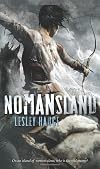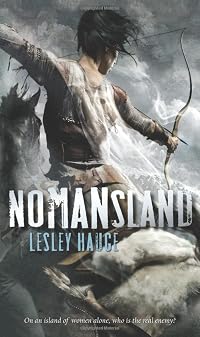
Nomansland
by Lesley Hauge
On This Page
Description
Living under a strict code of conduct in an all-female community 500 years after the earth's destruction, a sensitive teenaged girl raised to be a hunter discovers forbidden relics from the Time Before.Tags
Recommendations








Member Reviews
What would it be like to live in a world without men?
Nomansland explores this question, and I have to tell you: Life without men, the way Hauge portrays it, is not sugar and spice and everything nice. In this futuristic dystopia, women in power are ruthless, controlling, and are opposed to anything feminine. Reproduction and relationships have been reduced to pure functionality.
Of course, men are not completely gone. How else would the women make children? If this were a world filled with technology, maybe this would be possible, but this futuristic world is back-to-basics. There is little in the way of innovative technology. The women survive by raising animals and produce. Hard labor.
And, women have manly names. No names are given show more with an "e" sound at the end. No Jennies, Susies, Hayleys, Brittanys, etc. (My name, Hattie, would not be acceptable.) Women are not allowed to look at themselves in the mirror, wear makeup, or have relationships with one another. Of course, men are forbidden.
There is so much more that I could get into in relation to the plot and characters of this book. I am not sure that it's going to be a series, but I hope it is. I enjoyed this first book for the questions that it raises. What does it mean to be a woman? Are there inalienable characteristics that women possess? I have always thought so, and do even more after reading this book.
I've been thinking about this book ever since I finished it. I am a bit baffled by the world created in it and feel like there is room to explain how and why these women have decided to shun their womanly characteristics. It is an entertaining and interesting read. It leaves off with a bit of a cliffhanger, but I hope that is just a set-up for a sequel. show less
Nomansland explores this question, and I have to tell you: Life without men, the way Hauge portrays it, is not sugar and spice and everything nice. In this futuristic dystopia, women in power are ruthless, controlling, and are opposed to anything feminine. Reproduction and relationships have been reduced to pure functionality.
Of course, men are not completely gone. How else would the women make children? If this were a world filled with technology, maybe this would be possible, but this futuristic world is back-to-basics. There is little in the way of innovative technology. The women survive by raising animals and produce. Hard labor.
And, women have manly names. No names are given show more with an "e" sound at the end. No Jennies, Susies, Hayleys, Brittanys, etc. (My name, Hattie, would not be acceptable.) Women are not allowed to look at themselves in the mirror, wear makeup, or have relationships with one another. Of course, men are forbidden.
There is so much more that I could get into in relation to the plot and characters of this book. I am not sure that it's going to be a series, but I hope it is. I enjoyed this first book for the questions that it raises. What does it mean to be a woman? Are there inalienable characteristics that women possess? I have always thought so, and do even more after reading this book.
I've been thinking about this book ever since I finished it. I am a bit baffled by the world created in it and feel like there is room to explain how and why these women have decided to shun their womanly characteristics. It is an entertaining and interesting read. It leaves off with a bit of a cliffhanger, but I hope that is just a set-up for a sequel. show less
“Nomansland” is a combination of a post-apocalyptic world and “lord of the flies”.
After the great Tribulation the world is polluted, contaminated and scarred from many wars and fires. A group of women managed to escape this and formed an isolated society on an island. They have managed to remain isolated hundreds of years into the future. Keller is a Tracker in training. She is training to guard the borders against those who wish to contaminate their society; she is training to protect her society from the enemy, men. In this so called Utopian world, Keller is learning that not everything is as it seems, secrets are being kept and girls are no longer willing to stay in the dark about matters. The past is being explored and the show more future is now uncertain.
I love the fact that this book makes you think. The whole time you are reading this story you wonder “what if”. What if you found evidence of a lost culture and did not know what any of it meant? What if there was an island inhabited completely by women? What if you were in this situation? This story will reach many readers because it makes you expand your boundaries and even makes you a little uncomfortable. It talks about religion, conformity, punishment, obedience and many other interesting and even taboo topics. show less
After the great Tribulation the world is polluted, contaminated and scarred from many wars and fires. A group of women managed to escape this and formed an isolated society on an island. They have managed to remain isolated hundreds of years into the future. Keller is a Tracker in training. She is training to guard the borders against those who wish to contaminate their society; she is training to protect her society from the enemy, men. In this so called Utopian world, Keller is learning that not everything is as it seems, secrets are being kept and girls are no longer willing to stay in the dark about matters. The past is being explored and the show more future is now uncertain.
I love the fact that this book makes you think. The whole time you are reading this story you wonder “what if”. What if you found evidence of a lost culture and did not know what any of it meant? What if there was an island inhabited completely by women? What if you were in this situation? This story will reach many readers because it makes you expand your boundaries and even makes you a little uncomfortable. It talks about religion, conformity, punishment, obedience and many other interesting and even taboo topics. show less
I'm a sucker for dystopian lit, even though stand-outs are few and far between. At some level, so many of them are the same. As I read through this one, I was mentally ticking off boxes: "vague future setting? check. Strict governmental oversight--check--of an isolated people? check. Inability to travel beyond that town's borders? check again." In an odd bit of synchronicity, the Boston Bibliophile's husband posted a review today of Justin Cronin's The Passage, a review that included his checklist of elements found in nearly every dystopian novel. When he says "when reading a novel set in a certain type of post-apocalyptic future, there are things that a genre-savvy audience might expect to see," he's absolutely right, because that's show more exactly what I was doing the whole time I was reading this.
Nomansland is an engrossing story, but still predictable if you're familiar with the genre. Keller is a teenage Tracker-in-training in a society where frivolities and friendships are forbidden. When a fellow patrol-member invites Keller to check out a hidden house from the Time Before, stuffed with Found Objects, Keller is excited but also nervous. When the group starts making more regular trips, Keller enjoys the experiences but can't shake the bad feeling. Anyone who's ever read a book can see that this isn't going to end well.
My biggest complaint is how precious the descriptions and interpretations of current-world artifacts are--couches are "long chairs" and these "long chairs" are arranged around "a box with a gray window in it," etc. It's kind of interesting from an anthropological perspective, and it makes sense that the girls in the book don't know what, say, a computer looks like or what it would be used for, but the constant stream of coy, almost coquette-ish description is just too .... well, there's no better word than precious.
My biggest disappointment, however, is that in a book about this gynocentric civilization in which men are literally called "the enemy," there was surprisingly little discussion of gender politics. When I picked this up I was at least expecting something more similar to Charlotte Perkins Gilman's Herland, but at the very least hoping for some explanation of why the genders had split the way they had.
Engrossing, but not something I'm likely to buy for the collection--while dystopias circulate pretty well in my library, I don't think this one will really grab my teens. show less
Nomansland is an engrossing story, but still predictable if you're familiar with the genre. Keller is a teenage Tracker-in-training in a society where frivolities and friendships are forbidden. When a fellow patrol-member invites Keller to check out a hidden house from the Time Before, stuffed with Found Objects, Keller is excited but also nervous. When the group starts making more regular trips, Keller enjoys the experiences but can't shake the bad feeling. Anyone who's ever read a book can see that this isn't going to end well.
My biggest complaint is how precious the descriptions and interpretations of current-world artifacts are--couches are "long chairs" and these "long chairs" are arranged around "a box with a gray window in it," etc. It's kind of interesting from an anthropological perspective, and it makes sense that the girls in the book don't know what, say, a computer looks like or what it would be used for, but the constant stream of coy, almost coquette-ish description is just too .... well, there's no better word than precious.
My biggest disappointment, however, is that in a book about this gynocentric civilization in which men are literally called "the enemy," there was surprisingly little discussion of gender politics. When I picked this up I was at least expecting something more similar to Charlotte Perkins Gilman's Herland, but at the very least hoping for some explanation of why the genders had split the way they had.
Engrossing, but not something I'm likely to buy for the collection--while dystopias circulate pretty well in my library, I don't think this one will really grab my teens. show less
The Short and Sweet of It
Keller lives in a post-apocalyptic, all-female society where beauty and friendship are supplanted by hard work and community. When Keller and some other girls discover artifacts from the Time Before, they question their own society. While certain themes within the book frustrated me, overall I enjoyed the story and will pick up the next book in the series.
A Bit of a Ramble
First, what I didn't like. In Foundland, the rules are complex and strictly enforced. This post-apocalyptic world discourages or outright forbids friendship, beauty, and solitary introspection while promoting community, hard work, and efficiency. Nothing wrong with this part - after all this is what dystopian literature is all about. Then we show more have the Pitfalls which are sort of a seven deadly sins thing: Reflection, Decoration, Coquetry, Triviality, Vivacity, Compliance, and Sensuality. The book suggests that these feminine qualities were suppressed 1) in order to not distract from the harshness of survival and 2) because in the Time Before, women were obsessed with these things and were raped all the time. Of course, when Keller and company find their treasure trove of Time Before memorabilia, they spend all their time putting on make-up, trying on clothes, and organizing a beauty contest. I find this obsession with beauty artificial and mildly insulting. First, I resent the implication that these Pitfalls/Sins are "feminine" qualities. Second, I have a hard time believing that these women would become so enamored of make-up and clothes. With an entire house to explore and a houseful of goods to play with, would they really focus on nothing more than beauty?
While the presentation of the female in this book annoyed me, I did enjoy the characters. Keller is both the most loyal of the rebels and the most rebellious, which seems contradictory but is used often in dystopian novels. She wants to contribute to the communal good; she is adamant in supporting some of their beliefs; and she vehemently spouts portions of the ideology. When she rebels, she does so heavy with guilt and fear. I've always enjoyed this technique because I can see how it would be the most loyal, the most devout who would react most strongly to a loss of faith.
The most intriguing character was Ms. Windsor, the leader of Foundland. She's like a psychotic drug-using pimp who hasn't matured past 8. Seriously, it's crazy. My favorite part of her character is the violent hatred she has for the Time Before. I've never understood how characters in dystopian novels can hate a world, a culture, that they have no real knowledge of. Oh, or maybe my favorite part is the random tantrum-throwing screaming. I'm hoping we have a lot more of her in the next book. I've heard it may be a prequel, so I have my fingers crossed that it centers on this crazy character. show less
Keller lives in a post-apocalyptic, all-female society where beauty and friendship are supplanted by hard work and community. When Keller and some other girls discover artifacts from the Time Before, they question their own society. While certain themes within the book frustrated me, overall I enjoyed the story and will pick up the next book in the series.
A Bit of a Ramble
First, what I didn't like. In Foundland, the rules are complex and strictly enforced. This post-apocalyptic world discourages or outright forbids friendship, beauty, and solitary introspection while promoting community, hard work, and efficiency. Nothing wrong with this part - after all this is what dystopian literature is all about. Then we show more have the Pitfalls which are sort of a seven deadly sins thing: Reflection, Decoration, Coquetry, Triviality, Vivacity, Compliance, and Sensuality. The book suggests that these feminine qualities were suppressed 1) in order to not distract from the harshness of survival and 2) because in the Time Before, women were obsessed with these things and were raped all the time. Of course, when Keller and company find their treasure trove of Time Before memorabilia, they spend all their time putting on make-up, trying on clothes, and organizing a beauty contest. I find this obsession with beauty artificial and mildly insulting. First, I resent the implication that these Pitfalls/Sins are "feminine" qualities. Second, I have a hard time believing that these women would become so enamored of make-up and clothes. With an entire house to explore and a houseful of goods to play with, would they really focus on nothing more than beauty?
While the presentation of the female in this book annoyed me, I did enjoy the characters. Keller is both the most loyal of the rebels and the most rebellious, which seems contradictory but is used often in dystopian novels. She wants to contribute to the communal good; she is adamant in supporting some of their beliefs; and she vehemently spouts portions of the ideology. When she rebels, she does so heavy with guilt and fear. I've always enjoyed this technique because I can see how it would be the most loyal, the most devout who would react most strongly to a loss of faith.
The most intriguing character was Ms. Windsor, the leader of Foundland. She's like a psychotic drug-using pimp who hasn't matured past 8. Seriously, it's crazy. My favorite part of her character is the violent hatred she has for the Time Before. I've never understood how characters in dystopian novels can hate a world, a culture, that they have no real knowledge of. Oh, or maybe my favorite part is the random tantrum-throwing screaming. I'm hoping we have a lot more of her in the next book. I've heard it may be a prequel, so I have my fingers crossed that it centers on this crazy character. show less
Imagine a life, sometime in the future, after a nuclear disaster, on an island with no males and you have the setting for Nomansland. A group of women live, according to some very strict, almost ridiculous rules, in self imposed isolation on an island they call Foundland. There are very specific roles for the women, and they start being trained for these roles when they are 9 or 10. Keller is training to be a tracker, which means the chance of her being used for breeding is thankfully very slim. One of her friends, Laing, discovers a forbidden, buried Old Time house and she shares her discovery with the other Trackers. What they should have done was report the find immediately, but they don't tell anyone. Instead they continue to visit show more the house whenever they can get away from the night guard. Some of the girls become obsessed with using the make up and wearing the high heels and colourful clothing found in the house, and eventually they have a beauty contest, and shortly afterward are caught by the Committee. Keller, meanwhile, escapes notice, or so she thinks. The book has some great twists and turns and Keller isn't sure who to trust especially after a walkabout affords her the opportunity to see something almost unbelievable. Highly recommended for a reader ready to handle a book that might make them question the social organization of our world, and more specifically, the role of women and men, and how those roles developed.
I enjoyed the originality of the plot, and the strong character portrayed by Keller. Would not recommend it to just anyone, but definitely have an audience in mind for this one. show less
I enjoyed the originality of the plot, and the strong character portrayed by Keller. Would not recommend it to just anyone, but definitely have an audience in mind for this one. show less
Review posted here: http://offbeatvagabond.blogspot.com/2011/10/book-review-nomansland-by-lesley-hau...
Nomansland is a book set in post-apocalyptic world where men are the enemy. They have been diseased and many have died out. On an island known as Foundland, there are only women who run the island. They protect their island from the men. The trackers, teenage girls who protect the shores of the island, end up in a hidden house that is full of things they were told are forbidden. They must pretend as though they don’t know there is more out there and must continue to hide their emotions before they are all punished.
Another perfect example of a deceitful book cover. When I first saw this book, I immediately thought it was some modern show more take on Amazon women or even cooler, Xena Warrior Princess (HELLS YEAH!). But sadly, that was not the case. In fact, I am not entirely sure what the case was. This book was a little contradicting to me and sort of left me unsatisfied.
We have lots of characters, but given their society, they don’t have personalities. Women aren’t supposed to have friendships. They can’t have names that end in an “A” or a “Y”. They are not supposed to show emotions. All these things and more are pitfalls. Women are supposed to be self-sufficient, not worrying with silly things like friendship. Why? I am still not sure. And that is the real story of this book. The one characters, Ling (who started it all), found all those magazines, shoes and clothes; things forbidden in their world. Through this, she is becoming her own person and she is trying to help Keller (the main character) open her eyes and see there is more out there. Keller goes throughout this book questioning everything because she as well as the other girls is left in the dark.
The biggest problem with this book is the plot. It starts off okay and just keeps staying at okay. There is no real climax until close to the end which I can’t spoil. But then it was over so quickly. I didn’t appreciate it at all. I honestly thought it was incomplete. Nothing is really explained, they just are. I understand they are creating a world where no one is allowed to think for themselves, but how did it get that bad? You don’t really know how or why things got to where they are. You don’t know why they are fighting the men so much. As a matter of fact, I don’t understand how the girls don’t catch on at all. They get impregnated when the population is going low. Ummm, hello? That means they might be freezing sperm (don’t know how since there doesn’t seem to be electricity) or there are men around somewhere. But I guess I can’t complain too much because most of the girls seem brainwashed and can’t really think outside of the box.
Overall, with the setting of this dystopian world, this almost totalitarian society, I expected there to be an uprising of some sort. Some rebelling, some fight, some change. There wasn’t any of that. This book pretty much ends where it started with a couple of exceptions; lies being revealed, death and Keller escaping. What was the point? Where is the fight, the conflict? It just fell short for me. As much as I enjoyed the worldbuilding, not much was done in this world. I pray Hauge makes a sequel to this because there is so much more to explain. We have an interesting world, now we need more story and character. show less
Nomansland is a book set in post-apocalyptic world where men are the enemy. They have been diseased and many have died out. On an island known as Foundland, there are only women who run the island. They protect their island from the men. The trackers, teenage girls who protect the shores of the island, end up in a hidden house that is full of things they were told are forbidden. They must pretend as though they don’t know there is more out there and must continue to hide their emotions before they are all punished.
Another perfect example of a deceitful book cover. When I first saw this book, I immediately thought it was some modern show more take on Amazon women or even cooler, Xena Warrior Princess (HELLS YEAH!). But sadly, that was not the case. In fact, I am not entirely sure what the case was. This book was a little contradicting to me and sort of left me unsatisfied.
We have lots of characters, but given their society, they don’t have personalities. Women aren’t supposed to have friendships. They can’t have names that end in an “A” or a “Y”. They are not supposed to show emotions. All these things and more are pitfalls. Women are supposed to be self-sufficient, not worrying with silly things like friendship. Why? I am still not sure. And that is the real story of this book. The one characters, Ling (who started it all), found all those magazines, shoes and clothes; things forbidden in their world. Through this, she is becoming her own person and she is trying to help Keller (the main character) open her eyes and see there is more out there. Keller goes throughout this book questioning everything because she as well as the other girls is left in the dark.
The biggest problem with this book is the plot. It starts off okay and just keeps staying at okay. There is no real climax until close to the end which I can’t spoil. But then it was over so quickly. I didn’t appreciate it at all. I honestly thought it was incomplete. Nothing is really explained, they just are. I understand they are creating a world where no one is allowed to think for themselves, but how did it get that bad? You don’t really know how or why things got to where they are. You don’t know why they are fighting the men so much. As a matter of fact, I don’t understand how the girls don’t catch on at all. They get impregnated when the population is going low. Ummm, hello? That means they might be freezing sperm (don’t know how since there doesn’t seem to be electricity) or there are men around somewhere. But I guess I can’t complain too much because most of the girls seem brainwashed and can’t really think outside of the box.
Overall, with the setting of this dystopian world, this almost totalitarian society, I expected there to be an uprising of some sort. Some rebelling, some fight, some change. There wasn’t any of that. This book pretty much ends where it started with a couple of exceptions; lies being revealed, death and Keller escaping. What was the point? Where is the fight, the conflict? It just fell short for me. As much as I enjoyed the worldbuilding, not much was done in this world. I pray Hauge makes a sequel to this because there is so much more to explain. We have an interesting world, now we need more story and character. show less
This book is set in a post-apocalyptic future on Foundland, a windswept island populated solely by women. Keller is being trained in horsemanship and archery to become a tracker, one of those who protect the isolated island shore from their only enemy, mutant men. The harsh, subsidence society forbids friendships and demands absolute obedience. When Keller and fellow trainees discover a partially buried house from the ‘time before’ they are intrigued. What was life like back then? They only have glossy magazines, clothing and the mix of objects in the house to experiment with. This experience only serves to increase questioning of their current society. What will challenging these strict rules bring for the rebellious Keller?
The show more tale is not told as well as it potentially could be and comes across as a bit dry in places. Gender roles and the society that might results from one genders isolation from another is explored. An interesting read, but it had the potential to be better. show less
The show more tale is not told as well as it potentially could be and comes across as a bit dry in places. Gender roles and the society that might results from one genders isolation from another is explored. An interesting read, but it had the potential to be better. show less
Members
- Recently Added By
Talk Discussions
Past Discussions
3 YA fantasy/sci fi books in Name that Book (September 2013)
Author Information
1 Work 181 Members
Classifications
Statistics
- Members
- 181
- Popularity
- 181,609
- Reviews
- 18
- Rating
- (3.14)
- Languages
- English
- Media
- Paper, Audiobook, Ebook
- ISBNs
- 6
- ASINs
- 4