On This Page
Description
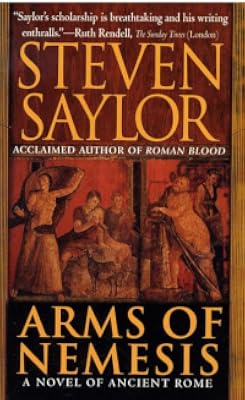
South of Rome on the Gulf of Puteoli stands the splendid villa of Marcus Crassus, Rome's wealthiest citizen. When the estate overseer is murdered, Crassus concludes that the deed was done by two missing slaves, who have probably run off to join the Spartacan Slave Revolt. Unless they are found within five days, Crassus vows to massacre his remaining ninety-nine slaves. To Gordianus the Finder falls the fateful task of resolving this riddle from Hades. In a house filled with secrets, the show more truth is slow to emerge. And as the hour of the massacre approaches, Gordianus realizes that the labyrinthine path he has chosen may just lead to his own destruction.. show less
Tags
Recommendations


Member Reviews
I thoroughly enjoyed this historical murder mystery; perhaps more for the history than for the mystery. An ancient 'detective' or finder is charged with finding the truth about a murder within a few days and thus might succeed in cancelling the slaugher of every slave in the victim's household.
Set against the backdrop of the Spartacan Slave Revolt, this book was thoroughly researched and managed to bring history alive in a most entertaining way. I was so impressed in the epilogue about the sources the author used.
I give it high marks within the mystery genre too. It had a strong, well-structured plot with a forceful conflict, and interesting characters. A few times I felt the physical desciptions of landscapes and background overtook show more the plot and while the resolution might have been predictable and the solution more by circumstances than by the detective's wit, overall the book was a real page turner. I eagerly look forward to reading more of Saylor's books. show less
Set against the backdrop of the Spartacan Slave Revolt, this book was thoroughly researched and managed to bring history alive in a most entertaining way. I was so impressed in the epilogue about the sources the author used.
I give it high marks within the mystery genre too. It had a strong, well-structured plot with a forceful conflict, and interesting characters. A few times I felt the physical desciptions of landscapes and background overtook show more the plot and while the resolution might have been predictable and the solution more by circumstances than by the detective's wit, overall the book was a real page turner. I eagerly look forward to reading more of Saylor's books. show less
This is an enjoyable story set in the context of an important historical event, as most of Saylor's books are. In this case the context, although kept at some distance, consists of the slave rebellion of Spartacus and the rise to prominence of Marcus Crassus.
The author is a classist who loves to give his readers a view of the Roman world. This is an important quality of the books but it also becomes a bit of weakness, as the protagonist Gordianus becomes more a wandering witness, a historical travel guide, than someone whose actions propel the story forward. In fact Gordianus blunders about quite a bit while he guides us through a long series of interesting locations and events (a trireme, an underground temple, a private bathhouse, a show more temporary arena, a funeral, a seashore cave, and a rich villa, in no particular order). It is all fun and the scenery is great, but the scenery can overwhelm the story.
The ending is a bit unsatisfactory to me. The denouement of the plot is presented in conversation by Marcus Crassus, while the culprit vanishes from the scene into a closed room (and a violent death). I think this comes about because, in defiance of the conventions of the genre, the criminal turns out to be a fundamentally uninteresting person. show less
The author is a classist who loves to give his readers a view of the Roman world. This is an important quality of the books but it also becomes a bit of weakness, as the protagonist Gordianus becomes more a wandering witness, a historical travel guide, than someone whose actions propel the story forward. In fact Gordianus blunders about quite a bit while he guides us through a long series of interesting locations and events (a trireme, an underground temple, a private bathhouse, a show more temporary arena, a funeral, a seashore cave, and a rich villa, in no particular order). It is all fun and the scenery is great, but the scenery can overwhelm the story.
The ending is a bit unsatisfactory to me. The denouement of the plot is presented in conversation by Marcus Crassus, while the culprit vanishes from the scene into a closed room (and a violent death). I think this comes about because, in defiance of the conventions of the genre, the criminal turns out to be a fundamentally uninteresting person. show less
Much better than the first Gordanius novel, this book takes us inside Crassus' villa and makes us root for his slaves. The mystery was well thought out; I could not figure it out before it came to the conclusion, which is a good thing. I have read some reviews that found the presence of Eco annoying, but I enjoyed Gordanius having a sidekick.
I'll be looking forward to the 3rd book in this series.
I'll be looking forward to the 3rd book in this series.
At the time of Spartacus's slave revolt, Lucius Lucinius is found dead in the Baiae villa belonging to his cousin Marcus Lucinius Crassus. The evidence points to two runaway slaves and the 99 other slaves in the household are going to be put to death. Mummius, Crassus's right hand man, and Gelina, the dead man's widow, ask Gordianus the Finder to help reveal the real culprit and stop the slaughter.
This was one of Gordianus's purely fictional adventures, not tied to any of Cicero's speeches. Saylor does a good job of evoking the times with only one massive information dump, where one character lectures the others on the history of slave revolts. Roman food is obviously one of Saylor's interests: in the three days of the story each meal show more is meticulously described.
As a mystery/thriller it works well with a good combination of action and ratiocination. There are also a couple of not unpleasant surprises in Gordianus's personal life. show less
This was one of Gordianus's purely fictional adventures, not tied to any of Cicero's speeches. Saylor does a good job of evoking the times with only one massive information dump, where one character lectures the others on the history of slave revolts. Roman food is obviously one of Saylor's interests: in the three days of the story each meal show more is meticulously described.
As a mystery/thriller it works well with a good combination of action and ratiocination. There are also a couple of not unpleasant surprises in Gordianus's personal life. show less
This episode of the Roma sub Rosa series mainly takes place in the coastal town of Baia, a place where the rich have sumptuous villas. Gordianus is brought here by Marcus Crassus, a very wealthy man, bent on building his own army to bring down Spartacus and his rebellious slaves. He is transported on a trireme manned by slaves which horrifies Gordianus and his adopted son, Eco. Crassus' cousin, Lucius Licinius was killed by a blow to his head and the main suspects are two slaves that have disappeared. Unless Gordianus can find that the true murderer was not a slave, all 100 slaves of Lucius' house and estate will be slaughtered in the arena by Crassus' soldiers.
Gordianus feels great empathy for slaves. He married his first slave, show more Bethesda, who he bought in Alexandria. He was appalled at the treatment of the slaves on the trireme and he is determined to save these innocent slaves.
Saylor has wonderfully mixed a murder mystery in a historical fiction setting with thoroughly researched details about the life and time of Rome in the 50s BC. show less
Gordianus feels great empathy for slaves. He married his first slave, show more Bethesda, who he bought in Alexandria. He was appalled at the treatment of the slaves on the trireme and he is determined to save these innocent slaves.
Saylor has wonderfully mixed a murder mystery in a historical fiction setting with thoroughly researched details about the life and time of Rome in the 50s BC. show less
Full of period details, Gordianus the Finder is involved in a case that touches several people. Crassus' brother is dead and one of the slaves is blamed, as that slave has absconded Crassus decides to kill all the slaves in the Villa. Not an unusual thing to do in the time.
Giordanus is convinced that there are plots within plots but can he find out what's happening before the funeral games that will have the slaves all killed. Set during the period of Spartacus' revolt this is not a surprising reaction.
Interesting and full of period detail this appealed to the classics geek in me, while some details didn't quite ring true overall it swept me up and kept me quite entertained
Giordanus is convinced that there are plots within plots but can he find out what's happening before the funeral games that will have the slaves all killed. Set during the period of Spartacus' revolt this is not a surprising reaction.
Interesting and full of period detail this appealed to the classics geek in me, while some details didn't quite ring true overall it swept me up and kept me quite entertained
This is the second in Saylor's Gordianus the Finder series, and I thoroughly enjoyed it. If you like mysteries and books set in ancient Rome, these are a treat. Saylor works in tons of Roman history, and from what I can tell his research is excellent. They are well written, exciting, and quick to read.
In this one, Gordianus goes to the luxury holiday home centre of the Roman Empire, Puteoli (near Naples and Mt Vesuvius), to figure out who's killed Lucius Licinus, Crassus's cousin and the manager of his enormous estate. If he can't prove that it wasn't 2 of Lucius's slaves, Crassus is going to kill all the slaves at the end of the funeral games to show that he's tough on slave rebellion, because he's trying to get a commission to rescue show more Rome from Spartacus's slave revolt. show less
In this one, Gordianus goes to the luxury holiday home centre of the Roman Empire, Puteoli (near Naples and Mt Vesuvius), to figure out who's killed Lucius Licinus, Crassus's cousin and the manager of his enormous estate. If he can't prove that it wasn't 2 of Lucius's slaves, Crassus is going to kill all the slaves at the end of the funeral games to show that he's tough on slave rebellion, because he's trying to get a commission to rescue show more Rome from Spartacus's slave revolt. show less
Members
- Recently Added By
Author Information

61+ Works 13,633 Members
Steven Saylor (born March 23, 1956) is an American author of historical novels. He is a graduate of the University of Texas at Austin, where he studied history and Classics. Although he also has written novels about Texas history, Saylor's best-known work is his Roma Sub Rosa series, set in ancient Rome. The novels' hero is a detective named show more Gordianus the Finder, active during the time of Sulla, Cicero, Julius Caesar, and Cleopatra. He divides his time residing in California and texas. (Bowker Author Biography) show less
Some Editions
Series

Work Relationships
Common Knowledge
- Canonical title
- Arms of Nemesis
- Original title
- Arms of Nemesis
- Alternate titles
- Arms of Nemesis: A Novel of Ancient Rome
- Original publication date
- 1992-10
- People/Characters
- Gordianus the Finder; Marcus Crassus; Eco; Meto; Bethesda; Marcus Mummius (show all 14); Lucius Claudius; Iaia; Gelina; Apollonius; Zeno; Alexandros; Sergius Orata; Olympias
- Important places
- Baie, Italy; Rome, Italy; Ancient Rome
- Important events
- Revolt of Spartacus; Spartacist Uprising
- Dedication
- To Penni Kimmel, helluo librorum et litterarum studiosus
- First words
- For all his fine qualities - his honesty and devotion, his cleverness, his uncanny agility - Eco was not well suited for answering the door.
- Last words
- (Click to show. Warning: May contain spoilers.)"Another crisis arrives," I whispered, feeling suddenly fearful, and then impossibly elated. "Another story begins."
- Original language
- English
Classifications
Statistics
- Members
- 1,058
- Popularity
- 24,357
- Reviews
- 27
- Rating
- (3.72)
- Languages
- 14 — Czech, Danish, Dutch, English, French, German, Hungarian, Italian, Norwegian (Bokmål), Norwegian, Polish, Portuguese, Spanish, Swedish
- Media
- Paper, Audiobook, Ebook
- ISBNs
- 49
- ASINs
- 12