On This Page
Description
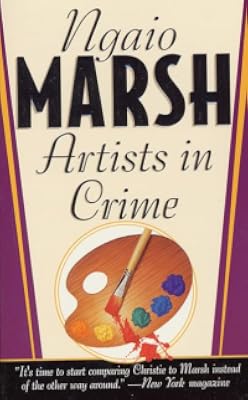
On a ship traveling back to England, Miss Agatha Troy finds Inspector Roderick Alleyn tedious and dull; he thinks she's a bohemian cliché. They may be destined for romance, but there's a murder in the way: No sooner has Alleyn settled in to his mother's house, eager for a relaxing end to his vacation, than he gets a call that a model has been stabbed at the artists' community down the road. And the talented Miss Troy is one of the community's most prominent and outspoken members ...Tags
Recommendations















Member Recommendations
Bjace Also about a murder among artists.
Member Reviews
In Dorothy Sayer's "Gaudy Night" Harriet Vane, a detective novelist, is struggling with the plot of her latest book "Death twixt wind and water". She discusses it with Peter Wimsey who suggests she leaves off writing a purely puzzle book and gives her characters real human emotions and motivations. I suspect that "Artists in Crime" may be Ngaio Marsh's equivalent. Although the murder itself is bizarre, in allowing Alleyn to fall properly in love she finally shows him as a fully rounded human being with real emotions behind the facetious facade and the book is all the better for it. I also love the introduction of Troy, and Marsh's real feel for the art milieu in which the book is set. Beautiful descriptions too. Her first fully realised show more book. show less
Summary: A murder occurs at the studio of artist Agatha Troy, who Alleyn had met on his voyage back to England; the beginning in fits and starts of a romance while Alleyn seeks to solve the crime.
It isn’t a promising beginning. An untimely interruption onboard ship followed by a brusque brushoff. Nevertheless artist Agatha Troy paints a striking likeness of Alleyn which he presents to his mother upon his return to England. It turns out Lady Alleyn lives but a few miles from Agatha Troy’s home and studio Tatter’s End House in Bossicote. Troy has turned the back garden into a studio for students who want to train under her, living at her house.
One of the students, Watt Hatchett, is a rough-around-the-edges Australian Troy has show more brought back and is sponsoring, recognizing his talent. The rest are a rag-tag collection of characters. Francis Ormerin is an aloof student from Paris. Cedric Malmsley is a bearded poseur, pretending to more talent than he has yet to evidence. Phillida Lee is a country girl turned Bohemian. Basil Pilgrim has the (mis)fortune to be the son of a strict religionist peer. Valmai Seacliff is the beauty who knows it, drawing the men to her like flies. Katti Bostock is the gruff but accomplished painter who is Troy’s roommate. She hired the beautiful but temperamental model, Sonia Gluck who is romantically involved with a sculptor, Garcia, extremely talented but without morals.
Alleyn’s reunion with his mother is cut short when Sonia is found murdered. About a week earlier, there was an experiment to make the scene she was posing, in which the figure posed has been impaled on a knife driven through a throne, concealed by a drape. A couple of students drove an actual knife through the draped seat so that it would stab the figure in the heart. It was all forgotten until everyone returned from weekend activities to set up the scene and resume their work. Sonia, who had a hard time keeping a pose and has incurred the wrath of nearly everyone at some point, is forcefully positioned by Valmai. She cries out, jerks, and passes out. When others come to help make her comfortable, they discover that she is impaled on the knife, hidden under the drape. And she dies. And Garcia has disappeared, supposedly on a walking tour.
All of them, including Troy are suspects. It is obvious there is a chemistry between Alleyn and Troy, yet the awkward questions and investigation that must occur do not provide the most conducive atmosphere for a romance. What is striking is that Troy is portrayed as strong, self-sufficient and self-possessed. It is Alleyn who comes off awkward, even apologetic. This is very different from, say, Harriet Vane and Lord Peter Wimsey (although Harriet is also a strong character).
But this doesn’t prevent Alleyn and his team of Fox, Bailey, and his journalist and Watson figure, Nigel Bathgate, from uncovering the truth. Young Pilgrim isn’t as pure as he seems. Malmsley is an opium user who isn’t above copying a famous scene, pretending it is his own work. Bathgate discovers through a sometime roommate of Sonia’s the sordid game she and Garcia have been playing. And who was it who had a late night meeting with Garcia? And Marsh lays a few surprises at the end, just when we think we know who the real killer is.
This “queen of crime” gives us a strong female counterpart to Alleyn, and casts aspersions on the gender pretensions of others. The portrayal of Valmai shows a disapproval of the glamourous female and it is only as Phillida stops pretending so much to be Bohemian that she becomes interesting. The unrefined Watt Hatchett, the only male favorably portrayed, helps bring this out. Ormerin, Malmsley, Pilgrim, and Garcia all come off badly. Today, we would call her best characters authentic, the ones who ring true.
The plot is straightforward, with enough twists to keep you on your toes, the characters interesting, the repartee between Alleyn and Bathgate sparkles, and Marsh leaves us all wondering whether and how the romance with Troy will go. show less
It isn’t a promising beginning. An untimely interruption onboard ship followed by a brusque brushoff. Nevertheless artist Agatha Troy paints a striking likeness of Alleyn which he presents to his mother upon his return to England. It turns out Lady Alleyn lives but a few miles from Agatha Troy’s home and studio Tatter’s End House in Bossicote. Troy has turned the back garden into a studio for students who want to train under her, living at her house.
One of the students, Watt Hatchett, is a rough-around-the-edges Australian Troy has show more brought back and is sponsoring, recognizing his talent. The rest are a rag-tag collection of characters. Francis Ormerin is an aloof student from Paris. Cedric Malmsley is a bearded poseur, pretending to more talent than he has yet to evidence. Phillida Lee is a country girl turned Bohemian. Basil Pilgrim has the (mis)fortune to be the son of a strict religionist peer. Valmai Seacliff is the beauty who knows it, drawing the men to her like flies. Katti Bostock is the gruff but accomplished painter who is Troy’s roommate. She hired the beautiful but temperamental model, Sonia Gluck who is romantically involved with a sculptor, Garcia, extremely talented but without morals.
Alleyn’s reunion with his mother is cut short when Sonia is found murdered. About a week earlier, there was an experiment to make the scene she was posing, in which the figure posed has been impaled on a knife driven through a throne, concealed by a drape. A couple of students drove an actual knife through the draped seat so that it would stab the figure in the heart. It was all forgotten until everyone returned from weekend activities to set up the scene and resume their work. Sonia, who had a hard time keeping a pose and has incurred the wrath of nearly everyone at some point, is forcefully positioned by Valmai. She cries out, jerks, and passes out. When others come to help make her comfortable, they discover that she is impaled on the knife, hidden under the drape. And she dies. And Garcia has disappeared, supposedly on a walking tour.
All of them, including Troy are suspects. It is obvious there is a chemistry between Alleyn and Troy, yet the awkward questions and investigation that must occur do not provide the most conducive atmosphere for a romance. What is striking is that Troy is portrayed as strong, self-sufficient and self-possessed. It is Alleyn who comes off awkward, even apologetic. This is very different from, say, Harriet Vane and Lord Peter Wimsey (although Harriet is also a strong character).
But this doesn’t prevent Alleyn and his team of Fox, Bailey, and his journalist and Watson figure, Nigel Bathgate, from uncovering the truth. Young Pilgrim isn’t as pure as he seems. Malmsley is an opium user who isn’t above copying a famous scene, pretending it is his own work. Bathgate discovers through a sometime roommate of Sonia’s the sordid game she and Garcia have been playing. And who was it who had a late night meeting with Garcia? And Marsh lays a few surprises at the end, just when we think we know who the real killer is.
This “queen of crime” gives us a strong female counterpart to Alleyn, and casts aspersions on the gender pretensions of others. The portrayal of Valmai shows a disapproval of the glamourous female and it is only as Phillida stops pretending so much to be Bohemian that she becomes interesting. The unrefined Watt Hatchett, the only male favorably portrayed, helps bring this out. Ormerin, Malmsley, Pilgrim, and Garcia all come off badly. Today, we would call her best characters authentic, the ones who ring true.
The plot is straightforward, with enough twists to keep you on your toes, the characters interesting, the repartee between Alleyn and Bathgate sparkles, and Marsh leaves us all wondering whether and how the romance with Troy will go. show less
Roderick Alleyn is returning from a year-long vacation in New Zealand and strikes up an acquaintance with the famed artist Agatha Troy, who is also returning to that part of the world. He is smitten but feels like he's made a fool of himself, even if she did paint a very nice portrait of him. He resolves to put their acquaintance behind him and enjoy the last few days of his vacation with his mother, only to be called out to a case involving the death of an artist's model. The studio where the model works is owned by none other than Agatha Troy. This will certainly be an interesting case…
This might be my favourite Ngaio Marsh so far. The real joy lies in the interactions between Alleyn and his crew, and Alleyn and his mother, who is show more adorable. They all have such a good rapport and are quite affectionate in their teasing. The case itself is also interesting. I guessed one element of the solution, but not until the end when Alleyn was in the process of explaining whodunnit anyway. The story moves along fairly quickly, and the very end is well done indeed. Definitely recommended if you're looking to try a Marsh. show less
This might be my favourite Ngaio Marsh so far. The real joy lies in the interactions between Alleyn and his crew, and Alleyn and his mother, who is show more adorable. They all have such a good rapport and are quite affectionate in their teasing. The case itself is also interesting. I guessed one element of the solution, but not until the end when Alleyn was in the process of explaining whodunnit anyway. The story moves along fairly quickly, and the very end is well done indeed. Definitely recommended if you're looking to try a Marsh. show less
Knife Out
Review of the Fontana paperback edition (1982) of the 1938 original
Ngaio Marsh sets this murder mystery in the world of artists and does capture the obsessions and egocentrism of the artistic temperament very well. It was actually better at that than Dorothy L. Sayer's Five Red Herrings which obsesses more over train schedules and conveying Scottish dialect in print than the actual art and artist suspects involved.
This is part of my current re-read projects of works from the Golden Age of Crime of which many are still in my collection after first being read in the 1970s and 1980s.
Review of the Fontana paperback edition (1982) of the 1938 original
Ngaio Marsh sets this murder mystery in the world of artists and does capture the obsessions and egocentrism of the artistic temperament very well. It was actually better at that than Dorothy L. Sayer's Five Red Herrings which obsesses more over train schedules and conveying Scottish dialect in print than the actual art and artist suspects involved.
This is part of my current re-read projects of works from the Golden Age of Crime of which many are still in my collection after first being read in the 1970s and 1980s.
It was such a pleasure to read one of Marsh's mysteries again. I first read these when I was in my teens and was struck by the development of the characters, especially of detective Roderick Alleyn. It was a further pleasure to discover that this is the book when Alleyn meets Agatha Troy, artist.
The two first meet on a cruise, and there is awkwardness on both sides. Later, when both are home and a murder happens in Troy's studio, Alleyn realizes he has not forgotten the artist.
It is something of a classic mystery, with a set of suspects, almost a locked-room situation, so the detective and his trusty Fox focus on the students who were living at the studio. When I read this I had to remember that many of these detective stories from the show more 30s-50s take place in old British manor houses, houses with many bedrooms and with servants. So it is here. Plenty of room for everyone.
The victim is a live model, killed in a way that limits the number of suspects considerably. But there are always possibilities that someone is not telling the truth and is thus messing up the timeline.
While investigating the murder, Alleyn makes some efforts to be professional yet not unapproachable to Troy. In this he mostly does not succeed. She misreads his signals and he hers. It is rather classic in that respect as well.
Overall, satisfying and, for me, does not suffer from its age. show less
The two first meet on a cruise, and there is awkwardness on both sides. Later, when both are home and a murder happens in Troy's studio, Alleyn realizes he has not forgotten the artist.
It is something of a classic mystery, with a set of suspects, almost a locked-room situation, so the detective and his trusty Fox focus on the students who were living at the studio. When I read this I had to remember that many of these detective stories from the show more 30s-50s take place in old British manor houses, houses with many bedrooms and with servants. So it is here. Plenty of room for everyone.
The victim is a live model, killed in a way that limits the number of suspects considerably. But there are always possibilities that someone is not telling the truth and is thus messing up the timeline.
While investigating the murder, Alleyn makes some efforts to be professional yet not unapproachable to Troy. In this he mostly does not succeed. She misreads his signals and he hers. It is rather classic in that respect as well.
Overall, satisfying and, for me, does not suffer from its age. show less
This is set after Alleyn's original trip to New Zealand (the 3 books I reviewed earlier were his 2nd trip). It starts on the way home, and details Alleyn's meeting with his future wife, the artist Agatha Troy, in Fiji. Back in England, Troy is running an art class at her family home, and in the course of the class, the model is murdered by being forced onto a knife while being posed. The kicker is that the method had been worked out by the class earlier - one of the class had a commission illustrating some Decameron-like stories, one of which had the plot where a man killed his mistress accidentally by making love to her on a bench with a hidden knife.
The story is the typical country house murder mystery with a rather Bohemian cast of show more characters. Of course, the entire setting comes across to modern eyes as rather quaint and dated. The other issue with Marsh's books is that they can seem rather stagey - her other career as a stage director shows up quite strongly even when the plot doesn't involve a theatre setting or actors.
Light but recommended. show less
The story is the typical country house murder mystery with a rather Bohemian cast of show more characters. Of course, the entire setting comes across to modern eyes as rather quaint and dated. The other issue with Marsh's books is that they can seem rather stagey - her other career as a stage director shows up quite strongly even when the plot doesn't involve a theatre setting or actors.
Light but recommended. show less
A breezy story set in an artists' studio school in 1930's England, this entry by Marsh has been compared by many to Sayers' work. Well, superficially this would be a true comparison. However, Marsh has, I think, a much more down-to-earth style, and Alleyn, while a bit too perfectly polite, is never the buffoonish (or alternatively the too-perfect, well-versed in every possible literate subject) sort that Wimsey often proves to be. The plot is nicely done and the characters are believable; the overall effect of this story is a lot of fun for the reader.
The mystery itself is engaging enough, the murderer is finely drawn, there are very clear clues, and the setting is different enough to hold one's attention. A very nice book for the fan show more of mysteries or a reader who needs something old-fashioned, amusing, and soothing. show less
The mystery itself is engaging enough, the murderer is finely drawn, there are very clear clues, and the setting is different enough to hold one's attention. A very nice book for the fan show more of mysteries or a reader who needs something old-fashioned, amusing, and soothing. show less
Members
- Recently Added By
Lists

Favorite Series
238 works; 94 members

British Mystery
469 works; 14 members

Female Author
1,234 works; 67 members

Books Read in 2021
5,361 works; 114 members

Books Read in 2023
5,638 works; 147 members

Books Read in 2010
631 works; 11 members
Must Read Detective Stories (Nick Fuller)
278 works; 2 members

Read in 2010
48 works; 1 member

Books Read in 2025
4,128 works; 98 members

Art and Artists
10 works; 1 member
Author Information

128+ Works 31,620 Members
Ngaio Marsh was born on April 23, 1895 in Christchurch, New Zealand. She attended St. Mary's College and Canterbury University. She worked in the theater acting, producing, and even painting scenery. She was a partner in an interior decorating business in England from 1928 to 1932. She later returned to New Zealand and produced plays for a show more Shakespearean repertory company. She also worked with the Drama Department of Canterbury University. During World War II, she served in the New Zealand Red Cross Transport Unit. She traveled to England frequently and founded the British Commonwealth Theatre Company in 1949. Her first novel, A Man Lay Dead, was published in 1934. She wrote more than 40 books including the Roderick Alleyn Mysteries series and Black Beech and Honeydew. She also wrote theatrical and television plays. She was named to the Order of the British Empire in 1949 and was made Dame Commander of the Order of the British Empire in 1966. The Mystery Writers of America named her a Grand Master in 1977. She died on February 18, 1982 at the age of 82. (Bowker Author Biography) show less
Some Editions
Series

Belongs to Publisher Series
Work Relationships
Is contained in
Has the adaptation
Is abridged in
Common Knowledge
- Canonical title
- Artists in Crime
- Original title
- Artists in Crime
- Original publication date
- 1938
- People/Characters
- Roderick Alleyn; Detective-Inspector Fox; Agatha Troy; Lady Helena Alleyn; Detective-Sergeant Bailey; Nigel Bathgate (show all 20); Dr. Curtis; Detective-Sergeant Thompson; Ampthill; Katti Bostock; Wolf Garcia; Sonia Gluck; Watt Hatchett; Phillida Lee; Cedric Malmsley; Bobbie O'Dawne; Francis Ormerin; Basil Pilgrim; Valmai Seacliff; Sligo
- Important places
- England, UK
- Related movies
- Alleyn Mysteries: Artists in Crime (1990 | IMDb)
- Dedication
- For Phyllis and John
- First words
- Alleyn leant over the deck-rail, looking at the wet brown wharf and the upturned faces of the people.
- Last words
- (Click to show. Warning: May contain spoilers.)'Then,' said Alleyn, 'I shall still allow myself to hope a little.'
- Original language
- English UK
Classifications
Statistics
- Members
- 1,304
- Popularity
- 18,648
- Reviews
- 34
- Rating
- (3.82)
- Languages
- 6 — Danish, Dutch, English, Estonian, French, Polish
- Media
- Paper, Audiobook, Ebook
- ISBNs
- 42
- ASINs
- 26