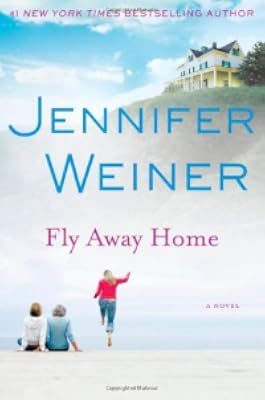
Fly Away Home
by Jennifer Weiner 
On This Page
Description
A politician's wife retreats with her grown daughters to a Connecticut beach house after a painful public betrayal, an escape marked by new beginnings and her younger daughter's pregnancy.Tags
Recommendations





Member Recommendations
Member Reviews
I’ve been a little reluctant to read more from Weiner, because the first two books I read focused so much on the weight of the protagonist that it was a little bit of a turn-off. Thankfully, Weiner has grown as a writer and moved away from that to focus on more important issues.
Fly Away Home is about what happens to a family when a betrayal is revealed in a very public way. Sylvie, the victimized wife, decides that she needs some time away. She moves to her mother’s vacation home, hoping to figure out who she is now that she’s not being the Senator’s wife. Her oldest daughter, Diana, is a busy doctor with an inattentive husband who finds excitement in the arms of another man, despite seeing what adultery has done to her parents. show more Her youngest daughter, Lizzie, is a recovering drug addict who is relishing the chance to be the caretaker for a change. I’d tell you more about the men, but they are rather one-dimensional.
I rather enjoyed Sylvie and Lizzie’s parts of the story, but had major issues with Diana, for several reasons. First, she’s basically a bitch. From the beginning to the end, I had a hard time mustering up any sympathy for her. Weiner tries really hard to make her husband, Gary, as distasteful as possible, but the more distasteful she made him, the worse Diana looks. In fact, I felt bad for Gary, because he married a woman who obviously never loved him to begin with and only married him because she figured she might as well get that part of her life over with. Box checked. I also didn’t like the hot and cold relationship she had with her young son, who seemed so much better off with his recovering addict aunt. And finally, the event that forces Lizzie out of Diana’s house made no sense to me. It seemed like an incredibly huge over-reaction. I think we’re supposed to accept it because Diana is lashing out at someone else to assuage her own guilt, but it didn’t work.
I also found the ending to be a bit disappointing. It’s open-ended, and I would have preferred at least a little resolution.
I listened to this on audio and enjoyed Judith Light as narrator. show less
Fly Away Home is about what happens to a family when a betrayal is revealed in a very public way. Sylvie, the victimized wife, decides that she needs some time away. She moves to her mother’s vacation home, hoping to figure out who she is now that she’s not being the Senator’s wife. Her oldest daughter, Diana, is a busy doctor with an inattentive husband who finds excitement in the arms of another man, despite seeing what adultery has done to her parents. show more Her youngest daughter, Lizzie, is a recovering drug addict who is relishing the chance to be the caretaker for a change. I’d tell you more about the men, but they are rather one-dimensional.
I rather enjoyed Sylvie and Lizzie’s parts of the story, but had major issues with Diana, for several reasons. First, she’s basically a bitch. From the beginning to the end, I had a hard time mustering up any sympathy for her. Weiner tries really hard to make her husband, Gary, as distasteful as possible, but the more distasteful she made him, the worse Diana looks. In fact, I felt bad for Gary, because he married a woman who obviously never loved him to begin with and only married him because she figured she might as well get that part of her life over with. Box checked. I also didn’t like the hot and cold relationship she had with her young son, who seemed so much better off with his recovering addict aunt. And finally, the event that forces Lizzie out of Diana’s house made no sense to me. It seemed like an incredibly huge over-reaction. I think we’re supposed to accept it because Diana is lashing out at someone else to assuage her own guilt, but it didn’t work.
I also found the ending to be a bit disappointing. It’s open-ended, and I would have preferred at least a little resolution.
I listened to this on audio and enjoyed Judith Light as narrator. show less
The great thing about Jennifer Weiner is that she creates characters that you want to know. Reading her books is like taking a holiday with a group of really cool people. I have read a number of her books over the years, and they never disappoint. The protagonist in fly away home is Sylvie, a politician's wife. While she is well educated and has a law degree, she decides early in her marriage that she will dedicate herself to supporting her husband's political ambitions. This is much to the dismay of Sylvie's mother, a very well-known judge, who believes her daughter has thrown her life away in service of her husband. Sylvia and her husband Richard have two daughters, Diana, a doctor, and Lizzie, a recovering addict. When news of show more Richard's extramarital affair is broadcast on network television, each family member's life begins to unravel. Richard's indiscretion becomes a catalyst for change. show less
I thought this was Weiner's best book since Little Earthquakes. It's the story of Sylvie and her two daughters, Lizzie and Diana. Sylvie is the politician's wife who's given up any vestige of her real self, while Lizzie is a recovering addict and Diana is an ER doctor trapped in a loveless marriage. Weiner treats all of this with humor and minimal drama. The characters seemed very real. My only complaint was that Sylvie's husband was annoying, so it was hard to understand why she was so attached to him, but as Weiner points out, "Marriages are mysteries."
The Woodruff women are going through simultaneous crises, and while these crises don't necessarily draw mother and daughters together, they do affect how they relate to one another. Younger daughter Lizzie is recently out of rehab and trying to prove - to herself as well as everyone else - that she's not just a screwup. Older daughter Diana's perfectly planned life - mother, wife, doctor - is being turned inside out by her involvement with an attractive intern. A similar involvement is doing the same thing to their mother, Sylvie - except in her case, the one who's involved is her husband, New York Senator Richard Woodruff. It's a ripped-from-the-headlines plot element - the scandal of the high-profile politician caught fooling around, show more and the spouse's reaction to the revelations - but in Weiner's hands, it's not necessarily the same story you've heard before.
Weiner takes some chances in building so much of her story around an incident so contemporary, and there are details in the ARC - references to a married golfer with a string of girlfriends and an Academy Award-winning actress' cheating husband - that could potentially date the novel. However, the themes related to it - the public presentation and the inner workings of marriages, the challenges of knowing and creating who you are, coping with life's curveballs - are pretty timeless, and Weiner explores them through some of the most vivid characters she's created in some time. Sylvie particularly appealed to me, but each of the Woodruff women was well-drawn, distinct, and layered. I found something to love in all of them, even brittle Diana.
I think Fly Away Home may be Jennifer Weiner's most ambitious, accomplished novel yet. She challenges her characters with common, yet complicated, topics like infidelity, addiction, unplanned pregnancy and family/career conflict, and acknowledges that there are no one-size-fits-all answers. The novel's humor isn't contrived, and neither is its humanity and emotional resonance. Books like this are why I enjoy contemporary women's fiction, and why Jennifer Weiner remains one of my favorite authors in the niche. show less
Weiner takes some chances in building so much of her story around an incident so contemporary, and there are details in the ARC - references to a married golfer with a string of girlfriends and an Academy Award-winning actress' cheating husband - that could potentially date the novel. However, the themes related to it - the public presentation and the inner workings of marriages, the challenges of knowing and creating who you are, coping with life's curveballs - are pretty timeless, and Weiner explores them through some of the most vivid characters she's created in some time. Sylvie particularly appealed to me, but each of the Woodruff women was well-drawn, distinct, and layered. I found something to love in all of them, even brittle Diana.
I think Fly Away Home may be Jennifer Weiner's most ambitious, accomplished novel yet. She challenges her characters with common, yet complicated, topics like infidelity, addiction, unplanned pregnancy and family/career conflict, and acknowledges that there are no one-size-fits-all answers. The novel's humor isn't contrived, and neither is its humanity and emotional resonance. Books like this are why I enjoy contemporary women's fiction, and why Jennifer Weiner remains one of my favorite authors in the niche. show less
This book was sad, funny, complicated, honest, and so much like real life, I had to remind myself it was a novel. I love Jennifer Weiner. She creates the most flawed, honest and perfect characters who are all going through similar situations that we have all encountered. I love that Weiner’s stories don’t all have happy endings and aren’t the stereotypical white picket fence chick-lit kind of book. I love the real way things have of unraveling. Great book, amazing characters – I’m only sad that I’m finished and there isn’t enough Weiner book to read.
This was the first Jennifer Weiner book I read. I picked up the book years ago, thinking it was another one. I was so excited for it to be the book I thought it was and, no, it was a story about an affair. I had no idea how the title was connected to the content. I certainly didn't grasp why the cover was a bowl of fruit with sugar on it, with plates stacked neatly below. Nothing to do with the content, at all. Fast forward to when my state shut down in March due to covid. I was new to ebooks, and eagerly clicked this one, again thinking it was the book I'd thought originally of. Midway through the sample, I recognized it instantly and shouted about false advertising. It wasn't false advertising, the book was just in a category I found show more unusual. Now, I read the book while I was waiting for another one to come in, and I regret it.
No one in this book is likeable. I didn't have a lot of life experience when I first checked this out in hardback, or it must have been when I had just moved out and was still developing the life experiences and knowledge that inform me now. I accepted everyone's decisions and descriptions without question the first time reading this. I had no idea about anything. Now, I know differently. Everyone in this book is a caricature or stereotype, and awful on top of that. I've known dozens of junkies. They do not act like Lizzie when they are looking for their next hit. And wtf, tying someone with a pair of fishnets? Holding up a -knife- is more common. If you're going to write about a recovering junkie who was in dangerous situations, TALK TO ACTUAL ONES WHO SURVIVED TERRIBLE THINGS. DO NOT PORTRAY THEM LIKE THIS. In 2014, Weiner released "All Fall Down," which was a -way- more realistic look at addiction, painkiller addiction in particular. This book was written in 2011, apparently. (dryly) Amazing how actual research can entirely change a story, huh? (sigh) Lizzie has Rape as Backstory, a trope I hate. She was in the story to make everyone else around her look good, and her character is self-aware in this regard. It's refreshing, but sometimes grew annoying. Diana was clearly a copy of her dad that the audience was supposed to feel sorry for, and possibly appreciate the fact that she was getting laid. I couldn't stand her, either. I hated Milo, but then again, I hate children and toddlers in books. I often find that they have no point except as a cheap ploy to score sympathy, as was the case here. No sympathy, Diana.
Every man except for Lizzie's boyfriend was portrayed negatively in the book and it drove me nuts. Had Richard been the only obviously despicable man, I would not be so angry. I never once felt sorry for him or Sylvie. I just didn't and couldn't, but I wasn't judgmental until chapter five or something. Richard is the walking personification of entitlement, so his cheating did not shock me. His -neediness- and not knowing how to take care of himself when Sylvie left did. I was -appalled- by what the book turned him into. He couldn't do his own laundry, schedules, food, anything. And he says he cheated because his mistress was "helpful." That's gotta be an emotional punch to the gut to Sylvie and to the intern. Helpful sexually, you mean. Say what you mean, Richard. Skeezy bastard. Stop treating your dick like a reward to women who look a certain way and are subordinates. I do not believe at all that this was your first mistress--it was clear to me that this was the first time you had been -caught.- It is NOT okay that you got her a job after preying on her. It is NOT okay that you justified it by "Yale grad blahblah." THEN LET HER GET THE JOB ON HER OWN. Rrgh. You did not have to marry Gary, Diana, when you were so clearly and thoroughly disgusted by every move he made, and even when he breathed. You said he sniffled. He was trying to breathe and probably had allergies. You married him and told yourself it was like an arranged marriage. You -nimrod-. You -moron-. THAT IS NOT HOW ARRANGED MARRIAGES WORK UGH. Yours is the opposite of an arranged marriage! Diana was an enormous martyr. Gary was indeed useless and a whiny, crying man-baby. I still felt sorry for him at times, whereas I wanted Diana to fail spectacularly at something, anything. No. She could have easily lost her job, but no. This book had ideas about sex I found bizarre. Yes, Richard's affair is the inciting incident, so that's an indicator of what was to come, but it didn't have to be. Everyone in this book needed sex therapy. Even Ceil and her husband seemed off. I wish the book had more of them in it, but no. Every time something resembling the plot inched forward or emerged from the sludge of nothing, backstory rushed to smother it. Everyone in this book thought a lot, and thought and reflected some more. I started skimming halfway through the book. I remembered how it ended. When I first read it, I was furious with how stupid the ending was. This time, I clenched my jaw and told myself I could grumble all I wanted. I am proud of myself for not screaming in rage. show less
No one in this book is likeable. I didn't have a lot of life experience when I first checked this out in hardback, or it must have been when I had just moved out and was still developing the life experiences and knowledge that inform me now. I accepted everyone's decisions and descriptions without question the first time reading this. I had no idea about anything. Now, I know differently. Everyone in this book is a caricature or stereotype, and awful on top of that. I've known dozens of junkies. They do not act like Lizzie when they are looking for their next hit. And wtf, tying someone with a pair of fishnets? Holding up a -knife- is more common. If you're going to write about a recovering junkie who was in dangerous situations, TALK TO ACTUAL ONES WHO SURVIVED TERRIBLE THINGS. DO NOT PORTRAY THEM LIKE THIS. In 2014, Weiner released "All Fall Down," which was a -way- more realistic look at addiction, painkiller addiction in particular. This book was written in 2011, apparently. (dryly) Amazing how actual research can entirely change a story, huh? (sigh) Lizzie has Rape as Backstory, a trope I hate. She was in the story to make everyone else around her look good, and her character is self-aware in this regard. It's refreshing, but sometimes grew annoying. Diana was clearly a copy of her dad that the audience was supposed to feel sorry for, and possibly appreciate the fact that she was getting laid. I couldn't stand her, either. I hated Milo, but then again, I hate children and toddlers in books. I often find that they have no point except as a cheap ploy to score sympathy, as was the case here. No sympathy, Diana.
Every man except for Lizzie's boyfriend was portrayed negatively in the book and it drove me nuts. Had Richard been the only obviously despicable man, I would not be so angry. I never once felt sorry for him or Sylvie. I just didn't and couldn't, but I wasn't judgmental until chapter five or something. Richard is the walking personification of entitlement, so his cheating did not shock me. His -neediness- and not knowing how to take care of himself when Sylvie left did. I was -appalled- by what the book turned him into. He couldn't do his own laundry, schedules, food, anything. And he says he cheated because his mistress was "helpful." That's gotta be an emotional punch to the gut to Sylvie and to the intern. Helpful sexually, you mean. Say what you mean, Richard. Skeezy bastard. Stop treating your dick like a reward to women who look a certain way and are subordinates. I do not believe at all that this was your first mistress--it was clear to me that this was the first time you had been -caught.- It is NOT okay that you got her a job after preying on her. It is NOT okay that you justified it by "Yale grad blahblah." THEN LET HER GET THE JOB ON HER OWN. Rrgh. You did not have to marry Gary, Diana, when you were so clearly and thoroughly disgusted by every move he made, and even when he breathed. You said he sniffled. He was trying to breathe and probably had allergies. You married him and told yourself it was like an arranged marriage. You -nimrod-. You -moron-. THAT IS NOT HOW ARRANGED MARRIAGES WORK UGH. Yours is the opposite of an arranged marriage! Diana was an enormous martyr. Gary was indeed useless and a whiny, crying man-baby. I still felt sorry for him at times, whereas I wanted Diana to fail spectacularly at something, anything. No. She could have easily lost her job, but no. This book had ideas about sex I found bizarre. Yes, Richard's affair is the inciting incident, so that's an indicator of what was to come, but it didn't have to be. Everyone in this book needed sex therapy. Even Ceil and her husband seemed off. I wish the book had more of them in it, but no. Every time something resembling the plot inched forward or emerged from the sludge of nothing, backstory rushed to smother it. Everyone in this book thought a lot, and thought and reflected some more. I started skimming halfway through the book. I remembered how it ended. When I first read it, I was furious with how stupid the ending was. This time, I clenched my jaw and told myself I could grumble all I wanted. I am proud of myself for not screaming in rage. show less
I heard someone say that this is not your typical Jennifer Weiner book, and I think I'd agree with that. Weiner does explore some of her usual themes (mothers, sisters, daughters, food issues) and the book is humorous at times, but it still has a different feel to me.
The novel alternates between a mother and her two daughters as they deal with the revelation that their politician husband/father has had an affair with an aide and re-evaluate their lives and life choices. With all of the recent political sex scandals, it was fun to see all the timely references to the Sanford/Clinton/Spitzer affairs, but I'm sure future readers may find some of that confusing. But I like how Weiner tries to get inside the head of a political wife and find show more out what she is really thinking when she chooses to stand (or not stand) behind her husband at the press conference when he confesses his sins. I also liked how realistic the book is and complicated the characters are. I found Sylvie and especially Diana unlikeable at times -- but just when I wanted to completely write the latter off, Weiner makes her sympathetic.
p. 6-7: She could admit, if only to herself, that was bright but not terribly ambitious; that she lacked a certain something, aggression or tenacity or even just desire, that magical quality taht would have lifted her from good to great. Btu she'd found a place for herself in the world. show less
The novel alternates between a mother and her two daughters as they deal with the revelation that their politician husband/father has had an affair with an aide and re-evaluate their lives and life choices. With all of the recent political sex scandals, it was fun to see all the timely references to the Sanford/Clinton/Spitzer affairs, but I'm sure future readers may find some of that confusing. But I like how Weiner tries to get inside the head of a political wife and find show more out what she is really thinking when she chooses to stand (or not stand) behind her husband at the press conference when he confesses his sins. I also liked how realistic the book is and complicated the characters are. I found Sylvie and especially Diana unlikeable at times -- but just when I wanted to completely write the latter off, Weiner makes her sympathetic.
p. 6-7: She could admit, if only to herself, that was bright but not terribly ambitious; that she lacked a certain something, aggression or tenacity or even just desire, that magical quality taht would have lifted her from good to great. Btu she'd found a place for herself in the world. show less
Members
- Recently Added By
Published Reviews
ThingScore 75
Weiner's trademark blend of wit and sensitivity distinguishes this timely tale about a family in crisis.
added by bell7
Lists

Books With Nursery Rhyme Titles
37 works; 8 members
Author Information

51+ Works 37,021 Members
Jennifer Weiner grew up in Simsbury, Connecticut. She attended Princeton University, where she studied with John McPhee, Toni Morrison and Joyce Carol Oates. She is currently a reporter/columnist at the "Philadelphia Inquirer" and a contributing editor at "Mademoiselle". Her short stories have been published in "Seventeen" and "Redbook". Her show more freelance work appears in Salon.com, "Time Out New York", "Animal Fair", the "Columbia Journalism Review" and "Seventeen". She lives in Philadelphia and appears regularly on "Philly after Midnight," Philadelphia's local late-night television show, as a commentator. (Publisher Provided) show less
Jennifer Weiner is a LibraryThing Author, an author who lists their personal library on LibraryThing.
Awards and Honors
Distinctions
Common Knowledge
- Canonical title
- Fly Away Home
- Original title
- Fly Away Home
- Original publication date
- 2010-07-13
- People/Characters
- Sylvie Serfer Woodruff; Richard Woodruff; Diana Woodruff; Lizzie Woodruff; Tim Simmons; Ceil (show all 11); Larry; Jeff Spencer; Gary; Milo; Selma Serfer
- Important places
- New York, New York, USA; Washington, D.C., USA; Fairview, Connecticut, USA
Classifications
Statistics
- Members
- 1,571
- Popularity
- 14,612
- Reviews
- 56
- Rating
- (3.35)
- Languages
- 5 — Dutch, English, French, German, Italian
- Media
- Paper, Audiobook, Ebook
- ISBNs
- 35
- ASINs
- 15