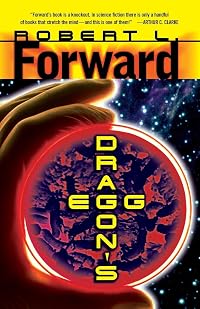
There is 1 current discussion about this work.
On This Page
Description
In a moving story of sacrifice and triumph, human scientists establish a relationship with intelligent lifeforms-the cheela-living on Dragon's Egg, a neutron star where one Earth hour is equivalent to hundreds of their years. The cheela culturally evolve from savagery to the discovery of science, and for a brief time, men are their diligent teachers.Tags
Recommendations
















Member Reviews
I'm not really sure what to think about this book. I liked the parts with the cheela best. I didn't really find any of the humans believable. Maybe there was too much effort in making them "from the future"? Whatever the case, I connected much more with the cheela than the humans.
It took me a long time to get into it. The concept is fascinating, though, and I'd be curious to see what it was like if we ever did meet an alien race who lived on a different time scale from us. (Well. I'm curious to meet another (peaceful) alien race, period.)
I had the same complaint others had about all the humans being intelligent and (in the case of the women) beautiful. Also: why did there need to be mention of not wearing a bra in space? And did anyone show more else stop to think about the no-bra-in-zero-G logistics? That could get really annoying and potentially painful for the woman. Yeah. Give me the cheela over the humans any day. show less
It took me a long time to get into it. The concept is fascinating, though, and I'd be curious to see what it was like if we ever did meet an alien race who lived on a different time scale from us. (Well. I'm curious to meet another (peaceful) alien race, period.)
I had the same complaint others had about all the humans being intelligent and (in the case of the women) beautiful. Also: why did there need to be mention of not wearing a bra in space? And did anyone show more else stop to think about the no-bra-in-zero-G logistics? That could get really annoying and potentially painful for the woman. Yeah. Give me the cheela over the humans any day. show less
We need more sci-fi books like this. There is all I love in a sci-fi book: hard physics, a mind-bending concept of alien life, an optimistic view of the future. I don't want to spoil the fun so I won't go into the details of how the pressure, magnetic field and gravity of the neutron star affect its inhabitants, but if you have some knowledge of physics (and/or of Star Trek LOL) you'll guess what's coming!
I hadn't had such fun since the spider society in Children of Time, and I have to say that the two books are very similar, albeit Dragon's Egg predates the other novel by decades. Forward must have inspired a whole genre, and I am here for it.
The social evolution on the surface of the neutron star is very much modelled on human history show more - again, pretty much as in Children of Time - and the human characters are quite roughly sketched, but the novel is thoroughly enjoyable nonetheless, especially if you like to be introduced to a different way of experiencing the world, through the eyes of an alien creature. I particularly liked the way Forward gave the Cheela society an original twist about sex, gender relationships and parenthood without making it feel forced. At some stage I was thinking Cheela for few minutes even after putting the book down :)
The biological evolution of the Cheela is also quite fun to witness, at least for a reader like me, quite ignorant in matters of biology and biochemistry. Maybe people with a more solid background will find the science laughable, but I had a helluva time. show less
I hadn't had such fun since the spider society in Children of Time, and I have to say that the two books are very similar, albeit Dragon's Egg predates the other novel by decades. Forward must have inspired a whole genre, and I am here for it.
The social evolution on the surface of the neutron star is very much modelled on human history show more - again, pretty much as in Children of Time - and the human characters are quite roughly sketched, but the novel is thoroughly enjoyable nonetheless, especially if you like to be introduced to a different way of experiencing the world, through the eyes of an alien creature. I particularly liked the way Forward gave the Cheela society an original twist about sex, gender relationships and parenthood without making it feel forced. At some stage I was thinking Cheela for few minutes even after putting the book down :)
The biological evolution of the Cheela is also quite fun to witness, at least for a reader like me, quite ignorant in matters of biology and biochemistry. Maybe people with a more solid background will find the science laughable, but I had a helluva time. show less
The concept is brilliant: intelligent life evolves on a neutron star, which means they experience the world a million times faster than us.
The question of how to communicate with a being whose lifespan unfolds over your coffee break adds an interesting personal dimension, as we see relationships develop in which each side has a very different experience of their shared time. The progress of the civilisation as a whole is just as compelling. The cheela (inhabitants of the neutron star), while capable of reasoning and abstract thought, had been acting essentially on instinct, under the harsh constraints of their environment. But with the slightest prod from human contact, they explode into civilisation.
Given their ability to spend a show more lifetime planning a response to any move from the humans, the cheela are able to run rings around us; no spoilers, though, about what they choose to do.
As usual, I'd love to be able to read a book like this without having to hear how hot all the female scientists are, but hey. show less
The question of how to communicate with a being whose lifespan unfolds over your coffee break adds an interesting personal dimension, as we see relationships develop in which each side has a very different experience of their shared time. The progress of the civilisation as a whole is just as compelling. The cheela (inhabitants of the neutron star), while capable of reasoning and abstract thought, had been acting essentially on instinct, under the harsh constraints of their environment. But with the slightest prod from human contact, they explode into civilisation.
Given their ability to spend a show more lifetime planning a response to any move from the humans, the cheela are able to run rings around us; no spoilers, though, about what they choose to do.
As usual, I'd love to be able to read a book like this without having to hear how hot all the female scientists are, but hey. show less
If you can get past the rampant sexism, hamfisted dialogue, inexplicable alien orgies, and detachment from all realistic human behavior, there's actually an interesting physics thought experiment here.
A very interesting treatment of different time scales in our reactions with other intelligences. The Cheelas live 40 minutes per generation as they inhabit a neutron star. We help them move through their development but in the long run.... a good read in hard Sci-Fi.
I just read the 1980 sci-fi novel, “Dragon’s Egg” by Robert L. Forward and enjoyed it. I got some ways into it and realized that Star Trek: Voyager must’ve borrowed the basic plot for one of their episodes.
It’s a hard sci-fi novel built around genuine physics and astronomy concepts, though maybe veers a bit away from that near the very end, with speculation on fantasy concepts such as faster-than-light travel.
There are two branches going on for most of the novel, the humans who identify a nearby neutron passing through the solar system, and the inhabitants of the neutron star, the cheela.
The beginning of plot has a university grad student looking for some other astronomical data, but then noticing that there’s a pattern to show more the “noise” or as she calls it, “scruff” in the data, then following up on that to find the neutron star. The news media calls it The Dragon’s Egg, because from Earth’s perspective, it visually looks like it traveled from the constellation the Dragon.
A generation later, her son leads an expedition of space ships to travel the Dragon’s Egg for research, with futuristic technology to get counteract the neutron star’s gravity so they can get relatively close to it without being torn apart.
Meanwhile, the cheela develop from primitive life to hunter-gatherers. They first spot the humans’ spaceships and worship them as gods. Then the desire to understand their god drives their society and technological innovation.
The time scale is different between the humans and the cheela. The bulk of the book is just a short time for the humans, while it’s many, many generations for the cheela. In terms of the story, Forward gives us the adventures and struggles and triumphs of a few cheela spread out over their entire societal evolution. But with the humans, there’s not much at all. There’s great character growth of various individual cheela characters, virtually none for the humans.
Even where the stories overlap in terms of the calendar date, we get pages and pages of cheela story, then a few paragraphs of human story. It’s harder to remember what the human plot points were at with most of the jumps into their story, because we’ve just read a full scale adventure for a cheela.
Overall, I enjoyed the book. I’m mainly disappointed by the lack of development for the human side of things. show less
It’s a hard sci-fi novel built around genuine physics and astronomy concepts, though maybe veers a bit away from that near the very end, with speculation on fantasy concepts such as faster-than-light travel.
There are two branches going on for most of the novel, the humans who identify a nearby neutron passing through the solar system, and the inhabitants of the neutron star, the cheela.
The beginning of plot has a university grad student looking for some other astronomical data, but then noticing that there’s a pattern to show more the “noise” or as she calls it, “scruff” in the data, then following up on that to find the neutron star. The news media calls it The Dragon’s Egg, because from Earth’s perspective, it visually looks like it traveled from the constellation the Dragon.
A generation later, her son leads an expedition of space ships to travel the Dragon’s Egg for research, with futuristic technology to get counteract the neutron star’s gravity so they can get relatively close to it without being torn apart.
Meanwhile, the cheela develop from primitive life to hunter-gatherers. They first spot the humans’ spaceships and worship them as gods. Then the desire to understand their god drives their society and technological innovation.
The time scale is different between the humans and the cheela. The bulk of the book is just a short time for the humans, while it’s many, many generations for the cheela. In terms of the story, Forward gives us the adventures and struggles and triumphs of a few cheela spread out over their entire societal evolution. But with the humans, there’s not much at all. There’s great character growth of various individual cheela characters, virtually none for the humans.
Even where the stories overlap in terms of the calendar date, we get pages and pages of cheela story, then a few paragraphs of human story. It’s harder to remember what the human plot points were at with most of the jumps into their story, because we’ve just read a full scale adventure for a cheela.
Overall, I enjoyed the book. I’m mainly disappointed by the lack of development for the human side of things. show less
Robert L. Forward (1932-2002) was better known as a physicist than a novelist. He worked on such science-fictionally hip projects as gravitational waves and the technology for spacecraft tethers. His first novel, Dragon’s Egg (1980), was inspired by Hal Clement's Mission of Gravity (1953), in which the crew of a human spacecraft interacts with a species on a high-gravity planet. In Dragon’s Egg, a human crew studies a fast-evolving species on the surface of a neutron star.
Like Clement, Forward was careful to keep his speculation scientifically accurate. He has been quoted as saying that his story was a textbook on neutron stars in novel form. The novel has a clever appendix explaining the physics. Its bibliography includes some show more fictional future works and some of Forward’s own scientific publications. I think I should have read it first.
The common complaint about his writing is that his character development is minimal. True enough, though I did root for several of his crab-like aliens. I also appreciated the timely case he makes for appreciating the talent of women in physics.
If your taste in science fiction runs to the hard stuff, you should relish a little Dragon’s Egg. show less
Like Clement, Forward was careful to keep his speculation scientifically accurate. He has been quoted as saying that his story was a textbook on neutron stars in novel form. The novel has a clever appendix explaining the physics. Its bibliography includes some show more fictional future works and some of Forward’s own scientific publications. I think I should have read it first.
The common complaint about his writing is that his character development is minimal. True enough, though I did root for several of his crab-like aliens. I also appreciated the timely case he makes for appreciating the talent of women in physics.
If your taste in science fiction runs to the hard stuff, you should relish a little Dragon’s Egg. show less
Members
- Recently Added By
Lists

Best Science Fiction Novels
816 works; 430 members

Truly alien aliens (SF)
42 works; 3 members

Otherland Book Club
36 works; 2 members
Talk Discussions
Current Discussions
Dragon's Egg in Good Show Sir! — bad science fiction and fantasy covers (September 2025)
Author Information

33+ Works 5,016 Members
Some Editions
Awards and Honors
Awards
Series

Belongs to Publisher Series
Common Knowledge
- Original publication date
- 1980
- First words
- TIME: 500,000 B.C.
Buu lay in his leafy arbor nest and looked up at the stars in the dark sky. • • Prologue
TIME: THURSDAY 23 APRIL 2020
Jacqueline Carmot strode over to a long table i... (show all)n the data processing lab in the CCCP-NASA-ESA Deep Space Research Center at CalTech. • • Pulsar - Last words
- (Click to show. Warning: May contain spoilers.)"It's time to go home!"
- Blurbers
- Dyson, Freeman; Hogan, James P.; Clement, Hal; Herbert, Frank; Asimov, Isaac; Sheffield, Charles (show all 9); Drake, Frank; Billigham, John; Niven, Larry
- Original language
- English
Classifications
Statistics
- Members
- 1,574
- Popularity
- 14,504
- Reviews
- 31
- Rating
- (3.96)
- Languages
- 6 — Czech, English, Finnish, French, German, Spanish
- Media
- Paper, Audiobook, Ebook
- ISBNs
- 18
- ASINs
- 13