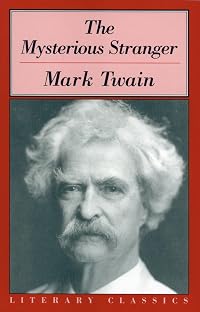
The Mysterious Stranger; or, The Chronicle of Young Satan
by Mark Twain 
On This Page
Description
In the last extended piece of fiction from beloved American fiction writer and humorist Mark Twain, Satan proudly surveys fin-de-siecle civilization and marvels at its hypocrisies. Twain was heavily invested in this story and rewrote it multiple times over the course of several decades. Although critics regard it as a serious work of satire, it is full of the side-splitting humor for which Twain's writing is known..
Tags
Recommendations



































Member Reviews
"Man is made of dirt - I saw him made. I am not made of dirt. Man is a museum of diseases, a home of impurities; he comes to-day and is gone to-morrow; he begins as dirt and departs as stench; I am of the aristocracy of the Imperishables. And man has the Moral Sense. You understand? He has the Moral Sense. That would seem to be difference enough between us, all by itself."
"Nothing exists; all is a dream. God—man—the world—the sun, the moon, the wilderness of stars—a dream, all a dream; they have no existence. Nothing exists save empty space—and you!"
"Men have nothing in common with me--there is no point of contact; they have foolish little feelings and foolish little vanities and impertinences and ambitions; their foolish show more little life is but a laugh, a sigh, and extinction; and they have no sense. Only the Moral Sense. I will show you what I mean. Here is a red spider, not so big as a pin's head. Can you imagine an elephant being interested in him-- caring whether he is happy or isn't, or whether he is wealthy or poor, whether his sweetheart returns his love or not, whether his mother is sick or well, whether he is looked up to in society or not, whether his enemies will smite him or his friends desert him, whether his hopes will suffer blight or his political ambitions fail, whether he shall die in the bosom of his family or neglected and despised in a foreign land? These things can never be important to the elephant; they are nothing to him; he cannot shrink his sympathies to the microscopic size of them. Man is to me as the red spider is to the elephant. The elephant has nothing against the spider--he cannot get down to that remote level; I have nothing against man. The elephant is indifferent; I am indifferent."
"I know your race. It is made up of sheep. It is governed by minorities, seldom or never by majorities. It suppresses its feelings and its beliefs and follows the handful that makes the most noise. Sometimes the noisy handful is right, sometimes wrong; but no matter, the crowd follows it. The vast majority of the race, whether savage or civilized, are secretly kind-hearted and shrink from inflicting pain, but in the presence of the aggressive and pitiless minority they don't dare to assert themselves. Think of it! One kind-hearted creature spies upon another, and sees to it that he loyally helps in iniquities which revolt both of them. Speaking as an expert, I know that ninety- nine out of a hundred of your race were strongly against the killing of witches when that foolishness was first agitated by a handful of pious lunatics in the long ago. And I know that even to-day, after ages of transmitted prejudice and silly teaching, only one person in twenty puts any real heart into the harrying of a witch. And yet apparently everybody hates witches and wants them killed. Some day a handful will rise up on the other side and make the most noise--perhaps even a single daring man with a big voice and a determined front will do it--and in a week all the sheep will wheel and follow him, and witch-hunting will come to a sudden end.
Monarchies, aristocracies, and religions are all based upon that large defect in your race--the individual's distrust of his neighbor, and his desire, for safety's or comfort's sake, to stand well in his neighbor's eye. These institutions will always remain, and always flourish, and always oppress you, affront you, and degrade you, because you will always be and remain slaves of minorities. There was never a country where the majority of the people were in their secret hearts loyal to any of these institutions"
"Well, I will tell you, and you must understand if you can. You belong to a singular race. Every man is a suffering-machine and a happiness- machine combined. The two functions work together harmoniously, with a fine and delicate precision, on the give-and-take principle. For every happiness turned out in the one department the other stands ready to modify it with a sorrow or a pain--maybe a dozen. In most cases the man's life is about equally divided between happiness and unhappiness. When this is not the case the unhappiness predominates--always; never the other. Sometimes a man's make and disposition are such that his misery- machine is able to do nearly all the business. Such a man goes through life almost ignorant of what happiness is. Everything he touches, everything he does, brings a misfortune upon him. You have seen such people? To that kind of a person life is not an advantage, is it? It is only a disaster. Sometimes for an hour's happiness a man's machinery makes him pay years of misery. Don't you know that? It happens every now and then." show less
"Nothing exists; all is a dream. God—man—the world—the sun, the moon, the wilderness of stars—a dream, all a dream; they have no existence. Nothing exists save empty space—and you!"
"Men have nothing in common with me--there is no point of contact; they have foolish little feelings and foolish little vanities and impertinences and ambitions; their foolish show more little life is but a laugh, a sigh, and extinction; and they have no sense. Only the Moral Sense. I will show you what I mean. Here is a red spider, not so big as a pin's head. Can you imagine an elephant being interested in him-- caring whether he is happy or isn't, or whether he is wealthy or poor, whether his sweetheart returns his love or not, whether his mother is sick or well, whether he is looked up to in society or not, whether his enemies will smite him or his friends desert him, whether his hopes will suffer blight or his political ambitions fail, whether he shall die in the bosom of his family or neglected and despised in a foreign land? These things can never be important to the elephant; they are nothing to him; he cannot shrink his sympathies to the microscopic size of them. Man is to me as the red spider is to the elephant. The elephant has nothing against the spider--he cannot get down to that remote level; I have nothing against man. The elephant is indifferent; I am indifferent."
"I know your race. It is made up of sheep. It is governed by minorities, seldom or never by majorities. It suppresses its feelings and its beliefs and follows the handful that makes the most noise. Sometimes the noisy handful is right, sometimes wrong; but no matter, the crowd follows it. The vast majority of the race, whether savage or civilized, are secretly kind-hearted and shrink from inflicting pain, but in the presence of the aggressive and pitiless minority they don't dare to assert themselves. Think of it! One kind-hearted creature spies upon another, and sees to it that he loyally helps in iniquities which revolt both of them. Speaking as an expert, I know that ninety- nine out of a hundred of your race were strongly against the killing of witches when that foolishness was first agitated by a handful of pious lunatics in the long ago. And I know that even to-day, after ages of transmitted prejudice and silly teaching, only one person in twenty puts any real heart into the harrying of a witch. And yet apparently everybody hates witches and wants them killed. Some day a handful will rise up on the other side and make the most noise--perhaps even a single daring man with a big voice and a determined front will do it--and in a week all the sheep will wheel and follow him, and witch-hunting will come to a sudden end.
Monarchies, aristocracies, and religions are all based upon that large defect in your race--the individual's distrust of his neighbor, and his desire, for safety's or comfort's sake, to stand well in his neighbor's eye. These institutions will always remain, and always flourish, and always oppress you, affront you, and degrade you, because you will always be and remain slaves of minorities. There was never a country where the majority of the people were in their secret hearts loyal to any of these institutions"
"Well, I will tell you, and you must understand if you can. You belong to a singular race. Every man is a suffering-machine and a happiness- machine combined. The two functions work together harmoniously, with a fine and delicate precision, on the give-and-take principle. For every happiness turned out in the one department the other stands ready to modify it with a sorrow or a pain--maybe a dozen. In most cases the man's life is about equally divided between happiness and unhappiness. When this is not the case the unhappiness predominates--always; never the other. Sometimes a man's make and disposition are such that his misery- machine is able to do nearly all the business. Such a man goes through life almost ignorant of what happiness is. Everything he touches, everything he does, brings a misfortune upon him. You have seen such people? To that kind of a person life is not an advantage, is it? It is only a disaster. Sometimes for an hour's happiness a man's machinery makes him pay years of misery. Don't you know that? It happens every now and then." show less
This book was odd, and very trippy, and kind of nightmarish. But it was very much ahead of its time, and prophetic, too, about human nature and endless war.
The premise is easy to explain: a group of boys befriend an angel named Satan (supposedly, not that Satan - that's his uncle). In execution, Twain has much to say about fate, human nature, the insidiousness of peer pressure/group think, and morality.
It is only at the end when Satan drops the proverbial bomb that you realize Twain set up the entire book as an argument for why there is no God. It's... fascinating. And trippy. And made my brain hurt a bit. But in a good way.
The premise is easy to explain: a group of boys befriend an angel named Satan (supposedly, not that Satan - that's his uncle). In execution, Twain has much to say about fate, human nature, the insidiousness of peer pressure/group think, and morality.
It is only at the end when Satan drops the proverbial bomb that you realize Twain set up the entire book as an argument for why there is no God. It's... fascinating. And trippy. And made my brain hurt a bit. But in a good way.
This book was one of Mark Twain’s late works, written at a time when the author was convinced that his misery-machine (to use an expression from the book) worked much harder than his happiness machine. The narrative reflects his scorn of humanity; to term their behavior brutish is an insult to animals, as Satan repeatedly points out. Satan appears as a companion to a boy in an Austrian village late in the 16th century, Theodore, the narrator of the book. The adventures this companion initiates are at times a foretaste of Bulgakov's Master and Margarita. There are also more than a few echoes of various versions of the Faust legend.
Although Theodore is the “I” of the book, it seems as if it is Satan who expresses the views of the show more author. The book recounts scenes of persecution of so-called witches and heretics, as well as other evils, such as the exploitation of poor workers by the rich. Satan ascribes it all to that which is said to differentiate humankind from all other animals, his moral sense. “Moral sense” serves as a leitmotif of the book, functioning similarly to “quality” in a section of the author’s earlier Huckleberry Finn. The book offers only two ways out: One is humor, providing humans turn at last from lampooning coarse targets and aim at “colossal humbug”: “Power, money, persuasion, supplication, persecution” (p. 114 of my copy). The other is the insight that closes the book: none of this is real. There is only you, but you are just a thought.
Since this reader cannot shake the conviction of being a flesh-and-blood person on a real planet, I take my hope for humankind from another thought: for all of the author’s sarcastic dismissal of the moral sense, it is surely Twain’s sense of right and wrong that fuels his outrage. show less
Although Theodore is the “I” of the book, it seems as if it is Satan who expresses the views of the show more author. The book recounts scenes of persecution of so-called witches and heretics, as well as other evils, such as the exploitation of poor workers by the rich. Satan ascribes it all to that which is said to differentiate humankind from all other animals, his moral sense. “Moral sense” serves as a leitmotif of the book, functioning similarly to “quality” in a section of the author’s earlier Huckleberry Finn. The book offers only two ways out: One is humor, providing humans turn at last from lampooning coarse targets and aim at “colossal humbug”: “Power, money, persuasion, supplication, persecution” (p. 114 of my copy). The other is the insight that closes the book: none of this is real. There is only you, but you are just a thought.
Since this reader cannot shake the conviction of being a flesh-and-blood person on a real planet, I take my hope for humankind from another thought: for all of the author’s sarcastic dismissal of the moral sense, it is surely Twain’s sense of right and wrong that fuels his outrage. show less
I hadn’t even known about this book until reading about it in Susan Gillman’s book, Blood Talk. It’s an unfinished work by Twain, and there are multiple manuscripts with different titles and lengths. It does make you wonder why Twain made so many attempts to write and rewrite the story from scratch and why he wasn’t happy with the various versions.
All that aside, it’s an enjoyable read. After all, this is Mark Twain.
It’s not at all subtle, either. The plot has three boys meeting Satan’s nephew in 1590 in the Austrian village of Eseldorf (other versions take place at other times and places). The three boys are entertained by Satan’s nephew, who introduces himself by that name after a short time with the boys. He performs show more various tricks, creating animals and miniature people, even a miniature village, out of clay or thin air.
What’s remarkable though is that he doesn’t care about the creatures and other things he creates. He crushes the village and the villagers without a second thought. The boys are shocked, but that doesn’t stop them from becoming friends with Satan’s nephew (usually just called Satan, but also going under the alias, Philip Traum, “Traum” significantly being German for “dream”).
I should say in passing that it’s not explained exactly in what sense Traum is a “nephew” to Satan. Let that go, maybe.
The main character among the boys is Theodor, who develops the closest relationship with Satan among the boys.
Satan becomes involved in the affairs of Eseldorf — especially the plight of Father Peter. Satan helps Father Peter escape his financial problems by placing a sum of money along a path Father Peter will walk along. Father Peter finds the money, is overjoyed, and is saved from financial ruin.
But as with all the recipients of Satan’s favors, Father Peter doesn’t just live happily ever after. He is accused of stealing the money, his niece Marget is accused of witchcraft, and so on.
What’s remarkable and core to the story that Twain wants to tell, though, is that those calamities are the results of human actions, in response to Satan’s work. The “evil” that results results consistently and reliably from the actions of human beings.
Satan explains to Theodor that human beings are the sole beings with “the Moral Sense,” a conscious sense of right and wrong. It’s because we possess that sense that we are alone capable of evil — other animals simply do what they do, as Satan himself did with the villagers he created and destroyed, without a thought as to right or wrong.
Given the power to do right or wrong, we choose wrong consistently. We pride ourselves on our moral sense, and we squander it.
Not all of us really want to do wrong, but we are too weak to resist the leadership of the strong-willed, as Satan calls them, “the aggressive and pitiless minority.”
As if to give hope, Satan grants, “. . . your race, in its poverty, has unquestionably one really effective weapon — laughter. Power, money, persuasion, supplication, persecution — these can lift at a colossal humbug — push it a little — weaken it a little century by century, but only laughter can blow it to rags and atoms at a blast. Against the assault of laughter, nothing can stand.” show less
All that aside, it’s an enjoyable read. After all, this is Mark Twain.
It’s not at all subtle, either. The plot has three boys meeting Satan’s nephew in 1590 in the Austrian village of Eseldorf (other versions take place at other times and places). The three boys are entertained by Satan’s nephew, who introduces himself by that name after a short time with the boys. He performs show more various tricks, creating animals and miniature people, even a miniature village, out of clay or thin air.
What’s remarkable though is that he doesn’t care about the creatures and other things he creates. He crushes the village and the villagers without a second thought. The boys are shocked, but that doesn’t stop them from becoming friends with Satan’s nephew (usually just called Satan, but also going under the alias, Philip Traum, “Traum” significantly being German for “dream”).
I should say in passing that it’s not explained exactly in what sense Traum is a “nephew” to Satan. Let that go, maybe.
The main character among the boys is Theodor, who develops the closest relationship with Satan among the boys.
Satan becomes involved in the affairs of Eseldorf — especially the plight of Father Peter. Satan helps Father Peter escape his financial problems by placing a sum of money along a path Father Peter will walk along. Father Peter finds the money, is overjoyed, and is saved from financial ruin.
But as with all the recipients of Satan’s favors, Father Peter doesn’t just live happily ever after. He is accused of stealing the money, his niece Marget is accused of witchcraft, and so on.
What’s remarkable and core to the story that Twain wants to tell, though, is that those calamities are the results of human actions, in response to Satan’s work. The “evil” that results results consistently and reliably from the actions of human beings.
Satan explains to Theodor that human beings are the sole beings with “the Moral Sense,” a conscious sense of right and wrong. It’s because we possess that sense that we are alone capable of evil — other animals simply do what they do, as Satan himself did with the villagers he created and destroyed, without a thought as to right or wrong.
Given the power to do right or wrong, we choose wrong consistently. We pride ourselves on our moral sense, and we squander it.
Not all of us really want to do wrong, but we are too weak to resist the leadership of the strong-willed, as Satan calls them, “the aggressive and pitiless minority.”
As if to give hope, Satan grants, “. . . your race, in its poverty, has unquestionably one really effective weapon — laughter. Power, money, persuasion, supplication, persecution — these can lift at a colossal humbug — push it a little — weaken it a little century by century, but only laughter can blow it to rags and atoms at a blast. Against the assault of laughter, nothing can stand.” show less
Mark Twain (1835-1910) uses this novel to mock the conventional ideas about God: that God is a loving ever-present entity who wants to help people and reward people who do what he wants done and punishes people who disobey him. He sets his parable in Austria hinting that Austria is no different than America. It is a country where the people are asleep and way behind time. They live in an age of belief, rather than science. It is a time when knowledge is kept from the common people. All people need to know is to be “good Christians; to revere the Virgin, the Church, and the Saints above everything.” Twain tell us that “knowledge was not good for the common people, and would make them discontented with the lot that God had appointed show more for them, and God would not endure discontent with his plan.”
Some boys – symbolic of the uncultivated immature people – meet a very affable elf-like creature who tells them that he is an angel – which, as we will see, represents God. He tells the boys that his name is Satan, but not “the Satan.” “The Satan” is his uncle – suggesting that God is related to evil. The angel explains that “the Satan” was chased out of heaven because he disobeyed God and enticed the woman God created to eat the fruit he forbid her to eat, and then went and ate the fruit himself. This suggests that God is bad-tempered and petulant, fussy about details, not wanting to be crossed even over a somewhat trivial matter.
The angel shows the boys that he can create tiny people to build a toy fortress for them, for fun. They watch, almost mesmerized by the tiny people’s activity. Then they and the angel see two tiny men disagreeing and starting a fight. The angle becomes annoyed, reaches down and grabs the two men between his fingers and squashes them. He does this while assuring them that he is an angel and can never do wrong. The families of the two murdered men begin to cry and shout in mourning, and the angel, annoyed at the noise, takes a board and squashes the mourners and the people near them.
Then the angel decides to complicate his building project to add tension and fun. He causes earthquakes and storms that kill most of the people. When the boys look on in horror, the angel says that there is no need to worry, he can always create new people. He explains that they need to understand that people are to him like bricks to them; he uses them as he sees fit, including breaking and crumbling them. Satan explains that the problem with people is that they have a moral sense, they distinguish between right and wrong, and this sense gives them all kinds of problems. They wouldn’t have had this problem if Eve had not eaten the fruit.
Satan shows them that he also has the ability to change the destiny of humans such as them. He manipulates the destiny of one of the boys and the boy dies while trying to save a girl who was drowning. He gives a woman a magic cat that can bring her food whenever she needs it; however, people hear about the cat and burn her as a witch. Thus it is clear that the angel – God – is uninterested in the people he creates. show less
Some boys – symbolic of the uncultivated immature people – meet a very affable elf-like creature who tells them that he is an angel – which, as we will see, represents God. He tells the boys that his name is Satan, but not “the Satan.” “The Satan” is his uncle – suggesting that God is related to evil. The angel explains that “the Satan” was chased out of heaven because he disobeyed God and enticed the woman God created to eat the fruit he forbid her to eat, and then went and ate the fruit himself. This suggests that God is bad-tempered and petulant, fussy about details, not wanting to be crossed even over a somewhat trivial matter.
The angel shows the boys that he can create tiny people to build a toy fortress for them, for fun. They watch, almost mesmerized by the tiny people’s activity. Then they and the angel see two tiny men disagreeing and starting a fight. The angle becomes annoyed, reaches down and grabs the two men between his fingers and squashes them. He does this while assuring them that he is an angel and can never do wrong. The families of the two murdered men begin to cry and shout in mourning, and the angel, annoyed at the noise, takes a board and squashes the mourners and the people near them.
Then the angel decides to complicate his building project to add tension and fun. He causes earthquakes and storms that kill most of the people. When the boys look on in horror, the angel says that there is no need to worry, he can always create new people. He explains that they need to understand that people are to him like bricks to them; he uses them as he sees fit, including breaking and crumbling them. Satan explains that the problem with people is that they have a moral sense, they distinguish between right and wrong, and this sense gives them all kinds of problems. They wouldn’t have had this problem if Eve had not eaten the fruit.
Satan shows them that he also has the ability to change the destiny of humans such as them. He manipulates the destiny of one of the boys and the boy dies while trying to save a girl who was drowning. He gives a woman a magic cat that can bring her food whenever she needs it; however, people hear about the cat and burn her as a witch. Thus it is clear that the angel – God – is uninterested in the people he creates. show less
A gloriously nihilistic tale of a village visited by a terribly amoral angel named Satan. While undeniably humorous in many ways, it's also a bitter indictment, not just of religion of all kinds, but of the hypocrisy of human nature. Wonderful.
(Laughing out loud, because I just read the other review of this story here on Goodreads, which says: "if you like "It's A Wonderful Life," you shouldn't read this work." I happen to absolutely despise that movie on so many levels...)
(Laughing out loud, because I just read the other review of this story here on Goodreads, which says: "if you like "It's A Wonderful Life," you shouldn't read this work." I happen to absolutely despise that movie on so many levels...)
What a remarkable piece of writing from a man known for his subtle mind. This is an almost unknown novella, one that has been shunted off stage in favor of the luminous Huck Finn, the multifarious Roughing It and Innocents Abroad, and is considered part of Twain's "dark period" because it doesn't adhere to our expectations of his style. I'm deeply fascinated by Twain's manifold aspects as a writer, and this interesting novella illuminates one of them. Many have dismissed this nihilistic, atheistic story as the work of an emotionally exhausted and broken man, who had suffered ruinous financial losses and the death of beloved family members, one after the other. I find this dismissal deeply condescending and moralistic. In fact, Twain was show more a critic of religion from his earliest writings, most memorably in Huck Finn.
While The Mysterious Stranger's narrative framework is unconventional, even if fable-like, its lucid and unsparing criticism of religious belief at a time when such criticism would have been career-endangering, is frankly wonderful and profoundly emotional. Twain set this fable in fifteenth-century Austria in order to gain closer access to the most horrific aspects of inquisitorial religious authority, but it reads as if it could have happened in St. Petersburg, Missouri. (In fact, there is a "St. Petersburg" fragment associated with this book.) Some readers looking for the kind of rich, detailed setting one finds in Twain's other work will be sorely disappointed. Humor is sparse here (notable exception is the name of the town, Eseldorf, or "ass/donkey town"). As a devoted admirer of Mark Twain, I found in this novella a important pathway toward better understanding him, as well as an affirmation of some of my own core beliefs, which are rarely reflected in the literature contemporaneous with Twain.
An important last note: The copy of this novella I checked out from my library was actually the 1916 publication, which was cobbled together by Albert Bigelow Paine, who had sole possession of Twain's papers at that time. In an attempt to smooth out a piece in revision, he made some additions. Be sure to read the version found in the University of California's definitive collection of Mysterious Stranger manuscripts titled "No.44, The Mysterious Stranger." show less
While The Mysterious Stranger's narrative framework is unconventional, even if fable-like, its lucid and unsparing criticism of religious belief at a time when such criticism would have been career-endangering, is frankly wonderful and profoundly emotional. Twain set this fable in fifteenth-century Austria in order to gain closer access to the most horrific aspects of inquisitorial religious authority, but it reads as if it could have happened in St. Petersburg, Missouri. (In fact, there is a "St. Petersburg" fragment associated with this book.) Some readers looking for the kind of rich, detailed setting one finds in Twain's other work will be sorely disappointed. Humor is sparse here (notable exception is the name of the town, Eseldorf, or "ass/donkey town"). As a devoted admirer of Mark Twain, I found in this novella a important pathway toward better understanding him, as well as an affirmation of some of my own core beliefs, which are rarely reflected in the literature contemporaneous with Twain.
An important last note: The copy of this novella I checked out from my library was actually the 1916 publication, which was cobbled together by Albert Bigelow Paine, who had sole possession of Twain's papers at that time. In an attempt to smooth out a piece in revision, he made some additions. Be sure to read the version found in the University of California's definitive collection of Mysterious Stranger manuscripts titled "No.44, The Mysterious Stranger." show less
Members
- Recently Added By
Lists

Best Books Involving Satan
63 works; 26 members

How to Read a Book's Recommended Reading List
309 works; 10 members

Harold Bloom - The Western Canon: C. The Democratic Age
336 works; 15 members

Best 20th Century Books as of 1924
100 works; 6 members
Works in the game of Authors
44 works; 2 members

Famously Incomplete Novels
16 works; 1 member

Llibres que he llegit el 2024
77 works; 1 member

Best literature ever!
39 works; 1 member
Author Information

2,763+ Works 208,981 Members
Mark Twain was born Samuel L. Clemens in Florida, Missouri on November 30, 1835. He worked as a printer, and then became a steamboat pilot. He traveled throughout the West, writing humorous sketches for newspapers. In 1865, he wrote the short story, The Celebrated Jumping Frog of Calaveras County, which was very well received. He then began a show more career as a humorous travel writer and lecturer, publishing The Innocents Abroad in 1869, Roughing It in 1872, and, Gilded Age in 1873, which was co-authored with Charles Dudley Warner. His best-known works are The Adventures of Tom Sawyer, Mississippi Writing: Life on the Mississippi, and The Adventures of Huckleberry Finn. He died of a heart attack on April 21, 1910. (Bowker Author Biography) show less
Mark Twain has a Legacy Library. Legacy libraries are the personal libraries of famous readers, entered by LibraryThing members from the Legacy Libraries group.
Some Editions
Series
Belongs to Publisher Series
Work Relationships
Is contained in
Has the adaptation
Inspired
Common Knowledge
- Canonical title
- The Mysterious Stranger; or, The Chronicle of Young Satan
- Original title
- The Mysterious Stranger; or, The Chronicle of Young Satan; The Mysterious Stranger
- Original publication date
- 1916
- People/Characters
- Satan; Theodor Fischer; Seppi Wohlmeyer; Nikolaus Bauman; Father Adolf; Father Peter (show all 11); Marget; Ursula; Wilhelm Meidling; The Astrologer; Gottfried Narr
- Important places
- Eseldorf, Austria
- Related movies
- The Mysterious Stranger (1982 | IMDb)
- First words
- It was in 1590 - winter.
- Quotations*
- Aber allein die christliche Zivilisation hat einen Triumph errungen, auf den man stolz sein kann. In zwei oder drei Jahrhunderten wird allgemein anerkannt sein, daß alle kompetenten Totschläger Christen sind. Dann wird die ... (show all)heidnische Welt beim Christenmenschen zur Schule gehen, nicht etwa, um an seine Religion zu kommen, sondern an seine Waffen. Der Mohammedaner und der Chinese werden ihm diese Waffen abkaufen, um damit Missionare und Bekehrte zu töten.
- Last words
- (Click to show. Warning: May contain spoilers.)He vanished, and left me appalled; for I knew, and realized, that all he had said was true.
- Original language*
- Englisch
- Disambiguation notice
- This work is the single work published in 1916. Do not combine it with the Mark Twain Library edition or with any work called No. 44, the Mysterious Stranger (or variations on that name) as they are different works with signi... (show all)ficantly different content.
Please don't combine this single work with any collections in which this work is contained.
*Some information comes from Common Knowledge in other languages. Click "Edit" for more information.
Classifications
Statistics
- Members
- 688
- Popularity
- 41,609
- Reviews
- 27
- Rating
- (3.96)
- Languages
- 14 — Chinese, Danish, English, French, German, Galician, Greek, Hebrew, Italian, Polish, Romanian, Croatian, Spanish, Turkish
- Media
- Paper, Audiobook, Ebook
- ISBNs
- 117
- ASINs
- 22