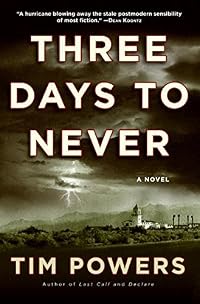
Three Days to Never
by Tim Powers
On This Page
Description
When Einstein told Roosevelt in 1939 that the atomic bomb was possible, he did not tell the president about another discovery he had made, something so horrific it remained a secret--until now. When 12-year-old Daphne takes a videotape labeled Pee-wee's Big Adventure from her grandmother's house, neither she nor her college-professor father Frank has any idea that the theft has drawn the attention of both the Israeli Secret Service and an ancient European cabal of occultists--or that within show more hours they'll be visited by her long-lost grandfather, who is also desperate to get that tape. And when Daphne's teddy bear is stolen, a blind assassin nearly kills Frank, and a phantom begins to speak to her from a switched-off television set, they find themselves caught in the middle of a murderous power struggle that originated long ago in Israel and Germany but now crashes through Los Angeles and the Mojave Desert.--From publisher description. show lessTags
Recommendations











Member Reviews
I don't usually go for "urban fantasy" books but Powers takes a decidedly outrageous plot involving time travel, spy rings, and multi-dimensional terrorists, wraps it up in a bunch of woo-woo science with a touch of the supernatural and then throws in Albert Einstein and Charlie Chaplin for good measure. The result is a highly entertaining, if somewhat confusing, melange of thriller and temporal paradox which kept me up way past my bedtime.
Tim Powers has a formula. Start with actual history, and focus on parts of it where what we know trails off into mystery. Fill in the unknown with elements of the fantastic. Connect it all to the lives of his characters via a fast-paced story.
But that formula doesn't constrain any of the inventive, exciting stories Powers writes with it. In Three Days to Never, the principal historical mystery concerns Lieserl Marić, first child of Albert Einstein and his first wife Mileva Marić. Lieserl was born in 1902, before Einstein and Marić married. That she had ever existed was unknown to the world before the 1980s, and history does not record her true name or what became of her. The linked Wikipedia article states that most observers think show more she died in infancy.
Powers imagines a much longer, eventful life for her, ending in California in her old age, in 1987. We learn a lot about that life, but much remains unknown, as she appears only as her descendants knew her.
Frank Marrity knew Lieserl as his grandmother Lisa. He and his daughter Daphne find their lives - and much more - endangered by agents of secret organizations, who want the magical artifacts Lieserl guarded.
Powers mixes time travel, Jewish mysticism, Albert Einstein, Charlie Chaplin, family dysfunction, the Six-Day War, relativity, paranormal powers, the Holy Grail, the Cold War, and California's architecture and landscape into his fast-moving story.
I'm bothered a bit by Powers using one of the most significant scientists of the twentieth century as a sort of arch-mage. But, given how badly Einstein treated Mileva Marić, maybe that's only fair, somehow. show less
But that formula doesn't constrain any of the inventive, exciting stories Powers writes with it. In Three Days to Never, the principal historical mystery concerns Lieserl Marić, first child of Albert Einstein and his first wife Mileva Marić. Lieserl was born in 1902, before Einstein and Marić married. That she had ever existed was unknown to the world before the 1980s, and history does not record her true name or what became of her. The linked Wikipedia article states that most observers think show more she died in infancy.
Powers imagines a much longer, eventful life for her, ending in California in her old age, in 1987. We learn a lot about that life, but much remains unknown, as she appears only as her descendants knew her.
Frank Marrity knew Lieserl as his grandmother Lisa. He and his daughter Daphne find their lives - and much more - endangered by agents of secret organizations, who want the magical artifacts Lieserl guarded.
Powers mixes time travel, Jewish mysticism, Albert Einstein, Charlie Chaplin, family dysfunction, the Six-Day War, relativity, paranormal powers, the Holy Grail, the Cold War, and California's architecture and landscape into his fast-moving story.
I'm bothered a bit by Powers using one of the most significant scientists of the twentieth century as a sort of arch-mage. But, given how badly Einstein treated Mileva Marić, maybe that's only fair, somehow. show less
I do love Tim Powers' writing. THREE DAYS TO NEVER marks me catching up completely, and finishing reading all of his novels, and they've all been brilliant in their own way. A couple haven't quite grabbed me as much as others, but this one has time travel, remote sensing, Albert Einstein, Charlie Chaplin and a great cast of characters tightly bound in an intricate plot. I was hooked from the start.
I've been away for two days in Powers' head,, held by his way of taking a weird idea, such as Einstien inventing a time machine, then filtering it through a world view that contains ghosts, ESP and all manner of psychic phenomena. Anybody who has read Powers in recent years knows all his tics and enthusiasms, and they're here in full, but this show more is tighter, more controlled than the frenzy of, say, Earthquake Weather, and all the better for it.
There are moments of briliance here too, in descriptions of how a blind woman can live by seeing through others' eyes, of swooping travels in the astral planes, and a climactic sequence as tense as any thriller.
But at heart, it's a story of a broken family, working together for each other against heavy odds, and it's often rather touching and tender. And funny too, with a comedic touch that's sometimes absent from Powers' books.
I'm sorry I took so long getting to this one.
It's another winner.
And I'm also sorry that there's no more new Powers books for me to read now. I'll be waiting impatiently for his next one. show less
I've been away for two days in Powers' head,, held by his way of taking a weird idea, such as Einstien inventing a time machine, then filtering it through a world view that contains ghosts, ESP and all manner of psychic phenomena. Anybody who has read Powers in recent years knows all his tics and enthusiasms, and they're here in full, but this show more is tighter, more controlled than the frenzy of, say, Earthquake Weather, and all the better for it.
There are moments of briliance here too, in descriptions of how a blind woman can live by seeing through others' eyes, of swooping travels in the astral planes, and a climactic sequence as tense as any thriller.
But at heart, it's a story of a broken family, working together for each other against heavy odds, and it's often rather touching and tender. And funny too, with a comedic touch that's sometimes absent from Powers' books.
I'm sorry I took so long getting to this one.
It's another winner.
And I'm also sorry that there's no more new Powers books for me to read now. I'll be waiting impatiently for his next one. show less
Time travelling Nazis, Albert Einstein's ghost, seance holding Mossad agents, dybbuks, blind Shakespeare quoting psychics, drunk English professors . . . . you get the picture. Scholarly,entertaining and well written, if a bit confusing at times ( I kept think of Shel Silverstein's "I'm My Own Grandpa" when multiple iterations of the same person appear at once)
It's almost redundant to say this is an odd book - it's a Tim Powers book after all. But even for him, it's an odd book.
It's set (mostly) in 1987 LA and concerns the hidden inventions of Einstein - a machine that lets you travel in space and time, and a process that lets you completely remove someone from space-time. It mixes in psychic investigators and remote viewers from government programmes and a huge dose of literary material that initially makes sense and then becomes increasingly bizarrely related to the story.
Despite all of that, it is a good read. It's a bit slow at times but it's fascinating and wonderfully done.
It's set (mostly) in 1987 LA and concerns the hidden inventions of Einstein - a machine that lets you travel in space and time, and a process that lets you completely remove someone from space-time. It mixes in psychic investigators and remote viewers from government programmes and a huge dose of literary material that initially makes sense and then becomes increasingly bizarrely related to the story.
Despite all of that, it is a good read. It's a bit slow at times but it's fascinating and wonderfully done.
It definitely is full of the who's who of cabals, famous personages, Time Travel, and just enough quirky psi and technological hijinks to want me to catapult this novel to one of those must-read realms of creative SF.
I mean, what does Einstein and Charlie Chaplin have in common with time-travel that mimics the trajectory of a swastika? Or a novel that attempts to do the same in it's plot progression? Theoretically, these are some damn cool villains.
The opening is solid and grounded, and even all of the Shakespeare quotations make perfect sense as a means to focus oneself in a timeline. It's cool!
So why didn't I love this?
I think it's probably the characters. I kept losing my "care" focus.
The family stuff was interesting in retrospect, show more especially when some of that family isn't family but is yourself at a different age or across an erased timeline or as a sacrifice to a better timeline that turned on itself to bite you, your progeny, or your friends on your ass. I love the fact that it got really wacky and strange. Truly.
But it also took it so far away from my love of the characters that I started going glassy-eyed. Especially when the ghosts came into play. Or the sex changes. Or the ragged bursts of time travel and reattachments of lifelines on a revolving helix of galaxies.
Or something like that.
Just how many Mary-s WERE there? Yikes.
At least when Heinlein did it, he spread out the weirdness over many books in small doses and grounded fully in good stories. :) Let's do an all-out 4th dimensional viewpoint romp, shall we? It's impressive, but it's even a bit too much for me! Whoa. :)
Maybe it's just me. I also don't like it when authors don't do ENOUGH of the weird stuff. :) Maybe I'm just impossible to please. :) show less
I mean, what does Einstein and Charlie Chaplin have in common with time-travel that mimics the trajectory of a swastika? Or a novel that attempts to do the same in it's plot progression? Theoretically, these are some damn cool villains.
The opening is solid and grounded, and even all of the Shakespeare quotations make perfect sense as a means to focus oneself in a timeline. It's cool!
So why didn't I love this?
I think it's probably the characters. I kept losing my "care" focus.
The family stuff was interesting in retrospect, show more especially when some of that family isn't family but is yourself at a different age or across an erased timeline or as a sacrifice to a better timeline that turned on itself to bite you, your progeny, or your friends on your ass. I love the fact that it got really wacky and strange. Truly.
But it also took it so far away from my love of the characters that I started going glassy-eyed. Especially when the ghosts came into play. Or the sex changes. Or the ragged bursts of time travel and reattachments of lifelines on a revolving helix of galaxies.
Or something like that.
Just how many Mary-s WERE there? Yikes.
At least when Heinlein did it, he spread out the weirdness over many books in small doses and grounded fully in good stories. :) Let's do an all-out 4th dimensional viewpoint romp, shall we? It's impressive, but it's even a bit too much for me! Whoa. :)
Maybe it's just me. I also don't like it when authors don't do ENOUGH of the weird stuff. :) Maybe I'm just impossible to please. :) show less
Ultimately disappointing from the master of the Anubis Gates. It starts well enough, with some powerful conceits about time and personal responsibility and the Israeli element is well drawn without the usual cliches. It is well written. But it is as if the author lost his nerve and thought of the film rights near the end and far too late. But, until that point, "quite fun".
Members
- Recently Added By
Published Reviews
ThingScore 100
The place is Greater Los Angeles, a neighborhood today, San Bernardino, Pasadena, Hollywood, Palm Springs. People arrive, or their predecessors did, so there are reflections, or repercussions, of Germany — Switzerland — Israel — and a ranging universe so vast and strange the characters think of it as a freeway to their local lives, or God.
The time is 1987: three days of it: hence the show more title — with a look at 1967 — the days of Charlie Chaplin and Albert Einstein — Pope Innocent III — Moses — and a man from 2006 who can’t stand the crude technology.
The actors are a preteen girl and her father who teaches literature — and her great-grandmother — and her uncle — and two teams trying to undo place, time, and action, one from the Israeli intelligence service, one vast and strange.
The focus of these forces keeps this story strong. Powers has set us at their nexus, holds us there. The careful painting of their operation, almost prosaic in the midst of poetry, almost mundane in the midst of the mystic, keeps this world weird. He makes it shock and shimmer. Its spine is his imagination. Its sinew is his understanding. He is unafraid of good or evil, of comedy or crime. show less
The time is 1987: three days of it: hence the show more title — with a look at 1967 — the days of Charlie Chaplin and Albert Einstein — Pope Innocent III — Moses — and a man from 2006 who can’t stand the crude technology.
The actors are a preteen girl and her father who teaches literature — and her great-grandmother — and her uncle — and two teams trying to undo place, time, and action, one from the Israeli intelligence service, one vast and strange.
The focus of these forces keeps this story strong. Powers has set us at their nexus, holds us there. The careful painting of their operation, almost prosaic in the midst of poetry, almost mundane in the midst of the mystic, keeps this world weird. He makes it shock and shimmer. Its spine is his imagination. Its sinew is his understanding. He is unafraid of good or evil, of comedy or crime. show less
added by TomVeal
Author Information

76+ Works 20,926 Members
Awards and Honors
Awards
Notable Lists
Series
Belongs to Publisher Series
Science Fiction Book Club (1213739)
Common Knowledge
- Original title
- Three Days to Never
- Original publication date
- 2006
- People/Characters
- Ernie Bozzaris (Mossad agent); Bennett Bradley; Moira Marrity Bradley; Roger Canino (agent of the Vespers); Charlie Chaplin; Albert Einstein (show all 16); Sam Glatzer (Mossad remote viewer); Paul Golze (agent of the Vespers); Orin Lepidopt (Mossad agent); Bert Malk (Mossad agent); Frank Marrity; Daphne Marrity; Derek Marrity; Lisa Marrity (Grammar, Lieserl Marity); Rascasse (agent of the Vespers); Charlotte Sinclair (agent of the Vespers)
- Important places
- Israel; California, USA; Jerusalem; Los Angeles, California, USA; Mount Shasta, California, USA; Pasadena, California, USA (show all 8); Palm Springs, California, USA; Tel Aviv, Israel
- Important events
- Six-Day War
- Dedication
- For Chris and Teresa Arena
And with thanks to Assaf Asheri, Mike Backes, John Bierer, Jim Blaylock, Didi Chanoch, Russell Galen, Patricia Geary, Tom Gilchrist, Rani Graff, Julia Halperin, John Hertz, Jon Hodge, Varnum ... (show all)Honey, Pat Hough, Barry Levin, Brian and Cathy McCaleb, Karen Meisner, Denny Meyer, Eric Nylund, Aya Shacham, Dave Sandoval, Bill Schafer, Sunila Sen Gupta, David Silberstein, Kristine Sobrero, Ed Thomas, Vered Tochterman, Guy Weiner, Hagit Weiner, Naomi Weiner, Par Winzell, and Mike Yanovich. - First words
- The ambulance came bobbing out of the Mercy Medical Center parking lot and swung south on Pine Street, its blue and red lights just winking dots in the bright noon sunshine and the siren echoing away into the cloudless blue v... (show all)ault of the sky. (prologue)
"It doesn't look burned." - Last words
- (Click to show. Warning: May contain spoilers.)"It's over, Dad," whispered Daphne, tugging him away.
- Blurbers
- Koontz, Dean ; Gibson, William; Straub, Peter
- Original language
- English
Classifications
Statistics
- Members
- 1,114
- Popularity
- 22,621
- Reviews
- 39
- Rating
- (3.63)
- Languages
- Czech, English, French, Hebrew
- Media
- Paper, Ebook
- ISBNs
- 11
- ASINs
- 5