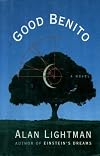
Good Benito
by Alan Lightman
On This Page
Description
Bennett "Benito" Lang is a young scientist who seeks solace in the precise and irrefutable laws of physics, only to find that he cannot escape his own humanity. But he is about to discover love, betrayal, and a whole spectrum of mortal phenomena. Soon he will be forced to face the unpredictable, everyday reality he evades, and to learn from it.Tags
Recommendations

















Member Reviews
Alan Lightman is a revelation – a physics professor at MIT, he also produces lean, beautiful books with depths that are hard to fathom. [Good Benito] is the second of his books. His debut, [Einstein’s Dreams], is a terribly hard act to follow. That book imagined the nighttime wonderings of the master of time, each dream eliciting a different aspect of his notions about the concept, with each a comment not just on the nature of time, but also on the nature of life and choice. Time, as described by Lightman through [Einstein’s Dreams], cannot be completely contained in the mathematical, must be viewed through a lens of humanity to be fully understood.
Elegiac and spare, Alan Lightman’s [Good Benito] follows that same examination, show more focusing on the life of one man, Bennett Lang. A physics student, and later professor, like Lightman himself, Bennett’s story is introduced as he takes a commission from a dean to engage the department’s brilliant hermit, Scalapino. Bennett is eventually accepted by the genius as an understudy. As he tries to comprehend the professor’s racing mind, he reminisces on his own life. The book, like time, folds back on itself several times, connecting the past to the present in otherwise incomprehensible ways, opening Bennett up to himself, and to us. And, like time, the book doesn’t end, as much as grows dark at a crossroads, a sort of black hole where Bennett contemplates the way into the future.
Lightman is one of the more intuitive writers of our time, able to provide a window into life with a subtlety that demands attention. His writing is spare, like a well-crafted formula. But the result is never clinical or scientific. He is the rare person who has bridged the gap between the right and left hemisphere of the brain, between the cold logic of science and the mystery of the human spirit.
Bottom Line: Elegiac and lean, intuitive – a brilliant mind lets us peek into the intersection of the scientific workings of the world and how they are a metaphor for our human existence.
4 ½ bones!!!!! show less
Elegiac and spare, Alan Lightman’s [Good Benito] follows that same examination, show more focusing on the life of one man, Bennett Lang. A physics student, and later professor, like Lightman himself, Bennett’s story is introduced as he takes a commission from a dean to engage the department’s brilliant hermit, Scalapino. Bennett is eventually accepted by the genius as an understudy. As he tries to comprehend the professor’s racing mind, he reminisces on his own life. The book, like time, folds back on itself several times, connecting the past to the present in otherwise incomprehensible ways, opening Bennett up to himself, and to us. And, like time, the book doesn’t end, as much as grows dark at a crossroads, a sort of black hole where Bennett contemplates the way into the future.
Lightman is one of the more intuitive writers of our time, able to provide a window into life with a subtlety that demands attention. His writing is spare, like a well-crafted formula. But the result is never clinical or scientific. He is the rare person who has bridged the gap between the right and left hemisphere of the brain, between the cold logic of science and the mystery of the human spirit.
Bottom Line: Elegiac and lean, intuitive – a brilliant mind lets us peek into the intersection of the scientific workings of the world and how they are a metaphor for our human existence.
4 ½ bones!!!!! show less
It seemed like the story of anyone,or maybe anyone. I'm having a hard time judging this book because I don't really know why I liked it so much. Sometimes though I think that this is the greater compliment.
This book gets three stars, but one the stars is a nostalgia star. From age 16 or so, when I first read it, this was my favorite book. Namely because I didn't read very many books at that point in my life. It resonated with my angst- and love-ridden soul because the main character, Bennett Lang, sometimes got to go to bed with women.
Upon reading it now, 10 years after the fact, the book is wanting in a several departments. None of the characters are fleshed out. Dramatic events whose effects could be drastically heightened by proper setting-up fall flat instead. The plot is a sort of brief meander through this character's life, and if there are any overarching themes I missed them.
That's not to say there isn't some good stuff. It's a show more pleasant and quick read, and there are some nice turns along the way. I wanted to love this book again, but unfortunately it's just sketchy, in the literal sense.
Re-reading this makes me afraid to re-read 'The Perks of Being A Wallflower,' another teen-aged favorite. show less
Upon reading it now, 10 years after the fact, the book is wanting in a several departments. None of the characters are fleshed out. Dramatic events whose effects could be drastically heightened by proper setting-up fall flat instead. The plot is a sort of brief meander through this character's life, and if there are any overarching themes I missed them.
That's not to say there isn't some good stuff. It's a show more pleasant and quick read, and there are some nice turns along the way. I wanted to love this book again, but unfortunately it's just sketchy, in the literal sense.
Re-reading this makes me afraid to re-read 'The Perks of Being A Wallflower,' another teen-aged favorite. show less
It seemed like the story of anyone,or maybe anyone. I'm having a hard time judging this book because I don't really know why I liked it so much. Sometimes though I think that this is the greater compliment.
I didn't enjoy this novel as much as Lightman's other (Einstein's Dreams), but I did enjoy reading it. I found it interesting to see life, love, and humanity from the point of view of a scientist.
A moving portrait of the lifestyle of a theoretical physicst. Probably of limited appeal to those who don't spend their days inside their own minds, but if you are serious about becoming a theoretical physicist, I highly recommend "Good Benito"
Almost like a memoir. Has some interesting details of a passion for physics. But now as I write this, I might have confused that with something else.
Members
- Recently Added By
Author Information

42+ Works 11,179 Members
Alan Lightman was born in Memphis, Tennessee on November 28, 1948. After completing an A.B. at Princeton University in 1970, a Ph.D. at the California Institute of Technology in 1974, and postdoctoral studies at Cornell University in 1976, he moved directly into academia, teaching astronomy and physics at Harvard University, the Smithsonian show more Astrophysical Observatory, and the Massachusetts Institute of Technology. In the 1980s, he found a way to combine his literary and scientific interests when he began to write essays about science. He explored astronomy, cosmology, particle physics, space exploration, and the life of a scientist, writing about these topics in a way that makes them understandable to the average reader. Many of his essays can be found in the collections Time Travel and Papa Joe's Pipe and A Modern-Day Yankee in a Connecticut Court and Other Essays on Science. He is the author of Ancient Light: Our Changing View of the Universe, which won the Boston Globe's 1991 Critics' Choice award for non-fiction; and is co-author of Origins: The Lives and Worlds of Modern Cosmologists, which received an award from the Association of American Publishers in 1990. In the 1990's, he branched out into fiction, although still with a focus on science. His novels include Einstein's Dreams, Good Benito, and The Diagnosis. (Bowker Author Biography) show less
Series
Belongs to Publisher Series
Heyne Allgemeine Reihe (10545)
Common Knowledge
- Canonical title
- Good Benito
- Original title
- Good Benito
- Original publication date
- 1994
- People/Characters
- Bennett Lang (Good Benito); Maury; Davis Jacoby; Arnold Scalapino; Sophie Scalapino; Florida (show all 8); Leila Phelps; Penny Lang
- Important places
- Baltimore, Maryland, USA; Maryland, USA
- Dedication
- This book is dedicated to my parents
- First words
- He stands up from the boxes and looks out the window.
- Last words
- (Click to show. Warning: May contain spoilers.)Her laughter slips through the fog, bounces off the invisible coast, returns in a flight of high notes, fragile and flutelike.
Classifications
Statistics
- Members
- 448
- Popularity
- 68,458
- Reviews
- 7
- Rating
- (3.39)
- Languages
- Dutch, English, German, Spanish
- Media
- Paper, Audiobook, Ebook
- ISBNs
- 14
- ASINs
- 2