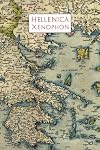
Xenophon, I, Hellenica: Books 1-4 (Loeb Classical Library)
by Xenophon
On This Page
Description
Xenophon was a Greek soldier who played a key role in several military skirmishes and attacks throughout his life. Later in his life, he began to write down his recollections of these battles and other key political and cultural events, thus becoming one of ancient Greece's most important historians. Hellenica offers Xenophon's first-hand account of many events in the Peloponnesian War. It is the only surviving account of the final years of the war and the period immediately following the show more war's conclusion.. show less
Tags
Recommendations






Member Reviews
411-362 B.C. is covered here and the crucial build up to 404 B.C. Xenophon sympathizes with the Spartans.
Edition: // Descr: xxiii, 286 p. 20.5 cm. // Series: College Series of Greek Authors Call No. { 888 X2 13 } Series Edited under the Supervision of John Williams White and Thomas D. Seymour Edited on the Basis of Buchsenschutz's Edition by Irving J. Manatt Contains Appendix, Index of Proper Names, and Greek and English Index. // //
Ratings
Members
- Recently Added By
Author Information

718+ Works 10,519 Members
Xenophon's life and personality is better known to us, perhaps, than that of any other Greek who lived before Alexander the Great. Much of his considerable output of historical writing and essays is frankly or implicitly autobiographical. He reveals himself as one of those many Athenians and other Greeks who turned to autocratic political models, show more including admiration of Persia, after the excesses of the Athenian democracy led to disaster in the Peloponnesian War. He also reveals himself as much more than a literary man and a critic of his times. A gentleman adventurer and something of a professional soldier, he followed in turn the philosopher Socrates, the Persian prince Cyrus the Younger, and the Spartan king Agesilaus, all of whom he wrote about with an air of close personal knowledge. His works include the autobiographical Anabasis, an account of his service with a mercenary Greek army that marched from Mesopotamia to the Black Sea after the defeat and death of the younger Cyrus. It provides the most detailed single perspective on the military practices and military mentality of Xenophon's age. His Hellenica, by contrast, is an impersonal continuation to the end of the Peloponnesian War of the work of Thucydides and a patchy memoir that concentrates on Sparta's fortunes until the definitive end of its power in 362 b.c. Xenophon's other major works are the Cyropaedia and the rambling Socratic dialogues known as the Memorabilia. The Cyropaedia is a fictional idealization of the career of Cyrus the Great, the only great conqueror known to the Greeks before Alexander. Often regarded merely as a novel, it is a species of a priori historical reconstruction. A retrojection of the military science and political values of the day into a largely unknown Persia of the past, it is intended to explain Cyrus's success on rational principles. The Memorabilia and the Socratic Apology that comes down with them contain nothing of philosophical value but are thought by some scholars to offer a possible corrective to Plato's altogether too Platonic Socrates. Xenophon had a conventional and second-rate mind, but he is a valuable resource because of his mediocrity. He enables us to make contact with an ordinary intellect from a world that often seems dominated by geniuses. (Bowker Author Biography) show less
Series
Belongs to Publisher Series
Loeb Classical Library (88N)
Classifications
- Genres
- Nonfiction, History
- DDC/MDS
- 913.3603 — History & geography Geography & travel Travel to Specific Places Antiquities of ancient countries Europe north and west of Italian Peninsula to ca. 499
- LCC
- PA4494 .H3 — Language and Literature Greek language and literature. Latin language and literature Greek literature Individual authors Xenophon
- BISAC
Statistics
- Members
- 104
- Popularity
- 310,127
- Reviews
- 2
- Rating
- (3.20)
- Languages
- English, Greek (Ancient)
- Media
- Paper, Ebook
- ISBNs
- 17
- ASINs
- 1