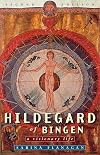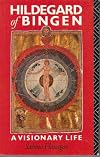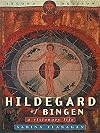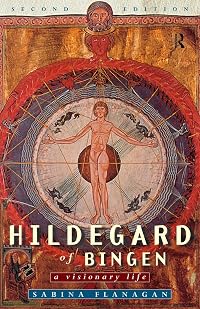
Hildegard of Bingen: A Visionary Life
by Sabina Flanagan
On This Page
Description
Drawing on contemporary sources, the text unfolds Hildegard's life from the time of her entrance into an anchoress's cell--where a woman would remain in pious isolation--to her death as a famed visionary and writer, abbess and confidante of popes and kings, more than seventy years later. Against this background the author explores Hildegard's vast creative work, encompassing theology, medicine, natural history, poetry, and music.Tags
Recommendations








Member Reviews
Whether you believe Hildegard was a prophetess, diviner or simply a nun suffering from an unexplained illness, the moment she dictated her visions and pen was put to paper, the Christian world has never stopped analyzing them.
"Hildegard of Bingen" by Flanagan is, disappointingly, not a biography. Yes, Flanagan gives "an account of what she wrote" - albeit not in chronological order - but fails in explaining "how Hildegard did it." Flanagan does not explore Benedictine monasticism, Hildegard's eagerness to educate and tour, her pride, the community of women she was raised by, or her dear friendships and personal losses. Anything regarding her flawed humanity is only briefly mentioned or neglected. I also noticed factual errors: "...an show more emergency confession or baptism can be performed by laymen or lay women." This was only allowed two centuries later, during the Black Death, and then was rescinded by the papacy. It's a solid literary study of Hildegard's works, but not a "visionary life."
Hildegard was unique, and ahead of her time, and I can respect her curiosity. Psychology teaches us that the brain can insert memories due to outside influence or trauma. A reclusive, elitist, Christian context is all she knew, and one cannot blame her for forcing these elaborate visions to fit this mold. Writing was probably therapeutic, and she was aware that privilege allowed her to ask questions and pursue a life beyond patriarchal expectations. Hildegard, regardless of religious beliefs, is a fascinating person! show less
"Hildegard of Bingen" by Flanagan is, disappointingly, not a biography. Yes, Flanagan gives "an account of what she wrote" - albeit not in chronological order - but fails in explaining "how Hildegard did it." Flanagan does not explore Benedictine monasticism, Hildegard's eagerness to educate and tour, her pride, the community of women she was raised by, or her dear friendships and personal losses. Anything regarding her flawed humanity is only briefly mentioned or neglected. I also noticed factual errors: "...an show more emergency confession or baptism can be performed by laymen or lay women." This was only allowed two centuries later, during the Black Death, and then was rescinded by the papacy. It's a solid literary study of Hildegard's works, but not a "visionary life."
Hildegard was unique, and ahead of her time, and I can respect her curiosity. Psychology teaches us that the brain can insert memories due to outside influence or trauma. A reclusive, elitist, Christian context is all she knew, and one cannot blame her for forcing these elaborate visions to fit this mold. Writing was probably therapeutic, and she was aware that privilege allowed her to ask questions and pursue a life beyond patriarchal expectations. Hildegard, regardless of religious beliefs, is a fascinating person! show less
Ratings
Members
- Recently Added By
Lists

Nonordinary States of Consciousness
184 works; 7 members

The Essential Western Mystics
66 works; 4 members

In Our Time books
4,934 works; 2 members
Author Information
3+ Works 311 Members
Sabina Flanagan is a Visiting Research Fellow in History at the University of Adelaide.
Common Knowledge
- People/Characters
- Hildegard of Bingen
- Important places
- Disibodenberg, Rhineland-Palatinate, Germany; Rupertsberg, Bingen am Rhein, Rhineland-Palatinate, Germany
- Epigraph
- When Henry, fourth of that name, ruled the Holy Roman Empire, there lived in hither Gaul a virgin famed equally for the nobility of her birth and her sanctity. Her name was Hildegard. Her parents, Hildebert and Mechthilde, al... (show all)though wealthy and engaged in worldly affairs, were not unmindful of the gifts of the Creator and dedicated their daughter to the service of God. For when she was yet a child she seemed far removed from worldly concerns, distanced by a precocious purity. (Vita, Bk 1)
- First words
- This is how Godrey, a monk from Disibodenberg who acted as Hildegard's secretary and provost to the nuns at Rupertsberg, introduces his subject in the first book of his Vita Sanctae Hildegardis (Life of St Hildegard).
- Last words
- (Click to show. Warning: May contain spoilers.)Yet aspects of Hildegard's thought have contributed to a broader and more enduring stream of speculation about the interrelations of divinity, humanity, and the natural world.
Classifications
- Genres
- Nonfiction, Religion & Spirituality, Biography & Memoir, History, General Nonfiction
- DDC/MDS
- 282.092 — Religion Christian denominations Roman Catholic Church Catholic Biography And History Biography
- LCC
- BX4700 .H5 .F54 — Philosophy, Psychology and Religion Christian Denominations Christian Denominations Catholic Church Biography and portraits Individual Saints
- BISAC
Statistics
- Members
- 307
- Popularity
- 104,517
- Reviews
- 1
- Rating
- (3.73)
- Languages
- English
- Media
- Paper, Ebook
- ISBNs
- 9
- ASINs
- 4