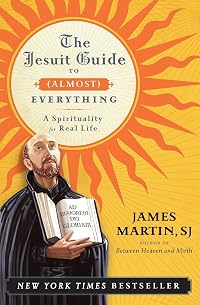
The Jesuit Guide to (Almost) Everything
by James Martin
On This Page
Description
The Jesuit Guide to (Almost) Everything by the Revered James Martin, SJ (My Life with the Saints) is a practical spiritual guidebook based on the life and teachings of St. Ignatius of Loyola, the founder of the Society of Jesus. Centered around the Ignatian goal of "finding God in all things," The Jesuit Guide to Almost Everything shows us how to manage relationships, money, work, prayer, and decision-making, all while keeping a sense of humor. Filled with user-friendly examples, humorous show more stories, and anecdotes from the heroic and inspiring lives of Jesuit saints and average priests and brothers, The Jesuit Guide to Almost Everything is sure to appeal to fans of Kathleen Norris, Richard Rohr, Anne Lamott, and other Christian Spiritual writers. show lessTags
Recommendations







Member Reviews
This is not a Jesuit guide to almost everything. It is a Jesuit guide to worshipping, written for people who are already practicing Catholics. In other words: preachy as balls.
You may ask, why was I surprised by this? Well, I bought the book after seeing Martin on the Colbert Report, where he came across as down-to-earth, thoughtful, and accepting. So I expected his book to be like In the Spirit of Happiness, by the monks of New Skete, which, although written by people who believe very passionately in a faith I don't share, is loving, useful, and doesn't proselytize. The monks are in fact very explicit about how their book is not designed to convert anyone or claim that any faith, or lack thereof, is better than another. It's utterly show more charming (with one unfortunate digression into abortion politics, but that is used as a discussion point for forgiveness, as opposed to Martin's stance on abortion, which he mentions gratuitously in the middle of a passage about something else entirely).
Martin comes right out in the beginning and says he only wants atheists or agnostics to read his book if it converts them. Frankly, if that's your aim, you should start with the real-life applications of the Jesuit principles and do the hard-core prayer bits in the second half. Martin starts with the prayer rituals, and the result is that for 170 pages the book's dry, pedantic, and dictatorial. I pushed through out of sheer stubbornness, and because the inserted quotes on many of the pages, from past Jesuits and/or poets (a lot of Gerard Manley Hopkins), pleased me aesthetically. I don't think you could pray a better prayer than Hopkins' "send my roots rain".
The second half is better, albeit still proselytizing. In that half Martin talks about the real-life applications of poverty, chastity, and obedience. I actually liked his chapter on chastity: even if he's heavy-handed about how the only acceptable sex life is within a marriage, he is insightful about how our society devalues the love in non-sexual relationships, because so many of us (especially women) are taught that the only way to show love is to engage in sex, and that the only value our love has is in its sexual expression. It was refreshing to hear someone honoring the love between friends.
Unfortunately, other than in that chapter, I felt that this book was actively hostile toward me, and towards anyone who isn't already sure of their Catholicism and doesn't already attend services regularly: there was no advice about finding a church which suits you, or incorporating religion into a life which didn't previously include it. It didn't honor any divergent beliefs, it didn't offer any way to use Jesuit teachings in your life without converting full-bore, and for all Martin's emphasis on "God meets you where you are," I came out of it feeling that Martin's God thinks I am not anywhere near the right place. I got the impression that if I sat down with Martin to talk theology and life choices I would get judged up one side and down the other. Again, to contrast with the monks of New Skete: I periodically return to In the Spirit of Happiness and always find something I can apply to my actual life and be more peaceful for it, and I'm often very tempted by the idea of a retreat at their monastery (or the adjoining convent). Disappointing. (Though not surprising that I identify more with Franciscans who raise dogs.) show less
You may ask, why was I surprised by this? Well, I bought the book after seeing Martin on the Colbert Report, where he came across as down-to-earth, thoughtful, and accepting. So I expected his book to be like In the Spirit of Happiness, by the monks of New Skete, which, although written by people who believe very passionately in a faith I don't share, is loving, useful, and doesn't proselytize. The monks are in fact very explicit about how their book is not designed to convert anyone or claim that any faith, or lack thereof, is better than another. It's utterly show more charming (with one unfortunate digression into abortion politics, but that is used as a discussion point for forgiveness, as opposed to Martin's stance on abortion, which he mentions gratuitously in the middle of a passage about something else entirely).
Martin comes right out in the beginning and says he only wants atheists or agnostics to read his book if it converts them. Frankly, if that's your aim, you should start with the real-life applications of the Jesuit principles and do the hard-core prayer bits in the second half. Martin starts with the prayer rituals, and the result is that for 170 pages the book's dry, pedantic, and dictatorial. I pushed through out of sheer stubbornness, and because the inserted quotes on many of the pages, from past Jesuits and/or poets (a lot of Gerard Manley Hopkins), pleased me aesthetically. I don't think you could pray a better prayer than Hopkins' "send my roots rain".
The second half is better, albeit still proselytizing. In that half Martin talks about the real-life applications of poverty, chastity, and obedience. I actually liked his chapter on chastity: even if he's heavy-handed about how the only acceptable sex life is within a marriage, he is insightful about how our society devalues the love in non-sexual relationships, because so many of us (especially women) are taught that the only way to show love is to engage in sex, and that the only value our love has is in its sexual expression. It was refreshing to hear someone honoring the love between friends.
Unfortunately, other than in that chapter, I felt that this book was actively hostile toward me, and towards anyone who isn't already sure of their Catholicism and doesn't already attend services regularly: there was no advice about finding a church which suits you, or incorporating religion into a life which didn't previously include it. It didn't honor any divergent beliefs, it didn't offer any way to use Jesuit teachings in your life without converting full-bore, and for all Martin's emphasis on "God meets you where you are," I came out of it feeling that Martin's God thinks I am not anywhere near the right place. I got the impression that if I sat down with Martin to talk theology and life choices I would get judged up one side and down the other. Again, to contrast with the monks of New Skete: I periodically return to In the Spirit of Happiness and always find something I can apply to my actual life and be more peaceful for it, and I'm often very tempted by the idea of a retreat at their monastery (or the adjoining convent). Disappointing. (Though not surprising that I identify more with Franciscans who raise dogs.) show less
After eleven years spent at Jesuit schools (high school, undergrad, grad school), I thought I had a good grasp on what Ignatian Spirituality consisted of and what the particular charism of the Jesuits was all about. Wrong! Fr. James Martin, once again, has written a gem of a book that is a welcome addition to the canon of contemporary texts of spirituality. In short, I loved this book and will keep it close by for easy reference.
Almost fifteen years ago, at my high school freshman orientation, I was first introduced to the Society of Jesus and Ignatian Spirituality. Two 10-page brochures provided me a quick background on Ignatius of Loyola, Jesuit education, and Ignatian Spirituality. In the years that followed, in undergrad and grad show more school, my exposure to "the way of Ignatius" stemmed from retreats, community service projects, campus ministry, and liturgies. None of those things, I know now, even began to scratch the surface.
Ignatian Spirituality is a rich tradition in the Catholic Church. Fr. Martin has done an exceptional job of putting all the main points of Ignatian Spirituality into a very accessible book. With humor and personal examples, Fr. Martin easily takes us from the examen to other contemplative forms of prayer, to the Ignatian method of decision making, to discussion of work and vocation. He starts off with a brief history of the Jesuits and includes stories, of some well-known and not-so-well-known Jesuits, that help readers better understand how Ignatian Spirituality can be put to work in our daily lives. More importantly, Fr. Martin challenges us in every chapter to change the way we think about faith, about God, and about who we are.
What I most appreciate about Fr. Martin's writings is that he's writing for the rest of us--everyday people with busy lives, careers, and all sorts of pressures. As a former GE executive, Martin knows the ups and downs of corporate culture along with the career pressures involved. From beginning to end, Martin takes into account as many aspects of our daily lives as possible--relationships, careers, doubts, fears, difficult decisions, etc. In his chapter on prayer, Martin presents various forms of Ignatian prayer and contemplation while acknowledging the difficulties our culture poses. How can we make time for prayer in our busy lives? How can we focus? Martin reminds us that all relationships need nurturing from both sides and prayer is a way of continuing to nurture our relationship with God. In this chapter he reminds us (or introduces us...depending on your background) to styles of prayers such as contemplation, lectio divina, the examen, and the Spiritual Exercises.
It is hard for me to pick just one chapter to highlight here. I found nuggets of wisdom and insight on every page. The chapters on friendship, discernment, Ignatian vows (obedience, poverty, chastity), and vocation were particularly helpful for where I am in my life at present. The chapters on Ignatian decision-making methods have helped me to think of new ways to approaching problems. Ignatius' suggestion to approach a problem with indifference is, perhaps, the most helpful piece of advice I've come across in a long time. So far, I've shared Ignatian decision-making techniques with two friends of mine as they approach a major life-altering decision. Fr. Martin reminds the reader that any decision should include God...something I, too often, forget under stress.
The final chapters on being who you are and vocation/career spoke to me in ways I can't explain. Being six years out of undergrad and one month out of grad school, I'm looking for my next step in life. A few months ago I made the decision to follow my heart and not my head. Unhappy in the workplace, I left to embark on what so far has been a journey with no immediate destination. My heart is pulling me towards a career in education and ministry, but my attempts to find a job in those areas have not gone quite as I had hoped. Fr. Martin provided some valuable insight in this area based on his own experiences at GE, in the Society of Jesus, and with friends and family. There's no doubt that I'll be revisiting those chapters from time to time.
This is a book that I find extremely helpful as it provides a spirituality that is both rich and practical to application in daily life. Ignatian Spirituality is a spirituality that can be practiced at every moment of everyday...following Ignatius' call to "find God in all things." The Jesuit Guide to (Almost) Everything is chock full of quotes and lessons that inspire and get one to reflect. Fr. Martin has written an awesome intro to Ignatian spirituality--helpful for Catholics, other Christians, and even people from non-Christian traditions that would like to apply Ignatian ideals into their lives.
I truly believe that this should be required reading at Jesuit schools...if not all of it then definitely a few chapters. A senior at a Jesuit university (or any university) would find this book helpful as they continue to make the transition to adulthood. If you're looking for a full history of the Society of Jesus this book is not for you, but Fr. Martin has some recommendations at the end of the book for further reading. Overall 5 out of 5 stars for this book. Don't go to the library. Buy it. I can guarantee it's a book you'll bookmark, highlight, and flip through again and again. I know I will. Bravo, Fr. Martin!
Review above taken from my blog post: http://throughaglassonion.com/2010/06/22/the-jesuit-guide-to-almost-everything-a... show less
Almost fifteen years ago, at my high school freshman orientation, I was first introduced to the Society of Jesus and Ignatian Spirituality. Two 10-page brochures provided me a quick background on Ignatius of Loyola, Jesuit education, and Ignatian Spirituality. In the years that followed, in undergrad and grad show more school, my exposure to "the way of Ignatius" stemmed from retreats, community service projects, campus ministry, and liturgies. None of those things, I know now, even began to scratch the surface.
Ignatian Spirituality is a rich tradition in the Catholic Church. Fr. Martin has done an exceptional job of putting all the main points of Ignatian Spirituality into a very accessible book. With humor and personal examples, Fr. Martin easily takes us from the examen to other contemplative forms of prayer, to the Ignatian method of decision making, to discussion of work and vocation. He starts off with a brief history of the Jesuits and includes stories, of some well-known and not-so-well-known Jesuits, that help readers better understand how Ignatian Spirituality can be put to work in our daily lives. More importantly, Fr. Martin challenges us in every chapter to change the way we think about faith, about God, and about who we are.
What I most appreciate about Fr. Martin's writings is that he's writing for the rest of us--everyday people with busy lives, careers, and all sorts of pressures. As a former GE executive, Martin knows the ups and downs of corporate culture along with the career pressures involved. From beginning to end, Martin takes into account as many aspects of our daily lives as possible--relationships, careers, doubts, fears, difficult decisions, etc. In his chapter on prayer, Martin presents various forms of Ignatian prayer and contemplation while acknowledging the difficulties our culture poses. How can we make time for prayer in our busy lives? How can we focus? Martin reminds us that all relationships need nurturing from both sides and prayer is a way of continuing to nurture our relationship with God. In this chapter he reminds us (or introduces us...depending on your background) to styles of prayers such as contemplation, lectio divina, the examen, and the Spiritual Exercises.
It is hard for me to pick just one chapter to highlight here. I found nuggets of wisdom and insight on every page. The chapters on friendship, discernment, Ignatian vows (obedience, poverty, chastity), and vocation were particularly helpful for where I am in my life at present. The chapters on Ignatian decision-making methods have helped me to think of new ways to approaching problems. Ignatius' suggestion to approach a problem with indifference is, perhaps, the most helpful piece of advice I've come across in a long time. So far, I've shared Ignatian decision-making techniques with two friends of mine as they approach a major life-altering decision. Fr. Martin reminds the reader that any decision should include God...something I, too often, forget under stress.
The final chapters on being who you are and vocation/career spoke to me in ways I can't explain. Being six years out of undergrad and one month out of grad school, I'm looking for my next step in life. A few months ago I made the decision to follow my heart and not my head. Unhappy in the workplace, I left to embark on what so far has been a journey with no immediate destination. My heart is pulling me towards a career in education and ministry, but my attempts to find a job in those areas have not gone quite as I had hoped. Fr. Martin provided some valuable insight in this area based on his own experiences at GE, in the Society of Jesus, and with friends and family. There's no doubt that I'll be revisiting those chapters from time to time.
This is a book that I find extremely helpful as it provides a spirituality that is both rich and practical to application in daily life. Ignatian Spirituality is a spirituality that can be practiced at every moment of everyday...following Ignatius' call to "find God in all things." The Jesuit Guide to (Almost) Everything is chock full of quotes and lessons that inspire and get one to reflect. Fr. Martin has written an awesome intro to Ignatian spirituality--helpful for Catholics, other Christians, and even people from non-Christian traditions that would like to apply Ignatian ideals into their lives.
I truly believe that this should be required reading at Jesuit schools...if not all of it then definitely a few chapters. A senior at a Jesuit university (or any university) would find this book helpful as they continue to make the transition to adulthood. If you're looking for a full history of the Society of Jesus this book is not for you, but Fr. Martin has some recommendations at the end of the book for further reading. Overall 5 out of 5 stars for this book. Don't go to the library. Buy it. I can guarantee it's a book you'll bookmark, highlight, and flip through again and again. I know I will. Bravo, Fr. Martin!
Review above taken from my blog post: http://throughaglassonion.com/2010/06/22/the-jesuit-guide-to-almost-everything-a... show less
An absolutely wonderful book! The only thing I would change is the repetitive description of Jesuit characteristics. I think if I didn't already know about the order, this might turn me off a bit.
The new pope is from the Americas, but I think the bigger story is that the new pope is from the Jesuits. Rev. Martin has been a TV talking head during the conclave but doesn't address the papacy here. His book is about the Jesuit worldview, and he does fill in some gaps in a Catholic upbringing supervised by two parents from Marquette. St. Ignatius' use of reason and imagination is distinctly modern and Zen-like in this telling. Martin makes his best case for poverty and chastity, but he's more likely to attract converts with suggestions on how to cultivate friends and handle setbacks. When packing for Mom's move I flipped through my father's prayer book from the Jesuit Retreat House on Lake Winnebago, then put the missal in the show more giveaway pile. Probably the Jesuit thing to do. Then I downloaded the breviary app. Not checking it as frequently as Twitter but there's hope for me yet. show less
I'm not Catholic and not religious, but I saw the author on the Colbert Report and had to have this book. The author does come down to the ultimate goal being a relationship with God, but he does a good job of making the book accessible to those with different beliefs. It gave me a lot to think about in how I live my life.
Founded in 1534 by Saint Ignatius of Loyola, the Jesuit order of priests takes a practical approach to spirituality, one in which every aspect of life is seen as touched by God. In this book, Jesuit priest James Martin explains how we can see God in every aspect of our lives. He touches on different disciplines, such as the daily examen, a brief reflection on the day, that can help us gain perspective. He also discusses how certain Jesuit commitments, such as those to obedience and yes, celibacy, can be relevant even to those of us who haven’t taken those vows. There’s helpful discussion on how our desires can inform our decision-making and the notion of vocation. In one way or another, Martin touches on virtually every aspect of show more life.
One thing that impressed me about this book is how flexible Martin’s version of Ignatian spirituality is. For example, when discussing the examen, Martin explains the five steps as presented by Ignatius and then shares several adaptations that others have made. He then encourages readers to experiment to find what pattern works best for them. In his chapter on different paths people take to God, Martin shows that he clearly understands that not everyone has the same spiritual needs, and he present lots of different examples to illustrate how people live by the ideas he discusses.
Through dipping into his own past, telling stories of Jesuits throughout history, and recounting anecdotes from other Christians of his acquaintance, Martin shows the great variety of religious experiences people may have. He even goes so far as to say that many Ignatian practices would be of value to non-Christians (and no doubt many non-Christians practice some variation of the examen or the Ignatian approach to decision-making).
I wouldn’t say that I learned a lot that was new in this book. It was more of a book that put into words some of the thoughts I’ve had in the back of my mind for years. I did gain some ideas for habits I’d like to develop and a little push toward pursuing my own spiritual growth more purposefully. There were some times when it seemed a little too self-helpy, and it could have done with some trimming. Although Martin takes some pains to be religiously inclusive, I’m not sure that this book would offer much to someone who isn’t interested in specifically Christian spirituality. I think the best audience for this book would be those who are new to the Christian faith and those who are newly trying to make their faith something more than just church on Sunday.
See my complete review on Shelf Love. show less
One thing that impressed me about this book is how flexible Martin’s version of Ignatian spirituality is. For example, when discussing the examen, Martin explains the five steps as presented by Ignatius and then shares several adaptations that others have made. He then encourages readers to experiment to find what pattern works best for them. In his chapter on different paths people take to God, Martin shows that he clearly understands that not everyone has the same spiritual needs, and he present lots of different examples to illustrate how people live by the ideas he discusses.
Through dipping into his own past, telling stories of Jesuits throughout history, and recounting anecdotes from other Christians of his acquaintance, Martin shows the great variety of religious experiences people may have. He even goes so far as to say that many Ignatian practices would be of value to non-Christians (and no doubt many non-Christians practice some variation of the examen or the Ignatian approach to decision-making).
I wouldn’t say that I learned a lot that was new in this book. It was more of a book that put into words some of the thoughts I’ve had in the back of my mind for years. I did gain some ideas for habits I’d like to develop and a little push toward pursuing my own spiritual growth more purposefully. There were some times when it seemed a little too self-helpy, and it could have done with some trimming. Although Martin takes some pains to be religiously inclusive, I’m not sure that this book would offer much to someone who isn’t interested in specifically Christian spirituality. I think the best audience for this book would be those who are new to the Christian faith and those who are newly trying to make their faith something more than just church on Sunday.
See my complete review on Shelf Love. show less
Father Martin's voice is friendly and compassionate as he guides the reader through different aspects of Jesuit spirituality and its application for seekers, regardless of their backgrounds. He talks a lot about Jesuit history too, which I thought was fascinating.
I'm glad I bought this one. There's a lot of wisdom within, and I'm sure I'll want to refer back to it.
I'm glad I bought this one. There's a lot of wisdom within, and I'm sure I'll want to refer back to it.
Members
- Recently Added By
Published Reviews
The Rev. James Martin, a Jesuit priest and associate editor of America, the Jesuit magazine — and a very funny, and fine man — has written a new book for those interested in borrowing from Jesuit tenets to live simpler lives. It's called The Jesuit Guide to Almost Everything: A Spirituality for Real Life.
added by bongiovi
He writes in The Jesuit Guide that "within the Christian tradition, all spiritualities, no matter what their origins, have the same focus — the desire for union with God, an emphasis on love and charity, and a belief in Jesus as the Son of God."
added by bongiovi
Author Information

28+ Works 4,818 Members
Rev. James Martin, SJ, is editor at large of America magazine, consultor to the Vatican's Dicastery for Communication, and author of the New York Times bestsellers Jesus: A Pilgrimage and The Jesuit Guide to (Almost) Everything. Father Martin is a frequent media commentator, having appeared on such diverse outlets as The Late Show with Stephen show more Colbert, Fresh Air, the New York Times, and The Wall Street Journal. show less
Some Editions
Awards and Honors
Awards
Distinctions
Common Knowledge
- Canonical title
- The Jesuit Guide to (Almost) Everything (Almost)
- Original publication date
- 2010-03-01
- Dedication
- Fratribus carissimis in Societate Jesu (To my very dear brothers in the Society of Jesus)
- First words
- Who is St. Ignatius Loyola, and why should you care?
- Publisher's editor
- Freet, Roger; Holland, Carolyn; Jeffreys, Mary Ann
- Blurbers
- Hansen, Ron; Norris, Kathleen; Barry, William A.; O'Malley, Sean; Prejean, Helen; Allen, John L., Jr. (show all 19); Rolheiser, Ronald; Radcliffe, Timothy; Rohr, Richard; Cunningham, Lawrence S.; Silf, Margaret; O'Malley, John W.; Foley, John; Rupp, Joyce; Gibson, David; Conroy, Maureen; Padberg, John W.; Ellsberg, Robert; Lamott, Anne
Classifications
- Genres
- Religion & Spirituality, Nonfiction, General Nonfiction
- DDC/MDS
- 248.482 — Religion Christian practice & observance Christian experience, practice, life Christian Living By Denomination Catholic
- LCC
- BX2350.3 .M265 — Philosophy, Psychology and Religion Christian Denominations Christian Denominations Catholic Church Practical religion. Christian life
- BISAC
Statistics
- Members
- 1,141
- Popularity
- 22,230
- Reviews
- 23
- Rating
- (4.18)
- Languages
- 5 — Czech, English, French, Italian, Norwegian
- Media
- Paper, Audiobook, Ebook
- ISBNs
- 9
- ASINs
- 7