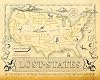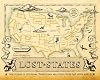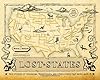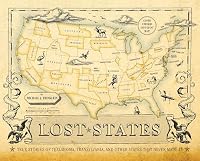
Lost States
by Michael J. Trinklein
On This Page
Description
The history of proposed states which were never granted statehood.Tags
Recommendations






















Member Reviews
I greatly enjoyed this alternate-history look at the U.S. States that might have been. Interesting historical snapshots, topped off with a healthy dose of dry wit, make this book a delight from start to finish.
Who wants to live in the breakaway territory of Nataqua? Apparently no women did, so it failed to acquire the population necessary for statehood. Anyone favor living in “Transylvania”? It was a failed state, in what would later become Kentucky, proposed by Daniel Boone. How about the state known as “Chicago”? You read that last sentence right, the great city of “Chicago” once had aspirations of becoming its’ own state. This was mostly born out of anger at not having enough representation in the state government (being outvoted by farmers makes one think of revolution). This book is full of many more cases of states, some crazy (like Boston as a city-state) and others rather logical (such as a better division of Idaho, show more Washington and Oregon) as well as the details behind the division of the Dakotas, the reoccurring attempts at New Jersey and Maine divisions and the desires of Long Island to separate from New York and become its own state. “Lost States” is a walk down the popular Historic Lane of What Might-Have-Been. It is a series of engaging, interesting, funny and surprising tales, all contained within a book less than 200 pages long. Each “failed state” has the pertinent details behind its creation attempt described and also includes either a map of the period with the state on it, or one of the author’s own creation. These short little snippets of our forgotten history help to illustrate the parts, politics, population, foreign policy, state and federal governments, environment, human temperament and sheer randomness played in the creation of the country we know today as the “United States of America”. show less
Who wants to live in the breakaway territory of Nataqua? Apparently no women did, so it failed to acquire the population necessary for statehood. Anyone favor living in “Transylvania”? It was a failed state, in what would later become Kentucky, proposed by Daniel Boone. How about the state known as “Chicago”? You read that last sentence right, the great city of “Chicago” once had aspirations of becoming its’ own state. This was mostly born out of anger at not having enough representation in the state government (being outvoted by farmers makes one think of revolution). This book is full of many more cases of states, some crazy (like Boston as a city-state) and others rather logical (such as a better division of Idaho, show more Washington and Oregon) as well as the details behind the division of the Dakotas, the reoccurring attempts at New Jersey and Maine divisions and the desires of Long Island to separate from New York and become its own state. “Lost States” is a walk down the popular Historic Lane of What Might-Have-Been. It is a series of engaging, interesting, funny and surprising tales, all contained within a book less than 200 pages long. Each “failed state” has the pertinent details behind its creation attempt described and also includes either a map of the period with the state on it, or one of the author’s own creation. These short little snippets of our forgotten history help to illustrate the parts, politics, population, foreign policy, state and federal governments, environment, human temperament and sheer randomness played in the creation of the country we know today as the “United States of America”. show less
Who wants to live in the breakaway territory of Nataqua? Apparently no women did, so it failed to acquire the population necessary for statehood. Anyone favor living in “Transylvania”? It was a failed state, in what would later become Kentucky, proposed by Daniel Boone. How about the state known as “Chicago”? You read that last sentence right, the great city of “Chicago” once had aspirations of becoming its’ own state. This was mostly born out of anger at not having enough representation in the state government (being outvoted by farmers makes one think of revolution). This book is full of many more cases of states, some crazy (like Boston as a city-state) and others rather logical (such as a better division of Idaho, show more Washington and Oregon) as well as the details behind the division of the Dakotas, the reoccurring attempts at New Jersey and Maine divisions and the desires of Long Island to separate from New York and become its own state. “Lost States” is a walk down the popular Historic Lane of What Might-Have-Been. It is a series of engaging, interesting, funny and surprising tales, all contained within a book less than 200 pages long. Each “failed state” has the pertinent details behind its creation attempt described and also includes either a map of the period with the state on it, or one of the author’s own creation. These short little snippets of our forgotten history help to illustrate the parts, politics, population, foreign policy, state and federal governments, environment, human temperament and sheer randomness played in the creation of the country we know today as the “United States of America”. show less
Michael Trinklein's very amusing Lost States: True Stories of Texlahoma, Transylvania, and other States that Never Made It (Quirk Books, 2010) profiles a bunch of states that might have been, complete with contextual maps, short explantations, and entertaining tidbits aboout the proposals.
Many of the "lost states" fall into one of several types: territories which the U.S. either controls now or controlled at one time, separatist movements within existing states, different plans for boundaries of existing states (basically different ways to slice up territories), or far-fetched schemes to annex all or parts of other countries (there are entries here for Albania, Great Britain, Guyana, and Taiwan, for example).
While I'm not sure I would show more have included a few of these, Trinklein makes a good case for each, and I really liked the maps he designed for them (also, the dust jacket unfolds into a poster-sized map, if you're into that sort of thing). The tone is light, and that's perfectly okay.
Quirky, and great fun.
http://philobiblos.blogspot.com/2011/09/book-review-lost-states.html show less
Many of the "lost states" fall into one of several types: territories which the U.S. either controls now or controlled at one time, separatist movements within existing states, different plans for boundaries of existing states (basically different ways to slice up territories), or far-fetched schemes to annex all or parts of other countries (there are entries here for Albania, Great Britain, Guyana, and Taiwan, for example).
While I'm not sure I would show more have included a few of these, Trinklein makes a good case for each, and I really liked the maps he designed for them (also, the dust jacket unfolds into a poster-sized map, if you're into that sort of thing). The tone is light, and that's perfectly okay.
Quirky, and great fun.
http://philobiblos.blogspot.com/2011/09/book-review-lost-states.html show less
This is a book that breathes life into both American History and Geography. Had it been around before, schools might still be teaching Geography as a subject because the author not only entertains us with the human foibles that fed the process of determining which domestic and foreign territories became states, he also gives us insight into how the process works and why it sometimes doesn't. He connects the past to the present with a sense of humor that makes it easier for us to look at our current areas of contentions with a less ominous perspective. That is a gift only a talented historian can give: the ability to draw from the past to enlighten the present and perhaps guide the future.
I found it fascinating to see the parallels in show more time and place. Many of the same geographic areas that are calling for secession now were calling for it then. Could it be that the spirit of those early zealots lives on in the spirit of the place or is it just in-breeding? Just when I am becoming dismayed at the contentiousness of the current political climate, this book reminds me that contention and discord is nothing new. That is power of captivating historical commentary: to give us perspective, to remind us of past mistakes so we might avoid repeating them, to allow us to see lessons never learned and learn from the mere study of them.
I was surprised to learn that there have been so many cities and states that have tried to secede so often and so recently. There were stories of politicians pressing for secession that have only recently left the national stage. It was no surprise to see how racism and religious fanaticism played such key roles in determining where and why to draw boundaries. However, I was encouraged to see that the majority of our leaders applied thoughtful, reasonable standards as to how and when an area would be admitted into the union: population density, urban vs. rural balance, ability of the area to sustain commerce or agriculture, as well as other rational criteria.
This book also gives us the unofficial rules for naming states along with stories as to how many of the state names came into being. Reading of the fads, trends, and political motives for naming a state made for delightful reading.
This book can be read quickly, but I would recommend against it. There is a hidden depth that, if mined, gives you delightful gems of fact and commentary that make a slower and more thoughtful read of the book worthwhile. I look forward to more from this author.
I thoroughly enjoyed this book and will be recommending to everyone I know because not only is it an informative and entertaining read, it well presented. The publisher has treated the material with respect and enhanced the text with good quality paper, pleasant and easily legible fonts, wonderful maps, and a dust cover that is not only printed on durable paper but also folds out into a map. The entire experience: content, artistic presentation, and the cover combine to make this a book you will be proud to have visible for guests and will find yourself reaching for time and time again to share anecdotes from its pages with anyone who sits still long enough to listen. show less
I found it fascinating to see the parallels in show more time and place. Many of the same geographic areas that are calling for secession now were calling for it then. Could it be that the spirit of those early zealots lives on in the spirit of the place or is it just in-breeding? Just when I am becoming dismayed at the contentiousness of the current political climate, this book reminds me that contention and discord is nothing new. That is power of captivating historical commentary: to give us perspective, to remind us of past mistakes so we might avoid repeating them, to allow us to see lessons never learned and learn from the mere study of them.
I was surprised to learn that there have been so many cities and states that have tried to secede so often and so recently. There were stories of politicians pressing for secession that have only recently left the national stage. It was no surprise to see how racism and religious fanaticism played such key roles in determining where and why to draw boundaries. However, I was encouraged to see that the majority of our leaders applied thoughtful, reasonable standards as to how and when an area would be admitted into the union: population density, urban vs. rural balance, ability of the area to sustain commerce or agriculture, as well as other rational criteria.
This book also gives us the unofficial rules for naming states along with stories as to how many of the state names came into being. Reading of the fads, trends, and political motives for naming a state made for delightful reading.
This book can be read quickly, but I would recommend against it. There is a hidden depth that, if mined, gives you delightful gems of fact and commentary that make a slower and more thoughtful read of the book worthwhile. I look forward to more from this author.
I thoroughly enjoyed this book and will be recommending to everyone I know because not only is it an informative and entertaining read, it well presented. The publisher has treated the material with respect and enhanced the text with good quality paper, pleasant and easily legible fonts, wonderful maps, and a dust cover that is not only printed on durable paper but also folds out into a map. The entire experience: content, artistic presentation, and the cover combine to make this a book you will be proud to have visible for guests and will find yourself reaching for time and time again to share anecdotes from its pages with anyone who sits still long enough to listen. show less
 This review was written for LibraryThing Early Reviewers.
This is an adorable book. It’s designed to be enjoyed in bits and pieces; each unrealized state is allotted two pages – one for three columns of text and one for an illustrated map. The trim size allows Trinklein to include sizable maps without requiring any turning of the book, and for a larger font and chapter heading, which makes the text even more inviting. Trinklein presents the book as a conversation, inviting the reader to stop by for a few minutes of interesting trivia, with no pressure to stay. It’s clear he had fun researching and writing the book – in his notes about the maps he warns the reader: “Don’t attempt a coup. You will fail. (But if you do, please mention this book as your inspiration. It will probably show more help sales.)” – and his diction only rarely crosses the line from charming to cheesy. I’d definitely recommend this book to anyone. And the cover unfolds into a map! So fun.
(Note: This is not a scholarly book in any way. There aren't any citations, though there is a light bibliography.) show less
(Note: This is not a scholarly book in any way. There aren't any citations, though there is a light bibliography.) show less
This review was written for LibraryThing Early Reviewers.Members
- Recently Added By
Published Reviews
ThingScore 50
Lost States is a quick little jaunt into the possibilities of what might have been had things gone in a slightly different direction. It's informative and fun, and if you're a history nerd, you should totally check it out.
added by cinaedus
Author Information

12+ Works 577 Members
Common Knowledge
- Canonical title
- Lost States
- Original title
- Lost States: True Stories of Texlahoma, Transylvania, and Other States That Never Made It
- Original publication date
- 2010
- Important places
- USA; Montezuma, USA; Navajo, USA; South Texas, USA; Jefferson, USA; South California, USA (show all 54); Deseret, USA; Nataqua, USA; Lost Dakota, USA; Absaroka, USA; Forgottonia, USA; West Kansas, USA; Texlahoma, USA; Sequoyah, USA; McDonald, USA; South Jersey, USA; Potomac, USA; Transylvania, USA; Vandalia, USA; Franklin, USA; Chesapeake, USA; Empire, USA; Lincoln, USA; Superior, USA; West Florida, USA; Acadia, USA; Muskogee, USA; Shasta, USA; Texalahoma, USA; Nickajack, USA; Albania; Alaska, USA; California, USA; Cuba; Connecticut, USA; Florida, USA; Greenland; Howland Island, Pacific Ocean; Kansas, USA; Long Island, New York, USA; Maine, USA; Marshall Islands; Maryland, USA; Michigan, USA; New Jersey, USA; New York, USA; New York, New York, USA; North Dakota, USA; Puerto Rico; Saipan; South Dakota, USA; Taiwan; Utah, USA; Washington, D.C., USA
- Important events
- American Revolution; American Civil War (1861 | 1865)
- Dedication
- For Lynne and Tim, who tolerate my quirks
daily. And my parents, who drove Patti and me
through nearly every state in the union. - Original language
- English
Classifications
Statistics
- Members
- 409
- Popularity
- 75,437
- Reviews
- 56
- Rating
- (3.88)
- Languages
- English
- Media
- Paper, Ebook
- ISBNs
- 3
- ASINs
- 4