
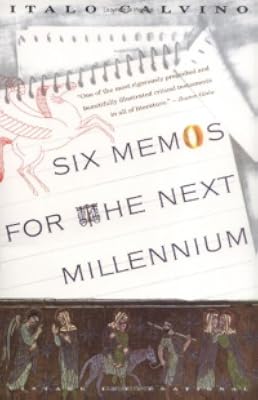
Six Memos for the Next Millennium
by Italo Calvino
On This Page
Description
"At the time of his death, Italo Calvino was at work on six lectures setting forth the qualities in writing he most valued, and which he believed would define literature in the century to come. Here, in Six Memos for the Next Millennium, are the five lectures he completed, forming not only a stirring defense of literature, but also an indispensable guide to the writings of Calvino himself. He devotes one "memo" each to the concepts of lightness, quickness, exactitude, visibility, and show more multiplicity, drawing examples from his vast knowledge of myth, folklore, and works both ancient and modern. Readers will be astonished by the prescience of these lectures, which have only gained in relevance as Calvino's "next millennium" has dawned"-- show lessTags
Recommendations

Member Reviews
I would not be so drastic. I think we are always searching for something hidden or merely potential or hypothetical, following its traces whenever they appear on the surface. I think our basic mental processes have come down to us through every period of history, ever since our Paleolithic forefathers, who were hunters and gatherers. The word connects the visible trace with the invisible thing, the absent thing, the thing that is desired or feared, like a frail emergency bridge flung over an abyss.
Calvino's posthumous lectures are a grand gallop across a cherished earth of letters. The Six Memos For The Next Millennium are a celebration of Lightness, Quickness, Exactitude, Visibility and Multiplicity (the sixth was never written at the show more time of Calvino's passing). The ruminations and citations extend from Ovid and Lucretius onward through Dante, Boccaccio, Shakespeare, Cyrano, Valery, Flaubert, Musil and, especially, Borges. This is a wonderful construction, one without grandiosity, but teeming with an organic eloquence.
Were I to choose an auspicious image for the new millennium, I would choose that one: the sudden agile leap of the poet-philosopher who raises himself above the weight of the world, showing that with all his gravity he ahs the secret of lightness, and that what many consider to be the vitality of the times--noisy, aggressive, revving and roaring--belongs to the realm of death, like a cemetery for rusty old cars. show less
Calvino's posthumous lectures are a grand gallop across a cherished earth of letters. The Six Memos For The Next Millennium are a celebration of Lightness, Quickness, Exactitude, Visibility and Multiplicity (the sixth was never written at the show more time of Calvino's passing). The ruminations and citations extend from Ovid and Lucretius onward through Dante, Boccaccio, Shakespeare, Cyrano, Valery, Flaubert, Musil and, especially, Borges. This is a wonderful construction, one without grandiosity, but teeming with an organic eloquence.
Were I to choose an auspicious image for the new millennium, I would choose that one: the sudden agile leap of the poet-philosopher who raises himself above the weight of the world, showing that with all his gravity he ahs the secret of lightness, and that what many consider to be the vitality of the times--noisy, aggressive, revving and roaring--belongs to the realm of death, like a cemetery for rusty old cars. show less
Calvino's lectures, prepared but not delivered late in his career, are just as thought-provoking as his fiction. He discusses some key, broad aspects of literature, and his personal discoveries of certain propulsive forces in writing. His discussion of Multiplicity I found most interesting, and the way he categorized encyclopedic and plural texts. It will certainly aid your understanding if you are already familiar with Flaubert, Gadda, Balzac, Ovid, Dante, Boccaccio, Shakespeare, Mann, Goethe, Poe, Borges, Calvino, Leopardi, Eliot, Joyce, Perec, da Vinci and more, but familiarity is by no means required for enjoyment. Skillfully, Calvino ropes in the work of all of these authors, outlines their methods in some measure and suggests how show more precisionism or autodidacticism or lightness and suggestion led into the completion or success of the work. By handling a wide range of styles and general approaches, Calvino offers a splendid viewpoint of artistic achievements of the mind.
There are many quotes, especially from the Zibaldone, which could have used some condensation. But it is easy to see how Calvino's own work, such as If On a Winter's Night, Cloven Viscount, Baron in the Trees, Nonexistent Knight, Invisible Cities, Palomar, Cosmicomics and other books, were inspired by literary predecessors, and he even reveals the sparks of intuitive imagination that led to their shape and form. show less
There are many quotes, especially from the Zibaldone, which could have used some condensation. But it is easy to see how Calvino's own work, such as If On a Winter's Night, Cloven Viscount, Baron in the Trees, Nonexistent Knight, Invisible Cities, Palomar, Cosmicomics and other books, were inspired by literary predecessors, and he even reveals the sparks of intuitive imagination that led to their shape and form. show less
In the five essays here (the sixth went unwritten because of the author's death), we are pointed towards a great variety of authors, ancient and modern, whose work exemplified one aspect of artistic value: Lightness, Quickness, Exactitude, Visibility, and Multiplicity. Calvino includes himself in the fifth chapter and it is both sad and fascinating to speculate on what it tells us what direction he might have continued his writing had he lived. It will send a Goodreads member interested in such matters off to seek out the books mentioned.
This book is tiny, but it was thoughtful and engaging and made me want to research about a million other things. My copy is full of notes- books to read, people to research- and left me with a burning desire to someday be as well read as Calvino (wowwowwow). The places this man goes to make his point! Impressive, though admittedly it was hard to keep things straight at times.
Calvino nails it:
"It sometimes seems to me that a pestilence has struck the human race in its most distinctive faculty--that is, the use of words. It is a plague afflicting language, revealing itself as a loss of cognition and immediacy, an automatism that tends to level out all expression into the most generic, anonymous, and abstract formulas, to dilute meanings, to blunt the edge of expressiveness, extinguishing the spark that shoots out from the collision of words and new circumstances.
At this point, I don't wish to dwell on the possible sources of this epidemic, whether they are to be sought in politics, ideology, bureaucratic uniformity, the monotony of mass media, or the way the schools dispense the culture of the mediocre. show more What interests me are the possibilities of health. Literature, and perhaps literature alone, can create the antibodies to fight this plague in language." show less
"It sometimes seems to me that a pestilence has struck the human race in its most distinctive faculty--that is, the use of words. It is a plague afflicting language, revealing itself as a loss of cognition and immediacy, an automatism that tends to level out all expression into the most generic, anonymous, and abstract formulas, to dilute meanings, to blunt the edge of expressiveness, extinguishing the spark that shoots out from the collision of words and new circumstances.
At this point, I don't wish to dwell on the possible sources of this epidemic, whether they are to be sought in politics, ideology, bureaucratic uniformity, the monotony of mass media, or the way the schools dispense the culture of the mediocre. show more What interests me are the possibilities of health. Literature, and perhaps literature alone, can create the antibodies to fight this plague in language." show less
Calvino nails it:
"It sometimes seems to me that a pestilence has struck the human race in its most distinctive faculty--that is, the use of words. It is a plague afflicting language, revealing itself as a loss of cognition and immediacy, an automatism that tends to level out all expression into the most generic, anonymous, and abstract formulas, to dilute meanings, to blunt the edge of expressiveness, extinguishing the spark that shoots out from the collision of words and new circumstances.
At this point, I don't wish to dwell on the possible sources of this epidemic, whether they are to be sought in politics, ideology, bureaucratic uniformity, the monotony of mass media, or the way the schools dispense the culture of the mediocre. show more What interests me are the possibilities of health. Literature, and perhaps literature alone, can create the antibodies to fight this plague in language." show less
"It sometimes seems to me that a pestilence has struck the human race in its most distinctive faculty--that is, the use of words. It is a plague afflicting language, revealing itself as a loss of cognition and immediacy, an automatism that tends to level out all expression into the most generic, anonymous, and abstract formulas, to dilute meanings, to blunt the edge of expressiveness, extinguishing the spark that shoots out from the collision of words and new circumstances.
At this point, I don't wish to dwell on the possible sources of this epidemic, whether they are to be sought in politics, ideology, bureaucratic uniformity, the monotony of mass media, or the way the schools dispense the culture of the mediocre. show more What interests me are the possibilities of health. Literature, and perhaps literature alone, can create the antibodies to fight this plague in language." show less
Een pak droger dan ik verwacht had.
Calvino schreef de lezingen maar overleed net voor hij ze ging geven. Dat draagt waarschijnlijk bij aan de uitstraling van het boek en de lezingen zelf. Calvino probeert 6 essentiële zaken uit literatuur aan te raken (uiteindelijk zijn het er 5, de zesde lezing ging hij ter plaatse schrijven) die moeten meegenomen worden naar het volgende millennium. Zes zaken waarvan hij vindt dat literatuur ze beter kan dan enige andere kunst of communicatievorm.
Ik had de inhoud universeler verwacht en ben dus niet helemaal objectief. Calvino graaft zich en en werpt zo een licht op zijn eigen schrijven en literatuur in het algemeen. Boeiend, en soms erg goed aangetoond, of dan weer verrassende verbanden boven show more gehaald.
Maar soms evenzeer wat te droog of academisch naar mijn zin. (dat ik naar het einde toe passages oversloeg is niet echt een goed teken :) ) show less
Calvino schreef de lezingen maar overleed net voor hij ze ging geven. Dat draagt waarschijnlijk bij aan de uitstraling van het boek en de lezingen zelf. Calvino probeert 6 essentiële zaken uit literatuur aan te raken (uiteindelijk zijn het er 5, de zesde lezing ging hij ter plaatse schrijven) die moeten meegenomen worden naar het volgende millennium. Zes zaken waarvan hij vindt dat literatuur ze beter kan dan enige andere kunst of communicatievorm.
Ik had de inhoud universeler verwacht en ben dus niet helemaal objectief. Calvino graaft zich en en werpt zo een licht op zijn eigen schrijven en literatuur in het algemeen. Boeiend, en soms erg goed aangetoond, of dan weer verrassende verbanden boven show more gehaald.
Maar soms evenzeer wat te droog of academisch naar mijn zin. (dat ik naar het einde toe passages oversloeg is niet echt een goed teken :) ) show less
Members
- Recently Added By
Lists

Italian Literature
556 works; 41 members
Author Information

387+ Works 69,868 Members
Italo Calvino 1923-1984 Novelist and short story writer Italo Calvino was born in Cuba on October 15, 1923, and grew up in Italy, graduating from the University of Turin in 1947. He is remembered for his distinctive style of fables. Much of his first work was political, including Il Sentiero dei Nidi di Ragno (The Path of the Nest Spiders, 1947), show more considered one of the main novels of neorealism. In the 1950s, Calvino began to explore fantasy and myth as extensions of realism. Il Visconte Dimezzato (The Cloven Knight, 1952), concerns a knight split in two in combat who continues to live on as two separates, one good and one bad, deprived of the link which made them a moral whole. In Il Barone Rampante (Baron in the Trees, 1957), a boy takes to the trees to avoid eating snail soup and lives an entire, fulfilled life without ever coming back down. Calvino was awarded an honorary degree from Mount Holyoke College in 1984 and died in 1985, following a cerebral hemorrhage. At the time of his death, he was the most translated contemporary Italian writer and a contender for the Nobel Prize for Literature. (Bowker Author Biography) show less
Some Editions
Series
Belongs to Publisher Series
Common Knowledge
- Canonical title
- Six Memos for the Next Millennium
- Original title
- Lezioni americane: Sei proposte per il prossimo millennio
- Original publication date
- 1988
- First words
- I will devote my first lecture to the opposition between lightness and weight, and will uphold the values of lightness.
- Quotations
- "In an age when other fantastically speedy, widespread media are triumphing, and running the risk of flattening all communication onto a single, homogeneous surface, the function of literature is communication between things ... (show all)that are different simply because they are different, not blunting but even sharpening the differences between them, following the true bent of written language."
"If I prefer writing, it is because I can revise each sentence until I reach the point where-if not exactly satisfied with my words-I am able at least to eliminate those reasons for dissatisfaction that I can put a finger on.... (show all)" - Last words
- (Click to show. Warning: May contain spoilers.)And what Lucretius was aiming at when he identified himself with that nature common to each and every thing?
Classifications
Statistics
- Members
- 2,307
- Popularity
- 8,568
- Reviews
- 19
- Rating
- (4.09)
- Languages
- 21 — Catalan, Czech, Danish, Dutch, English, Estonian, Finnish, French, German, Greek, Hebrew, Hungarian, Italian, Japanese, Norwegian (Bokmål), Polish, Portuguese, Croatian, Spanish, Swedish, Turkish
- Media
- Paper, Audiobook, Ebook
- ISBNs
- 61
- ASINs
- 20