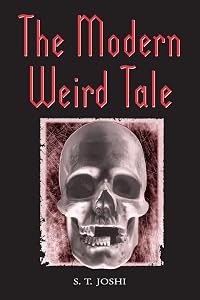
The Modern Weird Tale: A Critique of Horror Fiction
by S. T. Joshi
On This Page
Description
This is a critical study of many of the leading writers of horror and supernatural fiction since World War II. The primary purpose is to establish a canon of weird literature, and to distinguish the genuinely meritorious writers of the past fifty years from those who have obtained merely transient popular renown. Accordingly, the author regards the complex, subtle work of Shirley Jackson, Ramsey Campbell, Robert Aickman, T.E.D. Klein, and Thomas Ligotti as considerably superior to the show more best-sellers of Stephen King, Clive Barker, Peter Straub, and Anne Rice. Other writers such as William Peter Blatty, Thomas Tryon, Robert Bloch, and Thomas Harris are also discussed. Taken as a whole, the volume represents a pioneering attempt to chart the development of weird fiction over the past half-century. show lessTags
Recommendations









Member Reviews
Joshi's follow-up to The Weird Tale. Joshi takes a look at modern authors and their place in what he calls "the weird tradition." Covers more popular genre authors (King, Barker, Rice), lesser known stand outs (Ligotti, Klein, Campbell), and writers who skirt the horror/weird genre (Shirley Jackson, Thomas Harris, Brett Easton Ellis). A little less cohesive than The Weird Tale, since the autohrs covered are more heterogenous.
Joshi is something of an elitist, so it is easy to find fault with some of his reactions, especially to popular authors such as King and Blatty. He is, however, passionate about the field and well read, so his observations are worth reading.
Joshi is something of an elitist, so it is easy to find fault with some of his reactions, especially to popular authors such as King and Blatty. He is, however, passionate about the field and well read, so his observations are worth reading.
Out of the cannon of horror writers since the pulp era (particularly the 50's onward) who can be considered truly "weird"? This is the underlying topic of The Modern Weird Tale by S.T. Joshi, preeminent Lovecraft scholar.
What I learned from Joshi regarding the "weird" authors of the post-Lovecraft/Machen/Blackwood era:
Shirley Jackson,T.E.D. Klein, Ramsey Campbell, Robert Aickman and Thomas Ligotti are class A writers.
Peter Straub, Anne Rice, Clive Barker and Stephen King are shite.
It is clear there is an obvious bias against the best sellers. From the outset, he appears to demarcate those who are the true authors of the weird and who are not. He spends time setting up why certain authors are not considered "weird" and although it was show more entertaining to hear his opinions, I wasn't sure why some were even regarded. It would not occur to me to included Bret Easton Ellis, Thomas Harris and William Peter Blatty in this discussion, more or less the other noted best sellers, but he makes a case for horror to be a subgenre of the weird. I have never known Rice, Straub or even King to claim being weird. Although Barker has been in several weird fiction anthologies, despite a heavy tendency toward his brand of physical/violent horror, his work appears to still reflect that "cosmic-terror" that is clearly Lovecraft-influenced.
Some lines of discussion:
Supernatural vs non supernatural horror. Issues of psychological horror (Bloch vs Campbell). Short story vs novel form. Religious didaticism as a source for themes (Blatty)
Some areas of criticism:
Overused tropes. Derived plots. Depth of characters. Unnecessary sentimentality. Long winded tomes (Hello King!) Motivations and explanations for the appearances/purposes/uses of horror devices in a piece of writing.
I was generally entertained by Joshi's clearly elitist views of Weird writers of the modern age. The inclusion of a bibliography designated with "Primary" vs. "Secondary" works is very beneficial overall. This was for me clearly an introduction to authors I was familiar with and haven't read and an initiation to others. I am excited to seek out works by Klein and Campbell, who despite their sales and low reputation, are lauded by critics as unsung masters of horror. I am most excited to pursue Ligotti's short fiction. Making a judgment only by way of the brief excerpts that were included, I feel I connected with his writing above the rest. show less
What I learned from Joshi regarding the "weird" authors of the post-Lovecraft/Machen/Blackwood era:
Shirley Jackson,T.E.D. Klein, Ramsey Campbell, Robert Aickman and Thomas Ligotti are class A writers.
Peter Straub, Anne Rice, Clive Barker and Stephen King are shite.
It is clear there is an obvious bias against the best sellers. From the outset, he appears to demarcate those who are the true authors of the weird and who are not. He spends time setting up why certain authors are not considered "weird" and although it was show more entertaining to hear his opinions, I wasn't sure why some were even regarded. It would not occur to me to included Bret Easton Ellis, Thomas Harris and William Peter Blatty in this discussion, more or less the other noted best sellers, but he makes a case for horror to be a subgenre of the weird. I have never known Rice, Straub or even King to claim being weird. Although Barker has been in several weird fiction anthologies, despite a heavy tendency toward his brand of physical/violent horror, his work appears to still reflect that "cosmic-terror" that is clearly Lovecraft-influenced.
Some lines of discussion:
Supernatural vs non supernatural horror. Issues of psychological horror (Bloch vs Campbell). Short story vs novel form. Religious didaticism as a source for themes (Blatty)
Some areas of criticism:
Overused tropes. Derived plots. Depth of characters. Unnecessary sentimentality. Long winded tomes (Hello King!) Motivations and explanations for the appearances/purposes/uses of horror devices in a piece of writing.
I was generally entertained by Joshi's clearly elitist views of Weird writers of the modern age. The inclusion of a bibliography designated with "Primary" vs. "Secondary" works is very beneficial overall. This was for me clearly an introduction to authors I was familiar with and haven't read and an initiation to others. I am excited to seek out works by Klein and Campbell, who despite their sales and low reputation, are lauded by critics as unsung masters of horror. I am most excited to pursue Ligotti's short fiction. Making a judgment only by way of the brief excerpts that were included, I feel I connected with his writing above the rest. show less
I wanted to rate this higher. After reading the first half though I was tempted to put it down and rate it even lower than I did after I finished it.
The problem is that the chapter on King and Barker are just too long. I tend to like everything that S. T. Joshi recommends, so I'm going to hunt down the authors I hadn't heard of. I'd rather he had focused more on those folks than lambasting other authors. Indeed, the inclusion of so much harsh material on Blatty seems odd, as it seems few folks I know would even be aware of Blatty's existence.
The latter part of the book feels more polished and less repetitive than than first, but a bit rushed.
I'd like to see S.T. Joshi write another similar book, but tighten up his definition of weird show more or just give more examples. I believe weird is very tricky, but I'm not sure it's subject.
The one criticism of his that he often levelled that I personally don't care much is about a sense of cause and affect. (I want to avoid saying realism) but essentially that there's a structure. However, I'm not convinced that this should be part of a a weird tale. (The concept is more difficult than I really have time to expand on.) show less
The problem is that the chapter on King and Barker are just too long. I tend to like everything that S. T. Joshi recommends, so I'm going to hunt down the authors I hadn't heard of. I'd rather he had focused more on those folks than lambasting other authors. Indeed, the inclusion of so much harsh material on Blatty seems odd, as it seems few folks I know would even be aware of Blatty's existence.
The latter part of the book feels more polished and less repetitive than than first, but a bit rushed.
I'd like to see S.T. Joshi write another similar book, but tighten up his definition of weird show more or just give more examples. I believe weird is very tricky, but I'm not sure it's subject.
The one criticism of his that he often levelled that I personally don't care much is about a sense of cause and affect. (I want to avoid saying realism) but essentially that there's a structure. However, I'm not convinced that this should be part of a a weird tale. (The concept is more difficult than I really have time to expand on.) show less
Ratings
Members
- Recently Added By
Author Information

343+ Works 5,803 Members
S. T. Joshi is a freelance writer, a scholar, and an editor. He is the author of The Unbelievers: The Evolution of Modern Atheism and God's Defenders: What They Believe and Why They Are Wrong, and the editor of Atheism: A Reader, The Agnostic Reader, H. L Mencken on Religion; Documents of American Prejudice; In Her Place: A Documentary History of show more Prejudice against Women; and What Is Man? And Other Irreverent Essays. He is also the editor of the American Rationalist. show less
Common Knowledge
- People/Characters
- Stephen King; Anne Rice; Clive Barker
Classifications
- Genres
- Literature Studies and Criticism, Fiction and Literature
- DDC/MDS
- 813.0873809 — Literature & rhetoric American literature in English American fiction in English By type Genre fiction Adventure fiction Horror fiction; Ghost fiction Horror fiction Anthologies
- LCC
- PS374 .H67 .J67 — Language and Literature American literature American literature Prose Prose fiction
- BISAC
Statistics
- Members
- 53
- Popularity
- 575,436
- Reviews
- 3
- Rating
- (4.05)
- Languages
- English
- Media
- Paper, Ebook
- ISBNs
- 2
- ASINs
- 1