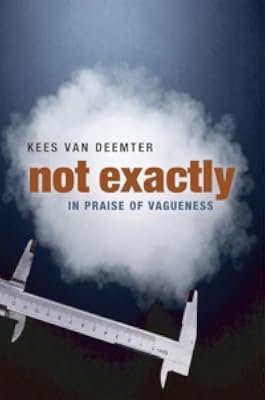
Not Exactly: In Praise of Vagueness
by Kees van Deemter
On This Page
Description
Not everything is black and white. Our daily lives are full of vagueness or fuzziness. Language is the most obvious example - for instance, when we describe someone as tall, it is as though there is a particular height beyond which a person can be considered 'tall'. Likewise the terms 'blond' or 'overweight' in common usage. We often think in discontinuous categories when we are considering something continuous.In this book, van Deemter cuts across various disciplines in considering the show more nature and importance of vagueness. He looks at the principles of measurement, and how we choose categories; show lessTags
Recommendations





Member Reviews
A book in praise of vagueness that begins with an epigraph from Robert Musil, describing the weather? Count me in.
Van Deemter engages language, mathematics, psychology, computer science and literature in this exploration of vagueness and the models developed to mimic vagueness in the quest for Artificial Intelligence. He begins with the Sorites Paradox—when does a collection of stones become a heap?—then launches into a discussion of how the either/or dichotomies of classical logic are inadequate as a basis for the scientific enterprise. The problem is that most indicators are gradable rather than “crisp,” whether the referent is species, temperature, length, intelligence or culture. Not every difference is a step change, or a show more change in kind. Quantitative adjustments—like the mathematical theory of computational complexity—remove vagueness while introducing a certain arbitrariness, and qualitative reasoning captures regularities but suppresses details. Alas, a machine cannot translate a poem.
Science counts on the hedge, the qualification, the exception. Scientific theories are, at best, approximations of the facts. Thinking about the world in crisp, Boolean terms may be justified, writes Van Deemter, but such simplifications often produce false clarity that can cause misinformation. It may now be necessary, he concludes, to invent new ways of thinking about truth, meaning, and communication. show less
Van Deemter engages language, mathematics, psychology, computer science and literature in this exploration of vagueness and the models developed to mimic vagueness in the quest for Artificial Intelligence. He begins with the Sorites Paradox—when does a collection of stones become a heap?—then launches into a discussion of how the either/or dichotomies of classical logic are inadequate as a basis for the scientific enterprise. The problem is that most indicators are gradable rather than “crisp,” whether the referent is species, temperature, length, intelligence or culture. Not every difference is a step change, or a show more change in kind. Quantitative adjustments—like the mathematical theory of computational complexity—remove vagueness while introducing a certain arbitrariness, and qualitative reasoning captures regularities but suppresses details. Alas, a machine cannot translate a poem.
Science counts on the hedge, the qualification, the exception. Scientific theories are, at best, approximations of the facts. Thinking about the world in crisp, Boolean terms may be justified, writes Van Deemter, but such simplifications often produce false clarity that can cause misinformation. It may now be necessary, he concludes, to invent new ways of thinking about truth, meaning, and communication. show less
Having written my masters thesis on adjectival semantics in Montague Grammar many years ago, I very much looked forward to reading Kees van Deemters book. And I was not disappointed. He manages to explain very convincingly "what the fuss is about": where it is we meet vagueness and why it is that it is an advantage and a necessity in dealing with the world, both scientifically and on a day-to-day basis. He also gives a very gentle explanation of the rather dense linguistic, logical and philosophical theories that underpins this area, without the resulting picture being in any way oversimplified. I can highly recommend this book for both the general "uneducated" reader and academics in linguistics, mathematics, philosophy, logic and show more computer science. show less
Interesting book that gives readers an idea about what vagueness is, how it functions and how/why we use it. The subject is treated from different points of view (linguistic, logical, mathematical, philosophical, ...) It's not an easy read: some sections are more difficult to grasp than others, especially the theories of vagueness in the second part. It's not a compelling book, and at times rather tedious, but still interesting enough to keep one's attention going.
The limits of technology are philosophical. The challenge, according to Van Deemter, is to come to terms with our inability to know anything with certainty. Boolean logic restricts reality to two alternatives, true or false, and is unable to deal with gradations or subtle changes. Because most objects in the world are not clearly distinct, and because conditions are contingent and events must be situated in a context, boundaries and measurements are always vague. Language and mathematics can reflect vagueness, and fuzziness, supervaluation and penumbral connections can model vagueness, but we cannot avoid it.
Six Points Sweet Action Ale
Legend Golden IPA
Six Points Sweet Action Ale
Legend Golden IPA
Ratings
Members
- Recently Added By
Author Information
4 Works 87 Members
Kees Van Deemter is Professor and Chair in Computing Science at the University of Aberdeen and the author of Not Exactly: In Praise of Vagueness.
Common Knowledge
- Epigraph
- 'Private investigator, huh?', he said thoughtfully. 'What kind of work do you do mostly?' 'Anything that's reasonably honest,' I said. He nodded. 'Reasonably is a word you could stretch. So is honest.' I gave him a shady l... (show all)eer. 'You're so right,' I agreed. 'Let's get together some quiet afternoon and stretch them.'
Raymond Chandler, The Little Sister
A barometric low hung over the Atlantic. It moved eastward towards a high-pressure area over Russia, without as yet showing any inclination to bypass it in a northerly direction. The air temperature was appropriate relativ... (show all)e to the annual mean temperature (...) In a word that characterizes the facts fairly accurately, even if it is a bit old-fashioned: It was a fine day in August 1913.
Robert Musil, The Man without Qualities - First words
- [Preface]
Vagueness is the topic of many scholarly books for professional academics.
[Prologue]
The world may be best measured in terms of neatly quantifiable entities such as millimeters, grams, and millibars, but we often speak more loosely.
A few years ago, the BBC carried a news story entitled 'Students feel unsafe after dark'. - Last words
- (Click to show. Warning: May contain spoilers.)Paradise it might not be, but life will be the more interesting for it.
(Click to show. Warning: May contain spoilers.)[Epilogue]
When I close the shop door behind me, the two of them have started boxing the barometers.
Classifications
- Genres
- Nonfiction, Philosophy, Science & Nature
- DDC/MDS
- 121.68 — Philosophy & psychology Epistemology (how do you know what you know?) Epistemology (Theory of knowledge) Belief Meaning, interpretation, hermeneutics
- LCC
- P325.5 .A46 .D44 — Language and Literature Philology. Linguistics Language. Linguistic theory. Comparative grammar Semantics
- BISAC
Statistics
- Members
- 73
- Popularity
- 430,922
- Reviews
- 4
- Rating
- (4.07)
- Languages
- English
- Media
- Paper, Ebook
- ISBNs
- 4