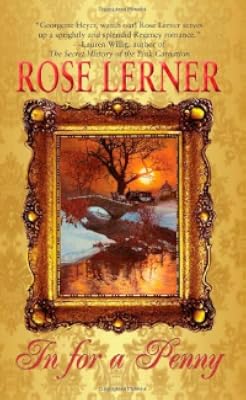
In for a Penny
by Rose Lerner 
On This Page
Description
A dashing and feckless lord enters a marriage of convenience with the lovely and practical daughter of a wealthy merchant to salvage his family fortune, but they find themselves unprepared for scandal, rioting tenants, a menacing neighbor--and discovering a love that is neither convenient nor practical but entirely heartfelt and enduring.Tags
Recommendations


















Member Reviews
I randomly came across this book on Goodreads, read the summary and was mildly intrigued. Then - I saw the cover, complete with a blurb from Lauren Willig. That was enough to make me immediately obtain and read it.
The social status of Penelope Brown, our heroine, is a difficult one. Her family became rich via her father's brewery. This means they are allowed to travel in aristocratic circles, but it doesn't mean they are accepted. I've read books with this particular prejudice before, Secrets of a Summer Night by Lisa Kleypas being the first that comes to mind. It adds an interesting layer of complication to the story, and one I appreciate.
Anyway, I loved Penny. She was a fantastic heroine...very smart and self-aware. When she receives show more an offer of marriage from Nev, she knows the reasons ($$) and she accepts them. They are both aware of why he is marrying her and I love the awareness of their relationship. It makes it easier for them to be honest and open with each other from the beginning. I loved seeing that - the way Nev knew that Penny (very cutesy nicknames, I know) would not only be able to help him try and rescue his family's country estate...but that she would be a necessity.
The complications that arise with the estate's tenants and neighbors are very captivating and kept the story constantly moving forward. They also added a very colorful and unique cast of secondary characters to the story. I love the roles they played and the way everyone interacted with each other.
Like I said before, the level of honesty between our MCs was very unique. I fell in love with both of them and loved watching as their relationship progressed. It is impossible not to root for both of them, so don't even bother trying to take sides.
Definitely a worthy addition to the multitudes of historical romance out there, and this is an author I'll be keeping track of! show less
The social status of Penelope Brown, our heroine, is a difficult one. Her family became rich via her father's brewery. This means they are allowed to travel in aristocratic circles, but it doesn't mean they are accepted. I've read books with this particular prejudice before, Secrets of a Summer Night by Lisa Kleypas being the first that comes to mind. It adds an interesting layer of complication to the story, and one I appreciate.
Anyway, I loved Penny. She was a fantastic heroine...very smart and self-aware. When she receives show more an offer of marriage from Nev, she knows the reasons ($$) and she accepts them. They are both aware of why he is marrying her and I love the awareness of their relationship. It makes it easier for them to be honest and open with each other from the beginning. I loved seeing that - the way Nev knew that Penny (very cutesy nicknames, I know) would not only be able to help him try and rescue his family's country estate...but that she would be a necessity.
The complications that arise with the estate's tenants and neighbors are very captivating and kept the story constantly moving forward. They also added a very colorful and unique cast of secondary characters to the story. I love the roles they played and the way everyone interacted with each other.
Like I said before, the level of honesty between our MCs was very unique. I fell in love with both of them and loved watching as their relationship progressed. It is impossible not to root for both of them, so don't even bother trying to take sides.
Definitely a worthy addition to the multitudes of historical romance out there, and this is an author I'll be keeping track of! show less
Rose Lerner's debut has glimpses of all the things I have come to love about her Lively St. Lemeston series but the back half got lost in the weeds a little bit. However, this is still a really good book and Lerner was constantly surprising me. Her Regency romances are some of my favorite because they are so interested in setting and that is the same case for In for a Penny: a young heiress marries a broke aristocrat after his father dies and he inherits nothing but mountains of debt.
When the MMC, Nev, returns to his family's estate to begin running it, he learns about the tenant struggles due to crop shortages from poor weather conditions in 1816 - also called the year without summer. I really appreciate Lerner including the effects show more of this real event that saw so many people starve, transfported for stealing food for their families, and the uprisings. What didn't work so well for me is that, ultimately, Nev is a landlord. His father ran the estate into debt which resulted in such terrible conditions for workers and tenants. What I've always appreciated about Lerner's romances is that they are usually not focused on the aristocracy - it's often normal people who have to do their own laundry and work for a living. I understand that Nev wanted to run a better estate for his family and tenants (thus he is a "good" landlord) but like at the end of the day, the well-being of everyone who lives on his land is one irresponsible heir away from starvation.
I still really liked this! As I said earlier, this has a lot of what I love about Lerner's other books. show less
When the MMC, Nev, returns to his family's estate to begin running it, he learns about the tenant struggles due to crop shortages from poor weather conditions in 1816 - also called the year without summer. I really appreciate Lerner including the effects show more of this real event that saw so many people starve, transfported for stealing food for their families, and the uprisings. What didn't work so well for me is that, ultimately, Nev is a landlord. His father ran the estate into debt which resulted in such terrible conditions for workers and tenants. What I've always appreciated about Lerner's romances is that they are usually not focused on the aristocracy - it's often normal people who have to do their own laundry and work for a living. I understand that Nev wanted to run a better estate for his family and tenants (thus he is a "good" landlord) but like at the end of the day, the well-being of everyone who lives on his land is one irresponsible heir away from starvation.
I still really liked this! As I said earlier, this has a lot of what I love about Lerner's other books. show less
Lerner's debut regency, In For a Penny was a surprising, delightful read. Between the careful development of the relationship between Penelope and Nev and the burgeoning social issues of the time, Lerner crafted a well thought out, entertaining and enchanting novel.
The premise itself isn't anything new or revolutionary--penniless titled gentleman seeks out rich heiress to fill the family coffers and fix all the money problems he has. What surprised me most was that instead of having either one or the both of them fall instantly in love with the other, Lerner detailed the various stages that veritable strangers go through to learn about one and other. Several times throughout the novel either Penelope or Nev would think to themselves show more that there was still so much to learn about the other.
Certainly their personalities were a good fit--they were both at opposite ends of the spectrum in most ways. Where Nev was careless and debauched, Penelope was careful and calculating. Where Nev could only see one extreme or the other (restraint vs. free reign), Penelope could only think in moderation. The two of them, more than anything else, taught the other how to compromise their ideas. Penelope didn't always have to be the perfect lady and Nev didn't always have to be the perfect embodiment of virtues either.
Lerner also sets up the scene for the background plot of the social confusion and evolving idea of class and class treatment as well. Through Nev we see the ton, through Penelope we see 'new money' and through the tenants of Lowestowe we see the worker class. Since the French Revolution all 3 classes have undergone changes--some swift and some gradual--as the world moved towards a new era of society and class reform. Because of the position Nev finds himself in--trying to restore the profitability of Lowestowe--we can clearly see how disastrous mismanagement can lead to absolutely terrible conditions for all.
Admittedly some of the plot threads and inclusions weren't as neatly tied up. I'm still confused about Tom Kedge and what exactly was going on there, and Amy's reappearance was abrupt and given scant thought unless the plot needed that obstacle.. I would have also liked more development between Louisa and her beau.
On a whole I believe In For a Penny was a sparkling, delightful and engrossing debut.
Re-Released Review. Originally reviewed on 3/10/2010 as a Dorchester title. This book is being re-released by Samhain Publishing on 6/3/2014. show less
The premise itself isn't anything new or revolutionary--penniless titled gentleman seeks out rich heiress to fill the family coffers and fix all the money problems he has. What surprised me most was that instead of having either one or the both of them fall instantly in love with the other, Lerner detailed the various stages that veritable strangers go through to learn about one and other. Several times throughout the novel either Penelope or Nev would think to themselves show more that there was still so much to learn about the other.
Certainly their personalities were a good fit--they were both at opposite ends of the spectrum in most ways. Where Nev was careless and debauched, Penelope was careful and calculating. Where Nev could only see one extreme or the other (restraint vs. free reign), Penelope could only think in moderation. The two of them, more than anything else, taught the other how to compromise their ideas. Penelope didn't always have to be the perfect lady and Nev didn't always have to be the perfect embodiment of virtues either.
Lerner also sets up the scene for the background plot of the social confusion and evolving idea of class and class treatment as well. Through Nev we see the ton, through Penelope we see 'new money' and through the tenants of Lowestowe we see the worker class. Since the French Revolution all 3 classes have undergone changes--some swift and some gradual--as the world moved towards a new era of society and class reform. Because of the position Nev finds himself in--trying to restore the profitability of Lowestowe--we can clearly see how disastrous mismanagement can lead to absolutely terrible conditions for all.
Admittedly some of the plot threads and inclusions weren't as neatly tied up. I'm still confused about Tom Kedge and what exactly was going on there, and Amy's reappearance was abrupt and given scant thought unless the plot needed that obstacle.. I would have also liked more development between Louisa and her beau.
On a whole I believe In For a Penny was a sparkling, delightful and engrossing debut.
Re-Released Review. Originally reviewed on 3/10/2010 as a Dorchester title. This book is being re-released by Samhain Publishing on 6/3/2014. show less
The young Lord Nevinstoke, known to his friends as Nev, loves nothing more than a good time, whether it's drinking with his friends or dallying with his mistress. But when his father dies unexpectedly, Nev suddenly inherits the responsibility of being head of the family, as well as a mountain of crushing debt. With a large estate to repair and no money for the task, his only choice is to marry a rich woman, and heiress Penelope Brown fits the bill nicely. Since Penelope's father is a tradesman, she is not of Nev's class, but her money seems a fair trade for his title. Nev and Penelope marry quickly, but despite their growing attraction to each other, they encounter many obstacles. Nev's estate is in even worse shape than he thought, and show more he has no knowledge of business matters. His tenants have grown increasingly discontented as the estate has become less prosperous. And meanwhile, Penelope feels uprooted from everything familiar and thrust into a place where she doesn't belong. Will Nev and Penelope be able to solve these problems and finally find happiness together?
I enjoy a good Regency romance every once in a while, and I'd read that this one is the next best thing to Georgette Heyer. I don't know if I'd go that far, but I do think the book is very well written and often entertaining. I enjoy the "marriage of convenience turns into something more" trope, so I was predisposed to like the plot, and I also liked both Nev and Penelope as characters. Specifically, I was a big fan of how Nev grows and changes throughout the book. He starts out as a careless young man -- albeit a likable one -- who lives entirely for pleasure. But when he is confronted with his responsibilities for the first time, he takes them seriously and tries to learn all he can. I also sympathized with Penelope quite a bit, as she experiences a lot of insecurity when she marries "above" herself. I did get annoyed at all the misunderstandings between her and Nev, though; every time it seemed like they were finally on the same page, one of them would second-guess the relationship for no good reason. There was also a lot more, ahem, "romance" than I was expecting. But overall, as Regency romances go, this is a fairly enjoyable one. show less
I enjoy a good Regency romance every once in a while, and I'd read that this one is the next best thing to Georgette Heyer. I don't know if I'd go that far, but I do think the book is very well written and often entertaining. I enjoy the "marriage of convenience turns into something more" trope, so I was predisposed to like the plot, and I also liked both Nev and Penelope as characters. Specifically, I was a big fan of how Nev grows and changes throughout the book. He starts out as a careless young man -- albeit a likable one -- who lives entirely for pleasure. But when he is confronted with his responsibilities for the first time, he takes them seriously and tries to learn all he can. I also sympathized with Penelope quite a bit, as she experiences a lot of insecurity when she marries "above" herself. I did get annoyed at all the misunderstandings between her and Nev, though; every time it seemed like they were finally on the same page, one of them would second-guess the relationship for no good reason. There was also a lot more, ahem, "romance" than I was expecting. But overall, as Regency romances go, this is a fairly enjoyable one. show less
Just as lovely the 2nd time around.
Beautifully done regency. Well researched and set firmly and correctly in the time period. The writing was flowing, immediate and interesting. The plotting was pretty tight. Most of the book was the hero, Nev, and the heroine, Penelope, learning to adapt to their marriage and working together to try to put right his neglected ancestral estate. Some of the problems current in England at the time were part of the plot, things relating to corn laws and enclosures and class struggle etc.
Nev was one of the best heroes I've read in a very long time. He was only 23 and had been used to partying around London unheeding of where his money came from when his father dies. He immediately straightened up and began show more trying to find his way out of the very deep debt his father left them in. He is incredibly sweet. He tries very hard while knowing that he is vastly unprepared to deal with finances and whatnot and knows that he is not really bright when it comes to finances. He marries a rich merchant's daughter for her money but he had already met her and had been taken with her. He treats Penelope like a princess though. He stands up for her and protects her and quickly comes to care for her. He is also very honorable and kindhearted but he does have a backbone of steel and can use his innate power as an Earl unconsciously when he needs to.
Penelope is 19 but is a pretty grownup and composed 19. Her parents love her and don't want her to marry for a title but she insists (I would too, if Nev were offering) and so they let her. She understands Nev's personality and knows that while she is good with numbers, he is good with people. She is sweet and caring.
They both try hard to make their marriage work while being a bit unsure of each other. This is not one of those books that revolve around the tension of 'will they or won't they go to bed'. The love scenes are lovely and sweet while still being hot.
I can't recommend this highly enough. show less
Beautifully done regency. Well researched and set firmly and correctly in the time period. The writing was flowing, immediate and interesting. The plotting was pretty tight. Most of the book was the hero, Nev, and the heroine, Penelope, learning to adapt to their marriage and working together to try to put right his neglected ancestral estate. Some of the problems current in England at the time were part of the plot, things relating to corn laws and enclosures and class struggle etc.
Nev was one of the best heroes I've read in a very long time. He was only 23 and had been used to partying around London unheeding of where his money came from when his father dies. He immediately straightened up and began show more trying to find his way out of the very deep debt his father left them in. He is incredibly sweet. He tries very hard while knowing that he is vastly unprepared to deal with finances and whatnot and knows that he is not really bright when it comes to finances. He marries a rich merchant's daughter for her money but he had already met her and had been taken with her. He treats Penelope like a princess though. He stands up for her and protects her and quickly comes to care for her. He is also very honorable and kindhearted but he does have a backbone of steel and can use his innate power as an Earl unconsciously when he needs to.
Penelope is 19 but is a pretty grownup and composed 19. Her parents love her and don't want her to marry for a title but she insists (I would too, if Nev were offering) and so they let her. She understands Nev's personality and knows that while she is good with numbers, he is good with people. She is sweet and caring.
They both try hard to make their marriage work while being a bit unsure of each other. This is not one of those books that revolve around the tension of 'will they or won't they go to bed'. The love scenes are lovely and sweet while still being hot.
I can't recommend this highly enough. show less
I'm used to deriding Dorchester as "the Dara Joy publisher" but I forget they also put out some good romances. I have a real soft spot for the "was it love or was it the poodle" book, for example. Anyway, I really enjoyed this Regency.
Regency romance heroines often have a special skill, but Penny's extreme practicality and head for business remind me of Heyer's A Civil Contract (but the story is a true genre romance, unlike A Civil Contract, which is more of a novel packaged as romance because of Heyer's ouevre). Penny isn't not-pretty-but-beautiful because she's got some special something (unfashionably tall and thin, perhaps?) but because, Nev realises, she looks like the other pretty girls except without as much makeup. Moreover, show more she's not perfect in character, either. Penny's own less-than-noble background doesn't give her any magical insight into the lives of the poor.
Meanwhile, Nev is not at all like typical Regency heroes. He's been a bit of a rakehell, but not because of [an evil first wife|his time in the war|abusive parents], but just because he was a bit of a fratboy until he was needed. When he teaches his wife sexual pleasure, he recognizes that she's just never learned she can treat herself to it, and he believes she's crediting him with a magical connection he knows he doesn't have. For that alone, Rose Lerner, ♥.
The story also makes wonderfully valid comparisons between a young woman whose marriage comes between her and the male friend she'd hoped to marry, and a young man whose marriage comes between himself and his male best friend, and it does so without subtext or slashiness, which I also loved. Friendship is vital in this text, and pairing up can threaten it, and it's rewarding but hard work to maintain friendships in the face of that.
Finally, I love the way the book confronts historic realities of class. Grim reality in Regencies is usually limited to battlefield descriptions for the sake of the hero's handy PTSD that can only be cured by hanky panky; class is usually about how both hero and heroine truly trust Dear Ould Sally the [alewife|housekeeper|village witch|nurse]. Lerner's book relies on the overwhelming injustices of Corn Laws, enclosure, treatment of trade unions, the Riot Act, and transportation. Both hero and heroine come to terms with the heroine only differing from the poor by luck. Better yet, there's no noblesse oblige, no sense that the poor trust the lord because he's their darling lordship. They come to terms as equals, when all is said and done. show less
Regency romance heroines often have a special skill, but Penny's extreme practicality and head for business remind me of Heyer's A Civil Contract (but the story is a true genre romance, unlike A Civil Contract, which is more of a novel packaged as romance because of Heyer's ouevre). Penny isn't not-pretty-but-beautiful because she's got some special something (unfashionably tall and thin, perhaps?) but because, Nev realises, she looks like the other pretty girls except without as much makeup. Moreover, show more she's not perfect in character, either. Penny's own less-than-noble background doesn't give her any magical insight into the lives of the poor.
Meanwhile, Nev is not at all like typical Regency heroes. He's been a bit of a rakehell, but not because of [an evil first wife|his time in the war|abusive parents], but just because he was a bit of a fratboy until he was needed. When he teaches his wife sexual pleasure, he recognizes that she's just never learned she can treat herself to it, and he believes she's crediting him with a magical connection he knows he doesn't have. For that alone, Rose Lerner, ♥.
The story also makes wonderfully valid comparisons between a young woman whose marriage comes between her and the male friend she'd hoped to marry, and a young man whose marriage comes between himself and his male best friend, and it does so without subtext or slashiness, which I also loved. Friendship is vital in this text, and pairing up can threaten it, and it's rewarding but hard work to maintain friendships in the face of that.
Finally, I love the way the book confronts historic realities of class. Grim reality in Regencies is usually limited to battlefield descriptions for the sake of the hero's handy PTSD that can only be cured by hanky panky; class is usually about how both hero and heroine truly trust Dear Ould Sally the [alewife|housekeeper|village witch|nurse]. Lerner's book relies on the overwhelming injustices of Corn Laws, enclosure, treatment of trade unions, the Riot Act, and transportation. Both hero and heroine come to terms with the heroine only differing from the poor by luck. Better yet, there's no noblesse oblige, no sense that the poor trust the lord because he's their darling lordship. They come to terms as equals, when all is said and done. show less
I bought In For A Penny after reading AnimeJune's review over at Gossamer Obsessions. Thank you AnimeJune!!The Blurb: No more drinking. No more gambling. And definitely no more mistress. Now that he's inherited a mountain of debts and responsibility, Lord Nevinstoke has no choice but to start acting respectable. Especially if he wants to find a wife-better yet, a rich wife. Penelope Brown, a manufacturing heiress, seems the perfect choice. She's pretty, rational, ladylike, and looking for a marriage based on companionship and mutual esteem. But when they actually get to Nev's family estate, all the respectability and reason in the world won't be enough to deal with tenants on the edge of revolt, a menacing neighbor, and Nev's family's show more propensity for scandal. Overwhelmed but determined to set things right, Nev and Penelope have no one to turn to but each other. And to their surprise, that just might be enough.Bouquets: Have you ever, in bright sunshine put on sunglasses and felt your eyes sigh in pleasure? Have you sat down in a comfy chair at the end of a busy day and felt your very bones sigh in relief? Sometimes, when I am very fortunate (because, sadly it is not as common as I would like), I pick up a book and after only a page or 2, I heave a happy sigh - in dual relief and anticipated delight because I know, I just KNOW that I have found a book which will please me from start to finish and I can just settle in to enjoy the experience. This, for me, was one of those books. At the foot of page 1 (page 1!!) is this:- "Lady Ambersleigh did not look delighted when the three young men were announced. Nev tried to avoid the eye of a young matron on whose new settee he had accidentally upended a punch bowl the month before, and that of an earl from whose son Percy had won almost two hundred pounds at piquet the week before, and that of a lady whom - oh, hell, he tried not to meet anyone's eye."And that was when I knew. The tone, the humour, even the sentence structure pleased me. So, I did a mental happy dance and settled on in.In For A Penny is not just the title and a play on the name of the heroine. The theme of "all or nothing" (or, "in for a penny, in for a pound") appears time and time again throught he book; there is Nev who starts off being a very likeable profligate - his life is drinking and playing and very little else. Then, after his father dies (a father who gambled excessively and very badly, another "all or nothing"), he decides to change - he gives up drinking, his mistress and his friends and throws himself completely into saving the estate. Penny's response to Nev's proposal surprises even her but she throws herself into it wholly. She also spends much of the time wholeheartedly showing to all that she is a "lady" (even though she is a Cit and she believes that makes her "lady-ness" (huh, I made up a word) fake). Even Sir Jasper, on the neighbouring estate, is totally uncompromising as to the rights of landholders vs. the citizenry. And, through the book, Nev and Penny and many of the secondary characters too, learn where compromise is appropriate (ie, where it doesn't have to be "all or nothing") and where it is not - Nev relaxes enough to enjoy a brandy occasionally, knowing that it won't mean he'll suddenly become a drunken, gambling, wastrel; he suggests compromise between the rioting tenants and himself as landholder but he loves Penny wholeheartedly, holding nothing back. And, although it is, I think, less obvious, over the course of the book Penny becomes more accepting of her origins and comfortable in her own skin. I enjoyed the secondary characters too. I really liked Penny's parents; I felt for Nev's friends when he dropped them like a hot potato because they were too frivolous for his new life; I felt for the tenants who were struggling with their lot. Even Sir Jasper had a backstory which made his "villainy" somewhat understandable. I say somewhat because he was, by the end, crazy 8 bonkers (I don't think that's giving anything away to mention).I started reading romance at about age 12 and I pretty much believed what I'd read about deflowering virgins in the books I'd read. Then I was educated (I'm looking at you Kalen Hughes!). Now, reading a "deflowering" (ugh, what a word!) scene getting it wrong wrong wrong makes me cringe. This is one of the very few novels I've come across where the position of the maidenhead was correct - Thank you, thank you, thank you! And, even Nev knew it! Hooray! In fact, the love scenes were all realistic, sexy and romantic at the same time and I don't see that all that often either.Brickbats: There isn't much to complain about in this book. The conflict was believable and there was no deus ex machina to solve everyone's problems. Through compromise and hard work, things started to turn around - this may sound dull but it actually wasn't. Penny and Nev don't fall into bed, they don't fall in love in a day or even a week, they had to learn how to communicate (and they did!). Nev's description of love (as explained to his sister Louisa) is accurate and, in my humble opinion, no less romantic for being so:- "Love isn't a game. Living with someone, being married to her - that's work, Louisa. It's trying to be what she needs even if it doesn't come naturally, and struggling to understand her and working together to make a life! It's accepting that sometimes things aren't perfect. It's understanding that sometimes one of you has responsibilities that have to come first and knowing that she understands that too!"So often, descriptions of love are about how the person makes "me" feel. While there was a bit of that in the book (well, it's true, after all), it was nice to see the hero recognising the effort, the sacrifice that love is too - the "it's not just that I think I'd die without him - it's that I'd sacrifice for him", kind of thing. Nice. If I were to have a quibble, it would be that I didn't have much sympathy with Penny's fears over her lack of aristocratic background. I identified more strongly with Nev. That Penny considered for the longest time that Nev could not love her because she was a Cit, especially when she had such loving parents herself, strained a bit for me. Nev never treated her as less than ladylike despite her fears. But, that could be a product of my modern upbringing. I certainly understood it was a concern, I just thought the self-flagellation dragged a little towards the end. But, as quibbles go, that's not much.I enjoyed this excellent book very much and will be watching out for future titles by this author. Just thinking about it gives me that happy sigh....Grade: A show less
Members
- Recently Added By
Author Information

18 Works 989 Members
Rose Lerner is a LibraryThing Author, an author who lists their personal library on LibraryThing.
Common Knowledge
- Original publication date
- 2010-03
- People/Characters
- Penelope Brown; Nathaniel Arthur Delaval Ambrey, Viscount Nevinstoke; Percy Garrett; Louisa Ambrey
- Important events
- Peterloo Massacre
- Dedication
- To my mother. I wrote this book for you. I wish you could have read it.
- First words
- June 1819
"Thirkell, you know what happened the last time we went to one of the Ambersleighs' do's" - Last words
- (Click to show. Warning: May contain spoilers.)"You reckless fool", she said, and kissed him right there in from of everyone.
- Blurbers
- Willig, Lauren
Classifications
Statistics
- Members
- 237
- Popularity
- 137,240
- Reviews
- 23
- Rating
- (3.79)
- Languages
- English
- Media
- Paper, Ebook
- ISBNs
- 8
- ASINs
- 4