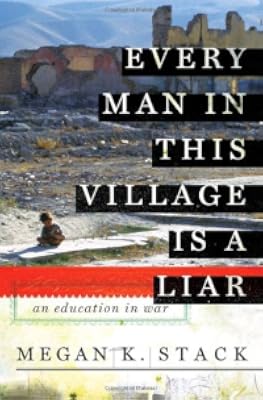
Every Man in This Village is a Liar: An Education in War
by Megan K. Stack
On This Page
Description
"Every Man in This Village Is a Liar" is LA Times reporter Megan K. Stack's riveting account of what she saw in the combat zones of the Middle East, in war-torn Afghanistan and Pakistan, and beyond. She relates her initial wild excitement and her slow disillusionment as the cost of violence outweighs the elusive promise of freedom and democracy.Tags
Recommendations






Member Reviews
"You can survive and not survive, both at the same time."
War on Terror! Manifest or farce? Megan Stack, a foreign correspondent for the LA Times, attempts to answer that question. Shortly after 9/11, Stack found herself thrust into the Middle East, spending the next six years, in various hot zones: Afghanistan, occupied Iraq, Lebanon, Yemen, Libya, Saudi Arabia and a few others.
Stack’s first hand account of many atrocities is eye-opening and gut-wrenching. She befriends a variety of people in each of these dangerous locales, putting a human face on these tragedies. She is able to witness the myriad of lies and deceptions and experience the ugly hatreds, that fuel and drive these regions. Her prose is both tough and beautiful. She is a show more daring, unflinching journalist, looking directly into the horrible face of war.
"Only after covering it for years did I understand that the war on terror never really existed. It was not a real thing. Not that the war on terror was flawed, not that it was cynical or self-defeating, or likely to breed more resentment and violence. But that it was hollow, it was essentially nothing but a unifying myth for a complicated scramble of mixed impulses and social theories and night terrors and cruelty and business interests.” show less
War on Terror! Manifest or farce? Megan Stack, a foreign correspondent for the LA Times, attempts to answer that question. Shortly after 9/11, Stack found herself thrust into the Middle East, spending the next six years, in various hot zones: Afghanistan, occupied Iraq, Lebanon, Yemen, Libya, Saudi Arabia and a few others.
Stack’s first hand account of many atrocities is eye-opening and gut-wrenching. She befriends a variety of people in each of these dangerous locales, putting a human face on these tragedies. She is able to witness the myriad of lies and deceptions and experience the ugly hatreds, that fuel and drive these regions. Her prose is both tough and beautiful. She is a show more daring, unflinching journalist, looking directly into the horrible face of war.
"Only after covering it for years did I understand that the war on terror never really existed. It was not a real thing. Not that the war on terror was flawed, not that it was cynical or self-defeating, or likely to breed more resentment and violence. But that it was hollow, it was essentially nothing but a unifying myth for a complicated scramble of mixed impulses and social theories and night terrors and cruelty and business interests.” show less
I picked up this book in my local library on a whim -- a kind of "why not"? I admit, my expectations were low -- I've read a lot of books by journalists since 9/11 about Afghanistan and the Middle East, and many of them have been mediocre. And frankly, I didn't know what there could conceivably be to say that hadn't already been said. And then I started reading this book this morning. And I'm blown away.
To start with, Megan Stack is an astonishing writer. Interviewing a Yemeni judge who's chewing qat and being rather inarticulate, she says, "my pen chased his runaway thoughts over the page in long broken sentences.” Libyan drivers are insane; "they hurtle like mad fish chased by some unseen shark." In Jordan, a country where free show more political expression isn't exactly encouraged, on the eve of the Iraqi war Stack watches a crowd of mosque worshipers try to morph into antiwar protestors. But wait a minute: “Who would start the demonstration? They had so little practice." On the impact of adrenaline in a war zone: "the world smears around you in a carousel spin." Her descriptions are vivid, personal and always eloquent.
She also has an eye for the ugly truths of situations that too many others try to convey in simplistic terms. She doesn't let herself off lightly at all -- she deplores herself for walking away from victims of bombings in order to chase down more of "the story" (one of the nasty secrets of war zone journalism), and she resents being held to account as a representative of her country and government, even as she admits that is necessary or inevitable. Covering Egyptian elections, she scorns "teahouse diplomats that came to see but didn't bother to look"; she is equally hard on Western women journalists who take refuge and instead of speaking out about endless harassment and discrimination they experience, says bluntly that the banal answer "but we get to talk to local women, which the men can't" is a cop-out.
This is an extraordinary book, and one everyone -- regardless of their place on the political spectrum -- should read. No, it's not heartwarming or encouraging -- in fact, Stack's stint as a war correspondent leaves her profoundly disillusioned. Her final chapter puts her in the middle of an insane asylum in southern Lebanon, in the midst of the Israeli attack on Hezbollah. "Here I stand among the mad and maybe that’s all it’s ever been. The Middle East goes crazy and we go along with it." She has her own beliefs -- developed through experience and honed by witnessing the internecine conflicts of the region -- that it's hard to ignore, but even those who don't share them can't deny what it is that she has witnessed or reject at least some of the conclusions that she draws. show less
To start with, Megan Stack is an astonishing writer. Interviewing a Yemeni judge who's chewing qat and being rather inarticulate, she says, "my pen chased his runaway thoughts over the page in long broken sentences.” Libyan drivers are insane; "they hurtle like mad fish chased by some unseen shark." In Jordan, a country where free show more political expression isn't exactly encouraged, on the eve of the Iraqi war Stack watches a crowd of mosque worshipers try to morph into antiwar protestors. But wait a minute: “Who would start the demonstration? They had so little practice." On the impact of adrenaline in a war zone: "the world smears around you in a carousel spin." Her descriptions are vivid, personal and always eloquent.
She also has an eye for the ugly truths of situations that too many others try to convey in simplistic terms. She doesn't let herself off lightly at all -- she deplores herself for walking away from victims of bombings in order to chase down more of "the story" (one of the nasty secrets of war zone journalism), and she resents being held to account as a representative of her country and government, even as she admits that is necessary or inevitable. Covering Egyptian elections, she scorns "teahouse diplomats that came to see but didn't bother to look"; she is equally hard on Western women journalists who take refuge and instead of speaking out about endless harassment and discrimination they experience, says bluntly that the banal answer "but we get to talk to local women, which the men can't" is a cop-out.
This is an extraordinary book, and one everyone -- regardless of their place on the political spectrum -- should read. No, it's not heartwarming or encouraging -- in fact, Stack's stint as a war correspondent leaves her profoundly disillusioned. Her final chapter puts her in the middle of an insane asylum in southern Lebanon, in the midst of the Israeli attack on Hezbollah. "Here I stand among the mad and maybe that’s all it’s ever been. The Middle East goes crazy and we go along with it." She has her own beliefs -- developed through experience and honed by witnessing the internecine conflicts of the region -- that it's hard to ignore, but even those who don't share them can't deny what it is that she has witnessed or reject at least some of the conclusions that she draws. show less
An eager 25-year-old journalist, Megan Stack learned about the bombing of the Trade Towers while on vacation in France. Since she was physically closest to Afghanistan, her editor at the Los Angeles Times sent her to Afghanistan to be on the ground for the invasion. Thus began a seven year stint, reporting from all over the Middle East, wherever the fighting was heaviest: Afghanistan, Iraq, Libya, Lebanon, the West Bank.
When her memoir begins, the world and its problems seem clear. Ms. Stack is naive and idealistic, absorbing all she experiences and writing the reports expected of her. But as time passes and the war drags on, she begins to see things that change the ways she thinks about the role of the West in the Middle East and show more specifically the policies of the United States. How can a nation promoting democracy turn a blind eye to some dictators and ruin a country in order to depose another? Who's side is just? Does it even matter given the amount of human suffering the conflicts inflict? Questions such as these begin to weigh on Megan, and her thoughts become grim as she reflects on the costs of the Middle East wars.
This is who gets left behind when war comes: poor people, old people, and handicapped people. This is who they are bombing now. In this moment I am numb and still, but I am aware that I deeply hate everybody for letting this happen. I hate the Lebanese families for leaving them here. I hate Hezbollah for not evacuating them, for ensuring civilian deaths that will bolster their cause. I hate Israel for wasting this place on the heads of the feeble. I hate all of us for participating in this great fiction of the war on terror, for pretending there is a framework, a purpose, for this torment. I sit in hatred and write everything down with filthy fingers.
Although the book is somewhat dated now, with Osama bin Laden dead and popular revolutions having brought down some of the despots about whom she writes, there is still an immediacy and potency to Ms. Stack's memoir that makes it compelling. Her writing is poetic, and her self-insights are honest and direct. The only difficulty for me is that as a journalist, she must remain apart and write of what she sees, instead of stopping to help the victims. She writes of how hard that is. I think I would have just stopped and done what I could. Regardless, the book is a heart-breaking tribute to those caught in a disaster not of their own making and to her own journey to greater self-awareness and understanding. show less
When her memoir begins, the world and its problems seem clear. Ms. Stack is naive and idealistic, absorbing all she experiences and writing the reports expected of her. But as time passes and the war drags on, she begins to see things that change the ways she thinks about the role of the West in the Middle East and show more specifically the policies of the United States. How can a nation promoting democracy turn a blind eye to some dictators and ruin a country in order to depose another? Who's side is just? Does it even matter given the amount of human suffering the conflicts inflict? Questions such as these begin to weigh on Megan, and her thoughts become grim as she reflects on the costs of the Middle East wars.
This is who gets left behind when war comes: poor people, old people, and handicapped people. This is who they are bombing now. In this moment I am numb and still, but I am aware that I deeply hate everybody for letting this happen. I hate the Lebanese families for leaving them here. I hate Hezbollah for not evacuating them, for ensuring civilian deaths that will bolster their cause. I hate Israel for wasting this place on the heads of the feeble. I hate all of us for participating in this great fiction of the war on terror, for pretending there is a framework, a purpose, for this torment. I sit in hatred and write everything down with filthy fingers.
Although the book is somewhat dated now, with Osama bin Laden dead and popular revolutions having brought down some of the despots about whom she writes, there is still an immediacy and potency to Ms. Stack's memoir that makes it compelling. Her writing is poetic, and her self-insights are honest and direct. The only difficulty for me is that as a journalist, she must remain apart and write of what she sees, instead of stopping to help the victims. She writes of how hard that is. I think I would have just stopped and done what I could. Regardless, the book is a heart-breaking tribute to those caught in a disaster not of their own making and to her own journey to greater self-awareness and understanding. show less
“The sun is shining like every mad morning in this garish war. I wake up to the crash of bombs and tell myself, just do it for one more day. Anyway you are trapped. If you try to get out of here they will kill you on the road. So do it for one more day. You know you wouldn’t leave, even if you could.” (Page 224)
I’ve always wondered what kept the foreign correspondents in the extremely dangerous regions they cover. In Megan Stack’s National Book Award nominee, we learn at least one of the reasons. They are totally unable to pull themselves away from the danger, the excitement, the adrenaline high that just being there allows to course through their veins. For five years, Stack covered events in the volatile Middle East, from show more just after the 2001 invasion of Afghanistan through the 2006 Israeli bombing of Lebanon. Her time in Afghanistan, Iraq, Egypt, Jordan, Israel, and Libya are highlighted by roadside bombs, interviews of warlords, suicide bombers, death and violence. And more death and more violence.
The first thing that strikes you is the dichotomy between the absolutely stunning prose and the terror-filled violence. It doesn’t seem right that they should be lined up next to each other. Beauty glancing edges alongside carnage. But there it is, right before your eyes. Shimmering, beautiful prose/ferocious, violent bloodshed.
Along the way, Stack makes the case against violence and against the course that the U.S. has chosen in the past. Regarding the war on terror she writes:
“Somewhere between Afghanistan and Iraq, we lost our way. The carnage of it and the disorder, all to create a new Middle East because the old Middle East is still here, and where should it go? Only a country as quixotic, as history-free, as America could come up with this notion: that you can make the old one go away. Maybe you can debate until it makes sense from a distance, as an abstraction. But up close the war on terror isn’t anything but the sick and feeble cringing in an asylum, babies in shock, structure smashed. Baghdad broken, Afghanistan broken,. The line between heaven and earth, broken. Lebanon broken. Broken peace and broken roads and broken bridges. The broken faith and years of broken promises. Children inheriting their parents broken hearts, growing up with a taste for revenge. And all along, America dreaming it’s deep sweet dreams, there and not there. America chasing phantoms, running uphill to nowhere in pursuit of a receding mirage of absolute safety.” (Page 243)
This is a book that should be on every American’s shelf, available to peruse at any time to remind ourselves of what we can and can’t do to influence the lives of those in the Middle East. You won’t regret buying it and you’ll be rewarded with an eye-opening frankness that just so happens to come in the form of beautiful poetry. show less
I’ve always wondered what kept the foreign correspondents in the extremely dangerous regions they cover. In Megan Stack’s National Book Award nominee, we learn at least one of the reasons. They are totally unable to pull themselves away from the danger, the excitement, the adrenaline high that just being there allows to course through their veins. For five years, Stack covered events in the volatile Middle East, from show more just after the 2001 invasion of Afghanistan through the 2006 Israeli bombing of Lebanon. Her time in Afghanistan, Iraq, Egypt, Jordan, Israel, and Libya are highlighted by roadside bombs, interviews of warlords, suicide bombers, death and violence. And more death and more violence.
The first thing that strikes you is the dichotomy between the absolutely stunning prose and the terror-filled violence. It doesn’t seem right that they should be lined up next to each other. Beauty glancing edges alongside carnage. But there it is, right before your eyes. Shimmering, beautiful prose/ferocious, violent bloodshed.
Along the way, Stack makes the case against violence and against the course that the U.S. has chosen in the past. Regarding the war on terror she writes:
“Somewhere between Afghanistan and Iraq, we lost our way. The carnage of it and the disorder, all to create a new Middle East because the old Middle East is still here, and where should it go? Only a country as quixotic, as history-free, as America could come up with this notion: that you can make the old one go away. Maybe you can debate until it makes sense from a distance, as an abstraction. But up close the war on terror isn’t anything but the sick and feeble cringing in an asylum, babies in shock, structure smashed. Baghdad broken, Afghanistan broken,. The line between heaven and earth, broken. Lebanon broken. Broken peace and broken roads and broken bridges. The broken faith and years of broken promises. Children inheriting their parents broken hearts, growing up with a taste for revenge. And all along, America dreaming it’s deep sweet dreams, there and not there. America chasing phantoms, running uphill to nowhere in pursuit of a receding mirage of absolute safety.” (Page 243)
This is a book that should be on every American’s shelf, available to peruse at any time to remind ourselves of what we can and can’t do to influence the lives of those in the Middle East. You won’t regret buying it and you’ll be rewarded with an eye-opening frankness that just so happens to come in the form of beautiful poetry. show less
The world of war in the Middle East left its mark on this young journalist, and I'm grateful that she shared her post-9/11 experiences in Afghanistan, Israel, Libya, Iraq, Yemen, Jordan, Lebanon, and Egypt witnessing the horror of death and the even more horrific impact on the survivors. Megan Stark ends up living in these war-torn countries for six years while she tries to figure out the truth to report to the readers of the Los Angeles Times.
For six long years she subjected herself to the insanity of war after war, roadside bombs and bombs from the sky, broken bodies and broken souls. Megan's poetic words bring out the humanity on both sides of the wars she lives through observing the heartbreak and violence "of all the smashed show more things left behind."
This eye-opening book is subtitled "An Education in War." By reading it, I learned that "you can survive and not survive, both at the same time." You won't hear these kinds of stories on the evening news. It's a very difficult book to read, but I urge you to read it and weep. show less
For six long years she subjected herself to the insanity of war after war, roadside bombs and bombs from the sky, broken bodies and broken souls. Megan's poetic words bring out the humanity on both sides of the wars she lives through observing the heartbreak and violence "of all the smashed show more things left behind."
This eye-opening book is subtitled "An Education in War." By reading it, I learned that "you can survive and not survive, both at the same time." You won't hear these kinds of stories on the evening news. It's a very difficult book to read, but I urge you to read it and weep. show less
http://shawjonathan.wordpress.com/2011/05/06/megan-stack-in-the-village-of-liars...
If you're looking for a brief, accessible introduction to the 21st century Middle East (at least as it was before the events beginning with the Egyptian Spring) this book probably fits the bill as well as anything. And I suspect we all need regular introductions and re-introductions like this, because of the phenomenon Stack describes in her Prologue:
'As Americans we have the gift of detaching ourselves and drifting on; it has saved us over and over again from getting mired in guilt or stuck in the past. Sometimes we are too good at it. Here in the same generation, the wars happening over there, elsewhere, already have the irreality of a dream. [...] But show more the wars are still happening, and they have been happening all along. People died. Promises were broken. Things were destroyed. And as Americans these actions belong to us.'
Detachment and moving on are even more rife in Australia. 'Over there, elsewhere' is even further away for us. And we can tell ourselves that we're only bit players after all.
The book is animated by a passionate concern to break through that detachment. It's a series of personal essays, more personal and more ambitious than a collection of journalistic pieces. Again and again she brings us the reality of war on the ground: not the prurient suspense of The Hurt Locker, the heroics of embedded journalists, or the ever so slightly smug satire of, say, Wag the Dog, but the purple corpse of a baby found in a bombed house in Lebanon, an Iraqi boy shot by US soldiers on his way to the corner shop, US expatriate women living in luxury and fear behind high walls in Saudi Arabia, the appalling realisation that two university students have disappeared after being seen talking to her, the hardening of an Ammanese interpreter friend against the US when she learns about Abu Ghraib.
This book, in other words, has sh*t on its shoes and, to push the metaphor, blood on its boots. It stands as a formidable challenge toawful lot of coverage of the Middle East – things like spin about spreading democracy and freedom, 'balanced' reporting of the bombing of civilian populations, or cant about collateral damage and rebel strongholds.
The book has one major flaw which I think comes from Stack's having to work against her training as impersonal, objective reporter. To tell this story, she needs to be present as a character in the story, to convey the emotional reality of what she witnesses, and the emotional reality of being a witness. To do this, she seems to have felt the need to write in a literary mode, and hardly a page goes by without a strained simile, an adjective that's working too hard or a dubious epigram. Even the book's title is an example: it's meant to evoke the difficulty of determining the truth in a war zone, but it refers to a famous logical puzzle, and sends the reader down a trail of irrelevant associations. In the Epilogue she writes, 'By now I have given up on pulling poetry out of war.' If only a great bully of an editor had persuaded her to give it up before the book got into print, this very good, useful book might have been a great one. show less
If you're looking for a brief, accessible introduction to the 21st century Middle East (at least as it was before the events beginning with the Egyptian Spring) this book probably fits the bill as well as anything. And I suspect we all need regular introductions and re-introductions like this, because of the phenomenon Stack describes in her Prologue:
'As Americans we have the gift of detaching ourselves and drifting on; it has saved us over and over again from getting mired in guilt or stuck in the past. Sometimes we are too good at it. Here in the same generation, the wars happening over there, elsewhere, already have the irreality of a dream. [...] But show more the wars are still happening, and they have been happening all along. People died. Promises were broken. Things were destroyed. And as Americans these actions belong to us.'
Detachment and moving on are even more rife in Australia. 'Over there, elsewhere' is even further away for us. And we can tell ourselves that we're only bit players after all.
The book is animated by a passionate concern to break through that detachment. It's a series of personal essays, more personal and more ambitious than a collection of journalistic pieces. Again and again she brings us the reality of war on the ground: not the prurient suspense of The Hurt Locker, the heroics of embedded journalists, or the ever so slightly smug satire of, say, Wag the Dog, but the purple corpse of a baby found in a bombed house in Lebanon, an Iraqi boy shot by US soldiers on his way to the corner shop, US expatriate women living in luxury and fear behind high walls in Saudi Arabia, the appalling realisation that two university students have disappeared after being seen talking to her, the hardening of an Ammanese interpreter friend against the US when she learns about Abu Ghraib.
This book, in other words, has sh*t on its shoes and, to push the metaphor, blood on its boots. It stands as a formidable challenge toawful lot of coverage of the Middle East – things like spin about spreading democracy and freedom, 'balanced' reporting of the bombing of civilian populations, or cant about collateral damage and rebel strongholds.
The book has one major flaw which I think comes from Stack's having to work against her training as impersonal, objective reporter. To tell this story, she needs to be present as a character in the story, to convey the emotional reality of what she witnesses, and the emotional reality of being a witness. To do this, she seems to have felt the need to write in a literary mode, and hardly a page goes by without a strained simile, an adjective that's working too hard or a dubious epigram. Even the book's title is an example: it's meant to evoke the difficulty of determining the truth in a war zone, but it refers to a famous logical puzzle, and sends the reader down a trail of irrelevant associations. In the Epilogue she writes, 'By now I have given up on pulling poetry out of war.' If only a great bully of an editor had persuaded her to give it up before the book got into print, this very good, useful book might have been a great one. show less
Wow. Megan Stack was a finalist in 2007 for the Pulitzer Prize in international reporting. After reading this book, I am not surprised she was a finalist, only that she didn't win. She has fearlessly taken on a subject of great world controversy sparing no danger to herself both physically and mentally. Her writing is stunningly beautiful and poetic. It is also clear, explicitly honest, and heartbreakingly blunt.
This is not a book about one experience in one country. It covers several countries in the Middle East region over a critical timeframe. Each chapter is a definitive account of a different country with her analysis of the situation as she was able to absorb and interpret what she saw and heard. Stack cuts to the heart of the show more problems, exposes the beauty and the ugliness of humanity, and holds up a mirror for Americans to see the reflection of their own policies and actions in this war.
The tension and fear never let up. The realities of living in the midst of war hit the reader like the bombs that were dropped on villages of the innocent. Words on a page are never the same as real life experience. But this book is truly "an education in war" (as the title proclaims) to a nation that is far removed from its everyday horror and we had best pay attention. Everyone should read this one.
Highly recommended. show less
This is not a book about one experience in one country. It covers several countries in the Middle East region over a critical timeframe. Each chapter is a definitive account of a different country with her analysis of the situation as she was able to absorb and interpret what she saw and heard. Stack cuts to the heart of the show more problems, exposes the beauty and the ugliness of humanity, and holds up a mirror for Americans to see the reflection of their own policies and actions in this war.
The tension and fear never let up. The realities of living in the midst of war hit the reader like the bombs that were dropped on villages of the innocent. Words on a page are never the same as real life experience. But this book is truly "an education in war" (as the title proclaims) to a nation that is far removed from its everyday horror and we had best pay attention. Everyone should read this one.
Highly recommended. show less
Members
- Recently Added By
Lists

Really Good Narrative Non-Fiction
65 works; 24 members

Best books read in 2011
200 works; 51 members

Club Read's Recommended Nonfiction Written by Women
618 works; 30 members
Author Information
2 Works 432 Members
Awards and Honors
Awards
Distinctions
Common Knowledge
- People/Characters
- Megan Stack
- Important places
- Jerusalem; Nablus, West Bank; Afghanistan; Iraq; Baghdad, Iraq; Beirut, Lebanon (show all 10); Lebanon; Yemen; Syria; Damascus, Syria
Classifications
- Genres
- Nonfiction, General Nonfiction, History, Biography & Memoir
- DDC/MDS
- 956.054 — History & geography History of Asia Middle East Asia: Turkey, Iraq, Syria, Lebanon, Israel, Jordan Middle East 1980–
- LCC
- DS63.1 .S696 — History of Europe, Asia, Africa and Oceania Asia History of Asia Middle East. Southwestern Asia. Ancient Orient. History
- BISAC
Statistics
- Members
- 311
- Popularity
- 102,664
- Reviews
- 17
- Rating
- (4.04)
- Languages
- Dutch, English, Finnish, French
- Media
- Paper, Audiobook, Ebook
- ISBNs
- 14
- ASINs
- 8