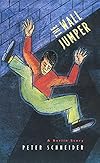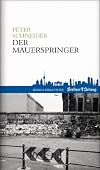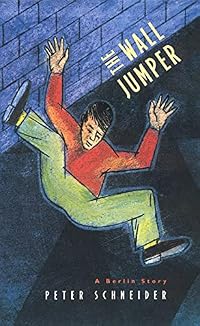
The Wall Jumper
by Peter Schneider
On This Page
Description
Berlin before the fall of the Wall is a city divided, yet its ordinary residents find ways to live and survive on both sides. There is Robert, teller of bar room anecdotes over beer and vodka, adjusting to a new life in the west; Pommerer, trying to outwit the system in the east; the unnamed narrator, who 'escapes' back-and-forth to collect stories; his beguiling, exiled lover Lena; the three boys who defect to watch Hollywood films; and the man who leaps across the Wall again and again - show more simply because he cannot help himself. All are, in their different ways, wall jumpers, trying to lose themselves but still trapped wherever they go. Ultimately, the walls inside their heads prove to be more powerful than any man-made barrier . . . show lessTags
Recommendations











































Member Reviews
This short book calls itself a story, but it reads more like an extended essay. Schneider playfully explores the way ordinary people were dealing with the phenomenon of the Berlin Wall at a point in the 1980s where it had been in existence for a good twenty years and wasn't showing any sign of ever going away again. He talks about his own experience as a West Berlin resident occasionally visiting the East, and about his friends on both sides — his girlfriend, who has moved from East to West leaving her family behind; a neighbour who moves from West to East; East German writers and their friends, and so on.
He also gives us various case-studies of individualists who challenged the existence of the border in odd ways: the eponymous show more "wall-jumper," who repeatedly vaulted the wall from West to East on the apparent grounds that he couldn't be bothered to walk round to the official crossing point (the West Berlin authorities couldn't prosecute him since they didn't recognise the border; those in the East didn't know what to do with him other than sticking him in mental institutions to cool his heels before sending him home); the three East Berlin lads who discovered a weak point in the wall and used it to spend their Saturday afternoons in a West Berlin cinema (no-one noticed until a West German journalist got hold of the story); a man who drove the intelligence services on both sides crazy by repeatedly crossing over to offer his services as a double- triple- or quadruple-agent; another who spent his time raiding the border fortifications to steal East German military hardware; and so on.
The point seems to be that in the real world, people are able to accommodate themselves to almost any weird situation, even a city arbitrarily split in two, and just find ways to get on with normal life. But also, it's a reminder to West Germans not to make too many easy assumptions about the intrinsic superiority of their system. The DDR had a lot of things wrong with it, but there was always another side to the argument, and — up to a point — it continued to function because there were enough people who still believed in the ideals of socialism and were not bursting to move away but cherished the hope that the country's deficiencies could be repaired. show less
He also gives us various case-studies of individualists who challenged the existence of the border in odd ways: the eponymous show more "wall-jumper," who repeatedly vaulted the wall from West to East on the apparent grounds that he couldn't be bothered to walk round to the official crossing point (the West Berlin authorities couldn't prosecute him since they didn't recognise the border; those in the East didn't know what to do with him other than sticking him in mental institutions to cool his heels before sending him home); the three East Berlin lads who discovered a weak point in the wall and used it to spend their Saturday afternoons in a West Berlin cinema (no-one noticed until a West German journalist got hold of the story); a man who drove the intelligence services on both sides crazy by repeatedly crossing over to offer his services as a double- triple- or quadruple-agent; another who spent his time raiding the border fortifications to steal East German military hardware; and so on.
The point seems to be that in the real world, people are able to accommodate themselves to almost any weird situation, even a city arbitrarily split in two, and just find ways to get on with normal life. But also, it's a reminder to West Germans not to make too many easy assumptions about the intrinsic superiority of their system. The DDR had a lot of things wrong with it, but there was always another side to the argument, and — up to a point — it continued to function because there were enough people who still believed in the ideals of socialism and were not bursting to move away but cherished the hope that the country's deficiencies could be repaired. show less
A precious insight into a world being quickly forgotten, Schneider’s novel elucidates the banal insanity of the Berlin Wall, and the complexity of the human responses to it. The wall jumper, who constantly leaps across the border from West to East (to the confusion of all) “because it’s there”, is one extroverted symptom of a wider, creeping malady. The inhabitants of each society voice their views about the world in the terminology of their home republic, and become by that means mouthpieces for their respective governments. This contrast between states that share a language and a history is exhibited endlessly, from conversations in bars to news coverage of terrorists/freedom fighters in Mozambique (according to taste). The show more Wall Jumper is a startling book that has an enormous amount to contribute to our understanding of our selves, as well as an invaluable history lesson for students of German politics who want to understand why, in many ways, the Wall still stands. show less
In this interesting book, published in 1984 five years before the Berlin Wall came down, Schneider explores the social, political and intellectual differences and similarities between the inhabitants of East and West Berlin. While some differences are apparent, little is black and white, and Schneider remarks that he is surprised at how quickly and how deeply attitudes have changed following the division of the two states: time, propaganda, repression, inculcation, education, psychology have all had their influences and effects and often inhibit dialogue and understanding:
“At first Pommerer was curious about the responses my foreign gaze on his surrounding would elicit. Since then, his curiosity has increasingly given way to the need show more to protect his routine from the impudence, even the stupidity of my first impressions. I am shocked by certain restrictions on his life which he has long since accepted. My shock inescapably reminds him of his initial feelings, which he has rejected as pointless. More and more often, he counters my reactions by referring to parallel phenomena in the West.”
Schneider and another of his friends argue because they interpret exactly the same news item or broadcast or picture in a paper or incident through entirely different lenses: “…I take what I see at face value; Robert has been trained to read between the lines. Where I perceive merely an event, maybe an accident, Robert perceives a plan that he has to decipher.”
The ambiguity of the situation of an East and West Germany is summed up nicely:
“I turned forty last year. The two states which bear the word “German” in their initials have just celebrated their thirtieth birthday. So I am ten years older than the state that has grown up around me and in me. On the basis of age alone, I can’t call it my fatherland. What’s more, this state represents only a part of the country that would be my fatherland. If my fatherland exists, it isn’t a state, and the state of which I am a citizen is not a fatherland. If I respond to queries about my nationality by saying without hesitation that I’m German, I am clearly opting not for a state, but for a people that no longer has a state identity. At the same time, however, I assert that my national identity does not depend on either of the German states.”
A book of interesting and insightful considerations, echoes of which are probably still apparent after the physical re-unification of the two Germanies. show less
“At first Pommerer was curious about the responses my foreign gaze on his surrounding would elicit. Since then, his curiosity has increasingly given way to the need show more to protect his routine from the impudence, even the stupidity of my first impressions. I am shocked by certain restrictions on his life which he has long since accepted. My shock inescapably reminds him of his initial feelings, which he has rejected as pointless. More and more often, he counters my reactions by referring to parallel phenomena in the West.”
Schneider and another of his friends argue because they interpret exactly the same news item or broadcast or picture in a paper or incident through entirely different lenses: “…I take what I see at face value; Robert has been trained to read between the lines. Where I perceive merely an event, maybe an accident, Robert perceives a plan that he has to decipher.”
The ambiguity of the situation of an East and West Germany is summed up nicely:
“I turned forty last year. The two states which bear the word “German” in their initials have just celebrated their thirtieth birthday. So I am ten years older than the state that has grown up around me and in me. On the basis of age alone, I can’t call it my fatherland. What’s more, this state represents only a part of the country that would be my fatherland. If my fatherland exists, it isn’t a state, and the state of which I am a citizen is not a fatherland. If I respond to queries about my nationality by saying without hesitation that I’m German, I am clearly opting not for a state, but for a people that no longer has a state identity. At the same time, however, I assert that my national identity does not depend on either of the German states.”
A book of interesting and insightful considerations, echoes of which are probably still apparent after the physical re-unification of the two Germanies. show less
An interesting exploration of the absurdity of a city and more so a country that is divided against itself. The basic synopsis of the story is that the narrator constantly travels back and forth between West and East Berlin collecting stories about people who have jumped the Berlin Wall. What the author seems to find is that the people on each side inevitably become mouth peaces or their prospective government. The best example of this can be seen at the end of the book when the narrator and his east German friend are watching the Olympic Hockey game between the USA and Russia when there is a referee call. The man from East Germany sees a bogus call stating that the American player pushed the Russian player pining the goalie. While the show more narrator who is from West Germany sees an acceptable goal for the USA. There’s also an interesting concept about how in the west we re-innovate while in the east they build. The writing is a little hard to get into at first as it's written almost like a journal or a collection of newspaper clippings but once you get past that it flows rather well. Each chapter is set with the narrator on one side of the wall or the other (ie ch1 in the east ch2 west ch3 east ect). Overall an interesting little novel about how people can change in a short span of time and how people are shaped by where they grow up as well as how trying to isolate a population has its own troubles. show less
A book of dualisms. Two cities of one city. Set in the last decade before the Berlin Wall came down
It’s a novel of sorts full of facts and stories about the wall and those who fight against it or live in its forbidding shadow. Sometimes essay like. Sometimes memoir like.
It’s a novel of sorts full of facts and stories about the wall and those who fight against it or live in its forbidding shadow. Sometimes essay like. Sometimes memoir like.
A figment of some anarchic imagination and a fascinating glimpse of Berlin life before the wall came down, by Peter Schneider
Members
- Recently Added By
Lists

EU Fiction: 1950-2022
223 works; 70 members

Walls
24 works; 2 members
Author Information

26+ Works 771 Members
Some Editions
Awards and Honors
Notable Lists
Series
Belongs to Publisher Series
Common Knowledge
- Canonical title
- The Wall Jumper
- Original title
- Der Mauerspringer
- Original publication date
- 1982
- Important places
- Berlin Wall, Berlin, Germany; Berlin, Germany; German Democratic Republic; Germany
- First words
- In Berlin, the prevailing winds are from the west.
- Last words
- (Click to show. Warning: May contain spoilers.)But the city outside, with its fire walls, garden walls, border walls - those walls will still be standing when no one is left to move beyond them.
- Original language
- German
Classifications
- Genres
- Fiction and Literature, General Fiction
- DDC/MDS
- 833.914 — Literature & rhetoric German & related literatures German fiction 1900- 1900-1990 1945-1990
- LCC
- PT2680 .N37 .M313 — Language and Literature German, Dutch and Scandinavian literatures German literature Individual authors or works 1961-2000
- BISAC
Statistics
- Members
- 347
- Popularity
- 90,658
- Reviews
- 8
- Rating
- (3.54)
- Languages
- 8 — Danish, Dutch, English, French, German, Italian, Portuguese, Spanish
- Media
- Paper
- ISBNs
- 20
- ASINs
- 3