Bones: Skeletons and How They Work
by Steve Jenkins
On This Page
Description
A guide to human and animal skeletons provides informative comparisons while sharing such facts as the number of bones in the human body and the ways that skeletal structures work.Tags
Recommendations



Member Reviews
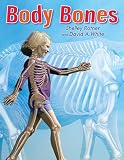
This book is far from skinny -- it's the definitive nonfiction title about human and animal bones, delivered with in-your-face accuracy and intrigue. In this visually driven volume, kids come face-to-face with some head-to-toe boney comparisons, many of them shown at actual size. Here you'll find the differences between a man's hand and that of a spider monkey; the great weight of an elephant's leg, paired with the feather-light femur of a stork; and rib-tickling info about snakes and sloths. How many bones are in the whole human body?
Really cool graphic representation of skeletal structures of various animals, showing differences and similarities. Z was particularly struck by the scale - he could easily extrapolate actual size.
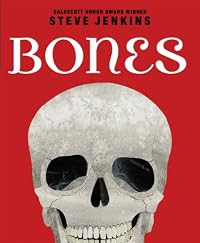
In this artistic and educational book about bones, Caldecott Honor award winner Steve Jenkins creates vivid images by crafting bones and skeletons from cut paper collage and mounting them on vibrant solid color backgrounds. Short paragraphs of large print text explain the basic functions of bones. Humorous headings, such as “Got Your Back” and “Rib-It,” help clarify the logical progression of information from a single bone to a complete skeleton. Bones of different species are compared to each other in fascinating page spreads to highlight their similarities and differences; a layout showing the skeletons of the arms or forelimbs of a human, mole, spider monkey, grey whale, turtle, and fruit bat clearly demonstrates that they show more are all comprised of the same basic bones. Three gatefold spreads open to reveal larger illustrations, such as the stunning skeleton of a small python with almost 200 pairs of ribs. A note at the bottom of each layout indicates its scale. The last four pages consist of boxes with smaller text containing interesting, illustrated facts, stories, and trivia about bones, exoskeletons, and fossils designed for older children, such as the possible origin of the Cyclops. Jenkins consulted with a manager of the Department of Mammalogy at the American Museum of Natural History on this book, but the lack of references and resources diminishes an otherwise an impressive work. Whether or not they enjoy science, children aged seven to twelve will be captivated by the intriguing images and information in this distinctive book. show less
I absolutely loved Bones: Skeletons and How they Work by Steve Jenkins. Being one of the first informational children’s books I decided to take a look at, I expected it to be boring. But surprisingly it wasn’t at all! The reasons I liked the book were because it was engaging, organized, and clear. This non-fiction book was about human and animal bones, with illustrations that show amazing comparisons. Some of these illustrations are labeled as “actual size shown”. The author used questions to engage the students, such as “So how many bones do you think are actually in the human body?” Then students would turn the page to find out. The writing was organized and clear, but extremely thorough. Not only do you learn about the show more human body, but find the difference between an elephant’s leg and a spider monkey. This was also cool information about the ribs of snakes! To make the illustrations more clear, the book has a fold-out section that reveals the entire bone structure of a human. The message of this informational text was to inform students about bones, comparing humans to animals! show less
Anatomy was one of my favorite courses in high school so immediately I chose this book to read. I think I would've rather the book be just about the human skeleton than bones in general. I realized that I don't really care about other creature's bones. Also half the book is fold out pages and what not. This is cool in theory but whoever read this book before me did not fold the pages back in the correct order so I was a confused mess trying to read it. I finally figured it out and arranged them how they should be. I guess I would suggest to either take the fold outs out completely or at least number the pages. The extra information in the back was honestly my favorite part.
This book is about skeletons and the bones we have. Not only human bones, but also animal bones. It also gives brief details of the function of bones and the importance of them. It is a really good book to use in mathematics to compare bones measurements. Students can measure the bones in the book and to the animal bones and explain the difference between them. It is very informational as well, where teachers can use it in Science class to learn about the skeletal system. I would not necessarily use it as an read-aloud, but would read portions of it and have students look at the pictures. Steve Jenkins never fails to amaze me!
Love the illustrations. They are interesting and yet shivery. As a child I was always drawn to the dead animals I found around me and their various stages of decay. One of the benefits of growing up in the country on a farm. I wish I had had a book like this to give answers to the many questions of that age. Bones gives comparative illustrations of bones from various animals and humans. Very considerately, the one of the snake skeleton is in fold out pages, so, once a person like me knows it is there, I never have to look at it again. ;) I love this book.
Members
- Recently Added By
Lists

Children's Books About Science and Math
461 works; 12 members
Author Information

75+ Works 21,314 Members
Awards and Honors
Awards
Distinctions
Notable Lists
Classifications
Statistics
- Members
- 638
- Popularity
- 45,333
- Reviews
- 38
- Rating
- (4.36)
- Languages
- English
- Media
- Paper, Ebook
- ISBNs
- 5
- ASINs
- 4