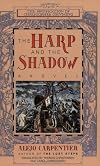
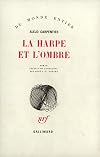
The Harp and the Shadow
by Alejo Carpentier
On This Page
Description
A collection of short stories, the harp, the hand, and the shadow.Tags
Recommendations




















Member Reviews
In the latter half of the 20th century, a petition by the aristocracy of the Catholic Church for the canonization of Christopher Columbus was received by the Pope. It will be 500 years since his discovery of the Americas, and while the circumstances were extraordinary -- too long a period since the death of the concerned, the lack of certain biographical documentation necessary to attribute sainthood according to the canon -- still, it was pointed out, Columbus deserved sainthood at the very least, being the instrument of God to bring the light of Christianity to the heathens in those dark lands. His halo has been invisible all these centuries and the time has come to make it manifest. The Pope ponders the issue and, for his own reasons show more as well (Columbus would be both an "indigenous" saint as well as a European one, thus unique in bridging the two worlds, and the Pope himself believed in "political action inspired by the politics of God"), put his signature on the petition that would the start the wheels turning on the process that would lead Columbus to either sainthood or eternal subsidiarity to other hallowed figures in the Catholic firmament.
The scene changes -- we are in a small room in a monastery in Valladolid, five centuries back. Christopher Columbus is on his deathbed, and as he waits for the priest to arrive for his last confession, he contemplates what the world knew of him and what they did not know of what it took for him to get there. Should he tell all to the priest, hiding nothing, or should he carry his secrets to his grave? He was not sure. Instead, he recalls everything -- the almost insurmountable challenges he faced before, during, and after his so-called discoveries of new lands, his singlemindedness to reach the place where gold was to be found, and the deception (always the deception) in all forms and excepting no one, that he employed without compunction throughout. Beneath all the hero worship, the celebrity status, the strong, indomitable image, the title conqueror for king and God -- and known only to himself and to the men he took with him on his voyages, however, he is none of the above. He knew he was no saint.
Fast forward, and he is a spirit wandering among the crowds in the piazza in the Vatican, and heading to the inner rooms where his possible sainthood was being deliberated, becomes a witness to the Morality Play of his life and deeds. It is all out now, the darkest of his secrets has been laid bare. He ends at the piazza where he meets the spirit of Andrea Doria, Grand Admiral of Venice and Genoa, a real hero who fought off the Turks in the Middle Ages. Columbus is embarassed -- he never did such battle for Christ or even contemplated it. He comes to a realization, and the reader does, too, that perhaps like the dreams of treasure that he spun in the imagination of the rulers of the Old World, he, too, was ephemeral.
Alejo Carpentier wrote this novel in 1979, which was translated into English in 1990, in anticipation of the quincentenary of Columbus's arrival in the New World. It is an excellent tale, written with exemplary wit and imagination in Carpentier's baroque style, which is pure pleasure to read. This is a short novel, as most of Carpentier's works are, but it is wonderful and for literary quality packs so much more than many books several times its size can. show less
The scene changes -- we are in a small room in a monastery in Valladolid, five centuries back. Christopher Columbus is on his deathbed, and as he waits for the priest to arrive for his last confession, he contemplates what the world knew of him and what they did not know of what it took for him to get there. Should he tell all to the priest, hiding nothing, or should he carry his secrets to his grave? He was not sure. Instead, he recalls everything -- the almost insurmountable challenges he faced before, during, and after his so-called discoveries of new lands, his singlemindedness to reach the place where gold was to be found, and the deception (always the deception) in all forms and excepting no one, that he employed without compunction throughout. Beneath all the hero worship, the celebrity status, the strong, indomitable image, the title conqueror for king and God -- and known only to himself and to the men he took with him on his voyages, however, he is none of the above. He knew he was no saint.
Fast forward, and he is a spirit wandering among the crowds in the piazza in the Vatican, and heading to the inner rooms where his possible sainthood was being deliberated, becomes a witness to the Morality Play of his life and deeds. It is all out now, the darkest of his secrets has been laid bare. He ends at the piazza where he meets the spirit of Andrea Doria, Grand Admiral of Venice and Genoa, a real hero who fought off the Turks in the Middle Ages. Columbus is embarassed -- he never did such battle for Christ or even contemplated it. He comes to a realization, and the reader does, too, that perhaps like the dreams of treasure that he spun in the imagination of the rulers of the Old World, he, too, was ephemeral.
Alejo Carpentier wrote this novel in 1979, which was translated into English in 1990, in anticipation of the quincentenary of Columbus's arrival in the New World. It is an excellent tale, written with exemplary wit and imagination in Carpentier's baroque style, which is pure pleasure to read. This is a short novel, as most of Carpentier's works are, but it is wonderful and for literary quality packs so much more than many books several times its size can. show less
Alejo Carpentier has been one of my favorite authors since I read The Lost Steps, and this book, essentially about Christopher Columbus, does not disappoint.
The story opens in the late 19th century, with pomp and circumstance, as the pope of the era, Pius IX, is escorted to his personal chambers where he will consider signing a document that will set in motion an investigation into whether Columbus should be made a saint. (This is tricky, because usually people are beatified soon after they die, so people who knew them can testify about their miracles.) As he reflects on this, he recalls his time in Peru as a young priest (he was the first pope to have spent any time in America) and by implication the political machinations that he show more engaged in to set him on the road to advancement within the church.
The majority of the book is set some 400 years earlier, as Columbus lies on his deathbed. Awaiting the confessor, he recalls his life, and vows to tell all to the confessor. The reader sees through Columbus's eyes as he learns of a land to the west (which he still thinks is the Indies) and builds up a spiel to try to convince ruler after ruler to finance ships for him to explore further south than the Vikings did. Although Ferdinand and Isabella first turn him down, after they conquer Granada and drive the Muslims out of Spain, they decide to sponsor him. It is Isabella who really is in charge, and Carpentier makes Columbus and Isabella lovers. (He also vaguely impleis that Columbus has "mixed" origins, i.e., Jewish. Various "new Christians" make appearances in the novel.) Once on the seas and in America, Columbus turns out to be obsessed by gold (or GOLD), and treats the people he encounters (who he calls cannibals, although he never sees them) cruelly and shamefully. The novel presents his dramatic return to the court in Spain with "Indians" and very little gold, but he is still received very grandly. Despite his lack of loot, the rulers send Columbus on another voyage (because basically they don't want him to go to other countries and have them sponsor him), and in this one he develops the idea of enslaving the "Indians" since there isn't gold, an idea which on practical and religious grounds doesn't fly. The books skims over his two other trips. But at the end of reviewing his life, Columbus hears the step of the confessor on the stair and decides not to tell him much.
Then the scene shifts and Columbus is a spirit, the Invisible One, at the meeting reviewing the proposal to make him a saint. This is an hilarious section, as the meeting participants include the Devil's Advocate and spirits of famous people like Victor Hugo (most of the others I had to look up on Wikipedia), with comments by the Invisible One on his chances; ultimately, as we know, the committee voted against making Columbus a saint. The novel closes with Columbus encountering another Genoan, and another famous sailor, Andrea Doria.
What holds this book together is the power of Carpentier's writing. With his dazzling prose, he creates worlds. show less
The story opens in the late 19th century, with pomp and circumstance, as the pope of the era, Pius IX, is escorted to his personal chambers where he will consider signing a document that will set in motion an investigation into whether Columbus should be made a saint. (This is tricky, because usually people are beatified soon after they die, so people who knew them can testify about their miracles.) As he reflects on this, he recalls his time in Peru as a young priest (he was the first pope to have spent any time in America) and by implication the political machinations that he show more engaged in to set him on the road to advancement within the church.
The majority of the book is set some 400 years earlier, as Columbus lies on his deathbed. Awaiting the confessor, he recalls his life, and vows to tell all to the confessor. The reader sees through Columbus's eyes as he learns of a land to the west (which he still thinks is the Indies) and builds up a spiel to try to convince ruler after ruler to finance ships for him to explore further south than the Vikings did. Although Ferdinand and Isabella first turn him down, after they conquer Granada and drive the Muslims out of Spain, they decide to sponsor him. It is Isabella who really is in charge, and Carpentier makes Columbus and Isabella lovers. (He also vaguely impleis that Columbus has "mixed" origins, i.e., Jewish. Various "new Christians" make appearances in the novel.) Once on the seas and in America, Columbus turns out to be obsessed by gold (or GOLD), and treats the people he encounters (who he calls cannibals, although he never sees them) cruelly and shamefully. The novel presents his dramatic return to the court in Spain with "Indians" and very little gold, but he is still received very grandly. Despite his lack of loot, the rulers send Columbus on another voyage (because basically they don't want him to go to other countries and have them sponsor him), and in this one he develops the idea of enslaving the "Indians" since there isn't gold, an idea which on practical and religious grounds doesn't fly. The books skims over his two other trips. But at the end of reviewing his life, Columbus hears the step of the confessor on the stair and decides not to tell him much.
Then the scene shifts and Columbus is a spirit, the Invisible One, at the meeting reviewing the proposal to make him a saint. This is an hilarious section, as the meeting participants include the Devil's Advocate and spirits of famous people like Victor Hugo (most of the others I had to look up on Wikipedia), with comments by the Invisible One on his chances; ultimately, as we know, the committee voted against making Columbus a saint. The novel closes with Columbus encountering another Genoan, and another famous sailor, Andrea Doria.
What holds this book together is the power of Carpentier's writing. With his dazzling prose, he creates worlds. show less
Articulada en torno a la figura de Cristóbal Colón y al intento que de canonizarle llevara a cabo Pío IX, EL ARPA Y LA SOMBRA es una obra en la que la maestría narrativa y el dominio del lenguaje de Alejo Carpentier (1904-1980) brillan con intensidad especial. En manos del gran escritor cubano, en efecto, la figura del des- cubridor se revela como materia insuperable para explorar los matices y claroscuros no sólo del individuo en sí, sino también en relación con la realidad que lo circunda: un vínculo complejo en que lo que aparece como sombra la mediocridad como marino, la usurpación de conocimientos ajenos, la impostura se transmuta acaso, por obra de la determinación, en el destellante resplandor de lo maravilloso que show more de pronto irrumpe en la opaca vida diaria. show less
May 19, 2014Spanish
Articulada en torno a la figura de Cristóbal Colón y al intento que de canonizarle llevara a cabo Pío IX, El arpa y la sombra-es una obra en la que la maestría narrativa y el dominio del lenguaje de Alejo Carpentier (1904-1980) brillan con intensidad especial. En manos del gran escritor cubano, en efecto, la figura del descubridor se revela como materia insuperable para explorar los matices y claroscuros no sólo del individuo en sí, sino también en relación con la realidad que lo circunda: un vínculo complejo en que lo que aparece como sombra -la mediocridad como marino, la usurpación de conocimientos ajenos, la impostura- se transmuta acaso, por obra de la determinación, en el destellante resplandor de lo maravilloso que de show more pronto irrumpe en la opaca vida diaria. show less
Jul 13, 2022Spanish
En esta novela cuaja un intento que se remonta a casi cuatro décadas: la desmitificación de la figura del Gran Almirante, a quien por aquel entonces se intentó incluso canonizar. Carpentier nos muestra en su obra, con agudeza, humor y acostumbrada erudición, la efigie de un Colón de carne y hueso, enmarcado en su contexto histórico, y las verdaderas motivaciones de su gran descubrimiento del mundo americano, surgidas de imperiosas necesidades económicas del poder español, arruinado por las guerras de Reconquista.
Con El arpa y la sombra, escrita en 1978, se cierra el fecundo ciclo creativo de Alejo Carpentier (1904-1980), que la muerte detuvo en plena producción. Una vez más demostró nuestro gran escritor su apasionado amor show more por el tema americano, en este su último viaje por las tierras de lo real-maravilloso. show less
Con El arpa y la sombra, escrita en 1978, se cierra el fecundo ciclo creativo de Alejo Carpentier (1904-1980), que la muerte detuvo en plena producción. Una vez más demostró nuestro gran escritor su apasionado amor show more por el tema americano, en este su último viaje por las tierras de lo real-maravilloso. show less
May 10, 2022Spanish
Ratings
Members
- Recently Added By
Author Information

123+ Works 6,243 Members
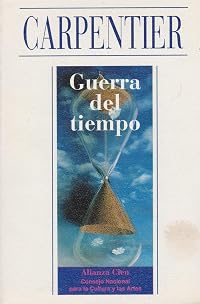
Alejo Carpentier was director of Cuba's National Press, which published many millions of volumes in an ambitious program, and for some years was Cuba's ambassador to France. A composer and musicologist, he consciously applied the principles of musical composition in much of his work. Imprisoned for political activity in 1928, he escaped with the show more aid of Robert Desnos, a French surrealist poet, to Paris, where he joined the literary circle of surrealists Louis Aragon, Tristan Tzara, and Paul Eluard. According to Carpentier surrealism influenced his style and helped him to see "aspects of American life he had not previously seen, in their telluric, epic, and poetic contexts." Carpentier articulated a theory of marvelous reality, "lo real maravilloso," with an almost surrealistic sense of the relationship among unrelated, or antithetical, elements, often from distinct ethnic and cultural backgrounds. The Lost Steps (1953) takes the form of a diary of a Cuban musician and intellectual who seeks escape from civilization during his trip to a remote Amazon village in search of native musical instruments. The short stories "The Road to Santiago," "Journey to the Seed," and "Similar to Night," present time as subjective rather than historical, and capable of remarkable personal variations. In his novel The Pursuit, printed in The War of Time (1958), whose title is an allusion to a line from Lope de Vega defining a man as "a soldier in the war of time, presents time similarly. "The Kingdom of This World (1949) deals with the period of Henri Christophe and the slave revolts in Haiti. Its circular structure presents the inevitable recurrence of tyranny and the need for eternal struggle against it. Reasons of State (1976), is another notable addition to the gallery of Latin American fictional portraits of dictators. It uses Carpentier's love for baroque style and parody to raise complex questions about the nature of revolution. (Bowker Author Biography) show less
Some Editions
Awards and Honors
Awards
Series
Belongs to Publisher Series
Gallimard, Folio (1742)
Common Knowledge
- Canonical title
- The Harp and the Shadow
- Original title
- El arpa y la sombra
- Original publication date
- 1979
- People/Characters
- Christopher Columbus
- Epigraph*
- Zur Harfe, wenn sie klingen soll, gehört dreierlei: die Kunst, die Hand und die Saite. Zum Menschen: der Körper, die Seele und der Schatten.
Legenda Aurea - Dedication*
- Für Lilia
- First words*
- Zurück blieben die siebenundachtzig Lampen auf dem Altar der Confessio, deren Flammen mehr als einmal an diesem Morgen aufgezuckt waren, wenn die siegreichen Töne des von den klangvollen Stimmen des päpstlichen Chors gesu... (show all)ngenen Te Deum die Glasbehälter hatten erbeben lassen; still wurden die monumentalen Portale geschlossen, und in der Sakramentskapelle, die in Dämmerschatten zu liegen schien für alle, die aus den strahlenden Lichtern der Basilika heraustraten, stand der Tragsessel, von den Schultern auf die Hände herabgelassen, drei Handbreit über dem Boden still.
- Last words*
- (Click to show. Warning: May contain spoilers.)Und genau an jener Stelle des Platzes, von wo aus, wenn man auf die kreisförmigen Kolonnaden blickt, vier Säulen aussehen wie eine einzige, löste sich der Unsichtbare in der ihn umfangenden, ihn durchwehenden Luft auf und wurde eins mit der Transparenz des Äthers.
- Original language
- Kubanisches Spanisch; Spanish
*Some information comes from Common Knowledge in other languages. Click "Edit" for more information.
Classifications
- Genres
- Fiction and Literature, General Fiction, Historical Fiction
- DDC/MDS
- 863 — Literature & rhetoric Spanish Literature Spanish fiction
- LCC
- PQ7389 .C263 .A8913 — Language and Literature French, Italian, Spanish and Portuguese literatures Spanish literature Provincial, local, colonial, etc. Spanish America
- BISAC
Statistics
- Members
- 254
- Popularity
- 127,349
- Reviews
- 5
- Rating
- (3.57)
- Languages
- 8 — English, French, German, Hungarian, Italian, Polish, Spanish, Swedish
- Media
- Paper, Ebook
- ISBNs
- 25
- ASINs
- 5