
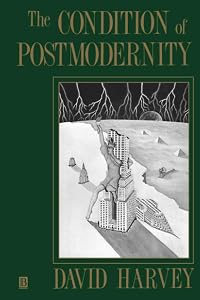
The Condition of Postmodernity: An Enquiry into the Origins of Cultural Change
by David Harvey
On This Page
Description
Traces the development of the concept of postmodernism, explains its differences with modernism, and discusses political and social influences.Tags
Recommendations









Member Reviews
Pretty clear introduction to postmodern theory, so I suppose this is a good place to start if you're interested in postmodernism. However, it didn't kindle much interest in me for this topic. I'm still not sure where the appeal of postmodern thought lies.
A great deal has been written on what has variously been described as the postmodern condition and on postmodern culture, architecture, art and society. In this new book, [the author] seeks to determine what is meant by the term in its different contexts and to identify how accurate and useful it is as a description of contemporary experience.
But the book is much more than this: in the course of his investigation the author provides a social and semantic history – from the Enlightenment to the present – of modernism and its expression in political and social ideas and movements, as well as in art, literature and architecture. He considers in particular how the meaning and perception of time and space themselves vary over time and show more space, and shows that this variance affects individual values and social processes of the most fundamental kind.
This book will be widely welcomed, not only for its clear and critical account of the arguments surrounding the propositions of modernity and postmodernity, but as an incisive contribution to the history of ideas and their relation to social and political change.
'Devastating. The most brilliant study of postmodernity to date. [The author] cuts beneath the theoretical debates about postmodernist culture to reveal the social and economic basis of this apparently free-floating phenomenon. After reading this book, those who fashionably scorn the idea of a "total" critique had better think again.' – Terry Eagleton
'[The author]'s book is probably the best yet written on the link between…economic and cultural transformations.' – Financial Times
'[The author]'s engrossing book is probably the most readable, ambitious, and intelligent work on postmodernism yet published.' – Voice Literary Supplement
'In [the author]'s skillful hands various strands of contemporary life, normally held far apart by specialized scholarly interests, come together again and are shown to fit with each other...a marvelous, enjoyable and mind-opening book.' – Time Literary Supplement show less
But the book is much more than this: in the course of his investigation the author provides a social and semantic history – from the Enlightenment to the present – of modernism and its expression in political and social ideas and movements, as well as in art, literature and architecture. He considers in particular how the meaning and perception of time and space themselves vary over time and show more space, and shows that this variance affects individual values and social processes of the most fundamental kind.
This book will be widely welcomed, not only for its clear and critical account of the arguments surrounding the propositions of modernity and postmodernity, but as an incisive contribution to the history of ideas and their relation to social and political change.
'Devastating. The most brilliant study of postmodernity to date. [The author] cuts beneath the theoretical debates about postmodernist culture to reveal the social and economic basis of this apparently free-floating phenomenon. After reading this book, those who fashionably scorn the idea of a "total" critique had better think again.' – Terry Eagleton
'[The author]'s book is probably the best yet written on the link between…economic and cultural transformations.' – Financial Times
'[The author]'s engrossing book is probably the most readable, ambitious, and intelligent work on postmodernism yet published.' – Voice Literary Supplement
'In [the author]'s skillful hands various strands of contemporary life, normally held far apart by specialized scholarly interests, come together again and are shown to fit with each other...a marvelous, enjoyable and mind-opening book.' – Time Literary Supplement show less
Marxist view of post-modernity.
Reviewed by Steven Best here:
http://www.drstevebest.org/papers/phiecosoc/book_reviews/harvey.htm
More on the book's contents here:
http://webpages.ursinus.edu/rrichter/harvey.html
http://www.drstevebest.org/papers/phiecosoc/book_reviews/harvey.htm
More on the book's contents here:
http://webpages.ursinus.edu/rrichter/harvey.html
(Har ett stencilerat utsnitt hemma). Intressant att höra en marxist närma sig postmodernismen. Insiktsfullt.
May 20, 2014Swedish
Members
- Recently Added By
Lists

culture
320 works; 1 member
Author Information

41+ Works 7,204 Members
David Harvey received a Bachelor's degree and Ph.D. in geography from Cambridge University. After graduating in 1961, he joined the geography department at Bristol University as a lecturer. In the following years, he held teaching positions at Johns Hopkins and Oxford universities. He has written numerous books including Justice Nature and the show more Geography of Differences, The Urban Experience, The Condition of Postmodernity, and An Enquiry into the Origins of Cultural Change. He has received many honors, among them the Outstanding Contributor Award of the Association of American Geographers, the Anders Retzuis Gold Medal of the Swedish Society of Anthropology and Geography, and the Vautrin Lud International Geography Prize. (Bowker Author Biography) show less
Common Knowledge
- Canonical title*
- La crisi della modernità
- Original title
- The Condition of Postmodernity: An Enquiry into the Origins of Cultural Change
- Original publication date
- 1990
*Some information comes from Common Knowledge in other languages. Click "Edit" for more information.
Classifications
- Genres
- Nonfiction, Sociology, History, General Nonfiction, Philosophy, Literature Studies and Criticism, Art & Design
- DDC/MDS
- 909.82 — History & geography History World history 1800- 1900-1999, 20th century
- LCC
- CB428 .H38 — Auxiliary Sciences of History History of Civilization History of Civilization By period
- BISAC
Statistics
- Members
- 1,034
- Popularity
- 24,981
- Reviews
- 6
- Rating
- (4.01)
- Languages
- 5 — English, Italian, Portuguese, Spanish, Turkish
- Media
- Paper
- ISBNs
- 11
- ASINs
- 5