The Whingdingdilly
by Bill Peet
On This Page
Description
Tired of a dog's life, Scamp visits the wicked little witch in the woods and becomes a whingdingdilly.Tags
Recommendations
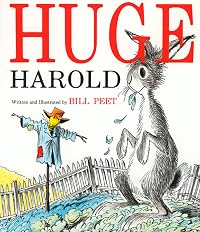
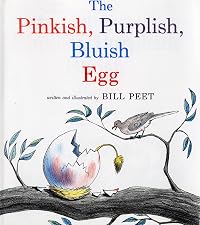


Member Recommendations
Member Reviews
One of the cleverest, funniest children's books I've ever read. I can still hear my kid brother laughing his head off and my father laughing himself to tears when reading it to him.
In my opinion, this is an amazing book that seeks to demonstrate the big idea of self-acceptance. The author demonstrates to the reader how one should accept himself or herself rather than wishing to be like someone else. Scamp wanted so desperately to be widely loved that he missed how the he was already loved by Orvie. It was only when Scamp became something else that he realized that his original appearance was fine.
There were many reasons why I liked this book. The first reason was due to the language. The author employed a variety of made up words such as “Whingdingdilly,” “Hullabalooper,” “hornswoggled,” “zarks,” “frowsy,” and “rooked” in order to catch the reader’s attention and create interest in the show more text. At one point in the story, Zidly turned Scamp back into a dog by stating, “’Whammy Ka Zammy Skrumbo Skaroof! Zigga Zum Zap! Zaroota Ker-Poof!” This one line is filled with made up words that add excitement to the text. In addition, by employing unknown words, the reader can associate strong emotions and feelings to the words because they are unknown. Furthermore, the new words test the reader’s pronunciation because the reader must determine how to say these unknown words.
Another reason why I liked this book was because the writing is organized in a way that engages the reader and allows the text to flow throughout the story. For instance, the author employed rhyme during multiple parts of the book. During Zidly’s first spell, she states, “’Zum zum zaroot most anything goes, so how about a rhinoceros nose.’” By employing rhyme, the author catches the reader’s attention and gears it back to the text. The author then continues using rhyme as a method of engagement and interest throughout various portions of the book.
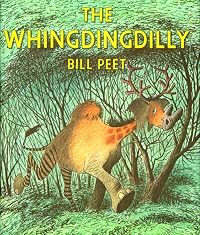
Finally, I like this book because the illustrations enhance the story and add understanding. This book is filled with a variety of new vocabulary and complex ideas, which can make it complicated for a child to understand. However, the illustrations match perfectly with the text and grant the reader additional insight and knowledge that help the reader to understand. For instance, the text says that Scamp is a Whingdingdilly and briefly describes what a Whingdingdilly is. However, without the illustration, the reader would be confused as to how the Whingdingdilly could possibly look because there are so many different parts to the animal. The illustration gives the reader the visual information he or she needs to make sense of the text. It also gives insight into why the people in the story react so strongly to Scamp’s appearance. The illustrations also provide color and imagery that interests the reader in the book and grabs his or her attention. The illustrations in combination to the writing and language produce a unique book that grabs the interest of the reader. show less
There were many reasons why I liked this book. The first reason was due to the language. The author employed a variety of made up words such as “Whingdingdilly,” “Hullabalooper,” “hornswoggled,” “zarks,” “frowsy,” and “rooked” in order to catch the reader’s attention and create interest in the show more text. At one point in the story, Zidly turned Scamp back into a dog by stating, “’Whammy Ka Zammy Skrumbo Skaroof! Zigga Zum Zap! Zaroota Ker-Poof!” This one line is filled with made up words that add excitement to the text. In addition, by employing unknown words, the reader can associate strong emotions and feelings to the words because they are unknown. Furthermore, the new words test the reader’s pronunciation because the reader must determine how to say these unknown words.
Another reason why I liked this book was because the writing is organized in a way that engages the reader and allows the text to flow throughout the story. For instance, the author employed rhyme during multiple parts of the book. During Zidly’s first spell, she states, “’Zum zum zaroot most anything goes, so how about a rhinoceros nose.’” By employing rhyme, the author catches the reader’s attention and gears it back to the text. The author then continues using rhyme as a method of engagement and interest throughout various portions of the book.
Finally, I like this book because the illustrations enhance the story and add understanding. This book is filled with a variety of new vocabulary and complex ideas, which can make it complicated for a child to understand. However, the illustrations match perfectly with the text and grant the reader additional insight and knowledge that help the reader to understand. For instance, the text says that Scamp is a Whingdingdilly and briefly describes what a Whingdingdilly is. However, without the illustration, the reader would be confused as to how the Whingdingdilly could possibly look because there are so many different parts to the animal. The illustration gives the reader the visual information he or she needs to make sense of the text. It also gives insight into why the people in the story react so strongly to Scamp’s appearance. The illustrations also provide color and imagery that interests the reader in the book and grabs his or her attention. The illustrations in combination to the writing and language produce a unique book that grabs the interest of the reader. show less
Scamp is an old dog who feels less and less important compared to the fancy horse next door. When he's finally had enough, he runs into the woods where a witch finds him and turns him into a "wingdingdilly". Scamp is now horrible to look at and scares the local folk, and eventually ends up in a circus where he's lonelier than ever. The witch turns him back into a dog and he returns home, happier than ever to be his old dog self.
The Whingdingdilly is a fantasy written for children 5-8 years old by Bill Peet, the author and illustrator of 36 much-loved picture books. All of Peets books have a moral, and Whingdingdilly is no different. Scamp the dog is the antihero of this fantasy on a quest to be famous and admired like the neighbor’s horse who he envies. Scamp runs away from his owner and meets a witch in the woods. When Scamp asks to be turned into a horse, the witch uses a spell to change him into a Whingdingdilly, a combination of several animals: a moose, an elephant, a rhinoceros, a giraffe, a camel, and a zebra. Achieving fame and recognition for his odd physique, Scamp realizes he misses his home and owner and wishes he could just be an ordinary dog show more again. When Scamp tries to go home, his owners, father and son, chase him away thinking he is a monster. After further misadventures, Scamp is finally changed back into an ordinary brown dog. Returning to his ordinary life, Scamp realizes that he likes himself, and his life, just the way it was. Thus, through humor and fantasy, Peet delivers his moral of optimism and self acceptance.
A former writer and cartoonist for Disney, Peet’s illustrations truly make the story believable. Our poor, pathetic antihero Scamp has an authentic hang dog expression in the beginning, and his antics as a Whingdingdilly do not seem far from our world of reality television today. The Whingdingdilly creature is ingenious, and the result of graphical exquisite corpse games Peet played with school children. Seeing the children’s delight in fantastical creatures he drew, Peet was inspired to write The Wingdingdilly. show less
A former writer and cartoonist for Disney, Peet’s illustrations truly make the story believable. Our poor, pathetic antihero Scamp has an authentic hang dog expression in the beginning, and his antics as a Whingdingdilly do not seem far from our world of reality television today. The Whingdingdilly creature is ingenious, and the result of graphical exquisite corpse games Peet played with school children. Seeing the children’s delight in fantastical creatures he drew, Peet was inspired to write The Wingdingdilly. show less
2023 - 1970’s Immersion Reading Challenge
The Whingdingdilly by Bill Peet (1970) 60 pages.
READING LEVEL: 4.9 AR POINTS 1.0
A cute little read teaching children that it’s best to just be who you are and not to envy others. In this case, Scamper the dog learned that it was no fun being famous and the center of attention, even more so than Palomar, the magnificent horse.
The Whingdingdilly by Bill Peet (1970) 60 pages.
READING LEVEL: 4.9 AR POINTS 1.0
A cute little read teaching children that it’s best to just be who you are and not to envy others. In this case, Scamper the dog learned that it was no fun being famous and the center of attention, even more so than Palomar, the magnificent horse.
Scamp, the old farm dog decides he wants to be a horse, he runs away and a tree-house living witch changes him into a whingdingdilly-- an utterly unique creature.
Scamp the dog feels unloved and not very special so when a witch changes him into a whingdingdilly, the towns people mistaken him for a dangerous, evil beast.
Members
- Recently Added By
Lists

Childhood Favorites
427 works; 24 members

75 Books for Fall Literacy Block - Dr. Reed
67 works; 2 members

Dogs -- children's/young adult fiction
1,317 works; 9 members
Written and Illustrated By
805 works; 1 member
Author Information

51+ Works 18,105 Members
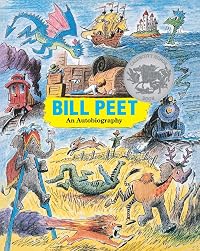
Bill Peet was born William Bartlett Peed on January 29, 1915 in Grandview, Indiana. He graduated from the John Herron Art Institute in Indianapolis. In 1937, he began his artistic career at Walt Disney Studios. While there, he worked on several feature films including Fantasia, Sleeping Beauty, Song of the South, Alice in Wonderland, and Peter show more Pan. He was both an artist and the screenwriter for several films including Cinderella, 101 Dalmatians, and Sword in the Stone. While working at Disney, he also wrote his own children's books and eventually left to become a full-time writer. His first book, Hubert's Hair-Raising Adventure, was published in 1955. During his lifetime, he wrote and illustrated 35 children's books including The Pinkish, Purplish, Bluish Egg; The Whingdingdilly; Chester the Worldly Pig; and Luckiest One of All. His book, Bill Peet: An Autobiography, was named a Caldecott Honor Book in 1989. He died on May 11, 2002 at the age of 87. (Bowker Author Biography) show less
Work Relationships
Is contained in
Common Knowledge
- Canonical title
- The Whingdingdilly
Classifications
Statistics
- Members
- 751
- Popularity
- 37,564
- Reviews
- 8
- Rating
- (4.15)
- Languages
- 6 — Danish, English, Finnish, French, German, Swedish
- Media
- Paper
- ISBNs
- 21
- UPCs
- 3
- ASINs
- 6