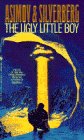
The Ugly Little Boy
by Isaac Asimov, Robert Silverberg
On This Page
Description
Science fiction story by Isaac Asimov, about a Neanderthal boy whom scientists have transported through time for scientific testing. A conflict arises when a dispassionate nurse suddenly refuses to let the boy be returned to his era.Tags
Recommendations















Member Reviews
Right from the beginning I knew this was going to be a book I was going to read more than once. It takes on intense subjects such as the morality of time travel and the awareness that one is growing old, with a light airy tone, and I dare say beautiful tact. Isaac Asimov and Robert Silverberg have done a wonderful job of creating a wonderfully refreshing strong, yet feminine woman. No one is right and no one is wrong, but depending on who the POV character is and how they are feeling, you get to see the good and bad side of everyone. This makes it feel so much more real.
There are few books that end in such a satisfying way that you just have to smile for a few moments after you read it (and it isn't the way you think it will end!!). show more This will be my new go to book when I am feeling down or sick. show less
There are few books that end in such a satisfying way that you just have to smile for a few moments after you read it (and it isn't the way you think it will end!!). show more This will be my new go to book when I am feeling down or sick. show less
Stasis Technologies Ltd has perfected a way to reach back into time and bring forth objects for scientific study. Their most recent triumph was a baby dinosaur and now they’ve taken a Neanderthal child from the Ice-age to the 21st century. The nurse assigned to care for the child must somehow bridge a 40,000-year cultural gap. Initially shocked by the “ugly little boy,” Edith Fellows soon recognizes that he is really a frightened child, and slowly forms a deep emotional bond with Timmie.
Originally written as a short story in 1956, Robert Silverberg teamed with Asimov to expand the work into this novel format (released as The Child of Time). According to Wikipedia, Silverberg added the storyline of the Neanderthal tribe, and the show more child advocate subplot, both of which definitely do add to the basic plot. This also explains how I was reminded of Jean Auel’s Clan of the Cave Bear when reading about Silver Cloud, Goddess Woman, She Who Knows and the other members of the Neanderthal tribe from which Timmie was taken. (I started out wondering if Auel had borrowed from Asimov, but now think Silverberg wrote these sections after Auel’s publication).
I do wish I had a copy of the original story, however, so that I could see how Asimov wrote the ending. I had pretty much figured this would be what happened, but don’t know if it conforms to the original story or is a result of the added elements. Sort of the same conundrum faced by the characters when bringing the child into the future – are you altering the course of history?
I did like that the characters are portrayed as fully developed – having both good and bad qualities. Miss Fellowes is dedicated and truly devoted to Timmie, but also very judgmental and frequently fails to see clear signals of what is to come. Hoskins is not merely a profit-seeking CEO, but a family man who listens to Miss Fellowes arguments and tries his best to provide the child with a nurturing environment given the constraints of the Stasis bubble. Child advocate Bruce Mannheim is originally painted as a rabid rabble-rousing attention-seeking hysteric adept at media relations but turns out to be genuinely concerned and willing to help. show less
Originally written as a short story in 1956, Robert Silverberg teamed with Asimov to expand the work into this novel format (released as The Child of Time). According to Wikipedia, Silverberg added the storyline of the Neanderthal tribe, and the show more child advocate subplot, both of which definitely do add to the basic plot. This also explains how I was reminded of Jean Auel’s Clan of the Cave Bear when reading about Silver Cloud, Goddess Woman, She Who Knows and the other members of the Neanderthal tribe from which Timmie was taken. (I started out wondering if Auel had borrowed from Asimov, but now think Silverberg wrote these sections after Auel’s publication).
I do wish I had a copy of the original story, however, so that I could see how Asimov wrote the ending. I had pretty much figured this would be what happened, but don’t know if it conforms to the original story or is a result of the added elements. Sort of the same conundrum faced by the characters when bringing the child into the future – are you altering the course of history?
I did like that the characters are portrayed as fully developed – having both good and bad qualities. Miss Fellowes is dedicated and truly devoted to Timmie, but also very judgmental and frequently fails to see clear signals of what is to come. Hoskins is not merely a profit-seeking CEO, but a family man who listens to Miss Fellowes arguments and tries his best to provide the child with a nurturing environment given the constraints of the Stasis bubble. Child advocate Bruce Mannheim is originally painted as a rabid rabble-rousing attention-seeking hysteric adept at media relations but turns out to be genuinely concerned and willing to help. show less
Silverberg did a good job of expanding Asimov's classic short story. The characters are much fleshed out, and the drama is important, not contrived. Maybe 3.5 stars really, though, compared to. the intense power of the original, as read in [b:Nine Tomorrows|1051969|Nine Tomorrows|Isaac Asimov|http://d.gr-assets.com/books/1328346942s/1051969.jpg|1065287].
Good story with a moving if somewhat predictable ending. There was interesting debate between scientific and child rights viewpoints; the chief protagonists on each side of the debate were not portrayed in black and white and each had strengths and weaknesses that were quite well drawn. I must admit I found some of the Neanderthal interludes a bit dull, and I didn't find this portrayal of Neanderthal society as convincing or emotionally engaging as Jean Auel's portrayal in her Earth's Children series. One jarring anachronism also struck me: a Neanderthal described snow as falling for "nearly an hour", which is meaningless in the context of an absence of instruments for measuring time accurately. But a very good read.
Everyone knows that love can cross generations, but the story of how love also crosses ages is a wonderful one. I read this as I was in my pregnancy with my second child, and it helped me to understand that I would love my little boy, no matter what.
The strength of this story is not in the science, but rather in the emotion.
The strength of this story is not in the science, but rather in the emotion.
Isaac Asimov & Robert Silverberg write a wonderful tale of how the bond between a mother and son doesn't have to be by birth alone but by a woman's love and attention to a boy who was frightened and alone. Miss Fellowes is a woman who modern society considered an ugly spinster but a boy from the past shows that it's not what is outside but what is in the heart that makes someone beautiful. I loved the development of the relationship between Miss Fellowes and Skyfire Face (The Ugly Little Boy). One question though - does the ending change the future?
Asimov and Silverberg do a fine job of expanding Asimov's most poignant short story into an affecting novel. The premise is that a scientific corporation has learned how to pluck individuals from the distant past to study, before returning them whence they came. Edith Fellowes is a nurse hired to care for "the ugly little boy", a Neanderthal child brought temporarily to our time. This is a wonderful expansion of one of Asimov's best and most atypical stories.
Members
- Recently Added By
Lists

Books Read in 2018
4,360 works; 110 members
Author Information

2,418+ Works 292,419 Members
Isaac Asimov was born in Petrovichi, Russia, on January 2, 1920. His family emigrated to the United States in 1923 and settled in Brooklyn, New York, where they owned and operated a candy store. Asimov became a naturalized U.S. citizen at the age of eight. As a youngster he discovered his talent for writing, producing his first original fiction at show more the age of eleven. He went on to become one of the world's most prolific writers, publishing nearly 500 books in his lifetime. Asimov was not only a writer; he also was a biochemist and an educator. He studied chemistry at Columbia University, earning a B.S., M.A. and Ph.D. In 1951, Asimov accepted a position as an instructor of biochemistry at Boston University's School of Medicine even though he had no practical experience in the field. His exceptional intelligence enabled him to master new systems rapidly, and he soon became a successful and distinguished professor at Columbia and even co-authored a biochemistry textbook within a few years. Asimov won numerous awards and honors for his books and stories, and he is considered to be a leading writer of the Golden Age of science fiction. While he did not invent science fiction, he helped to legitimize it by adding the narrative structure that had been missing from the traditional science fiction books of the period. He also introduced several innovative concepts, including the thematic concern for technological progress and its impact on humanity. Asimov is probably best known for his Foundation series, which includes Foundation, Foundation and Empire, and Second Foundation. In 1966, this trilogy won the Hugo award for best all-time science fiction series. In 1983, Asimov wrote an additional Foundation novel, Foundation's Edge, which won the Hugo for best novel of that year. Asimov also wrote a series of robot books that included I, Robot, and eventually he tied the two series together. He won three additional Hugos, including one awarded posthumously for the best non-fiction book of 1995, I. Asimov. "Nightfall" was chosen the best science fiction story of all time by the Science Fiction Writers of America. In 1979, Asimov wrote his autobiography, In Memory Yet Green. He continued writing until just a few years before his death from heart and kidney failure on April 6, 1992. (Bowker Author Biography) show less

990+ Works 62,312 Members
Some Editions
Series
Belongs to Publisher Series
Heyne Allgemeine Reihe (10366)
Work Relationships
Is an expanded version of
Has as a commentary on the text
Common Knowledge
- Canonical title*
- Il figlio del tempo
- Original title
- The Ugly Little Boy
- Alternate titles
- Child of Time
- Original publication date
- 1991
- People/Characters*
- Edith Fellowes; Timmie; Gerald Hoskins; Nube Argentea; Colei Che Sa; Donna Della Dea
- Important places*
- USA
- Related movies
- The Ugly Little Boy (1977 | IMDb)
- Epigraph*
- “E, solo nel buio vuoto degli alloggi dei marinai immersi nel sonno, egli sembrava più grande, un colosso, vecchissimo; vecchio come il Tempo stesso, che si fosse recato in quel luogo quieto come un sepolcro per contemplar... (show all)e con occhi pazienti la breve vittoria del sonno, il consolatore. Invece era solo un figlio del tempo, solitaria reliquia di una generazione consumata e dimenticata...”
JOSEPH CONRAD - Dedication
- For Martin Harry Greenberg --- with a double measure of affection
- First words
- Snow had come in during the night, a fine dusting of it, thin as mist, traveling on the western wind.
Prologue:
Snow had come during the night, a fine dusting of it, thin as mist, travelling on the western wind.
Edith Fellowes smoothed her working smock as she always did before opening the elaborately locked door and stepping across the invisible dividing line between the is and the is not. - Last words
- (Click to show. Warning: May contain spoilers.)Everybody side by side, all thoughts of warfare forgotten, one by one kneeling in the snow, looking up with wondering eyes to pay homage to the shining figure with the smiling child in her arms who stood in their midst like a harbinger of springtime and peace.
(Click to show. Warning: May contain spoilers.)And Stasis was punctured and the room was empty. - Original language*
- Inglese
- Disambiguation notice
- This is the novel by Asimov and Robert Silverberg.
*Some information comes from Common Knowledge in other languages. Click "Edit" for more information.
Classifications
Statistics
- Members
- 1,058
- Popularity
- 24,189
- Reviews
- 13
- Rating
- (3.73)
- Languages
- 11 — Czech, Dutch, English, French, German, Hebrew, Hungarian, Italian, Polish, Spanish, Swedish
- Media
- Paper, Audiobook
- ISBNs
- 23
- ASINs
- 4