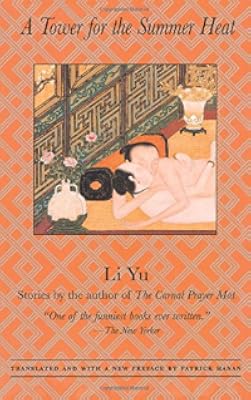
Tower for the Summer Heat
by Li Yu
On This Page
Description
Li Yu, considered a master of comedy in Chinese literature, was a novelist, playwright, and essayist in the 17th century. In this collection, patrick Hanan has translated six of the twelve stories in the Sh'ier lou collection, which is one of the most famous individual collections of vernacular stories from pre-modern China. With Hanan's introduction and notes, and containing Li Yu's emphasis marks, notes, and critiques, this volume should be of interest to students of Chinese literature and show more general readers alike. show lessTags
Recommendations














Member Reviews
I’ll say first that these six stories from Li Yu are pretty innocuous; there are a few bawdy references, but they certainly pale in comparison to ‘The Carnal Prayer Mat’. The most interesting is the title story, and it’s noteworthy because the telescope (or ‘thousand-li glass’) had been so recently imported from the West, that the author needed to take time to explain it to his readers, along with the microscope (‘minute-revealing glass’) and others before continuing on with the story. Does the guy who comes across the telescope use it to gaze out into the heavens, and make scientific discoveries? No, he uses it to spy on women bathing, and to find things out with it that no one else could know in order to appear like an show more immortal, thereby getting the upper hand while courting one of them. Ah, the male mind, so simple and unchanged across the centuries.
It’s a common theme in the stories – using trickery to either con people, to advance in some way in life, or to marry a beautiful girl. The book does openly acknowledge homosexuality (referred to as ‘rear courtyard relationships’) in a non-judgmental way, which I found interesting. Overall, however, there is just not enough here to recommend the book – the character development is minimal, the plots are simple, and the real glimpses into what life was like in China in 1657 are fleeting.
Quotes:
On religion:
“From this example, it is clear that where the mind is concentrated, objects of clay and wood can work miracles. The worship of gods and buddhas means worshipping our own minds; it does not mean that gods and bodhisattvas really exist.”
On the pain of parting from a lover:
“But this young man had never cared for success, only pleasure; he regarded his beautiful wife as the be-all and end-all of his existence and could not put her out of his mind. Besides, she had been incredibly solicitous in his marriage and anticipated his every desire. The endearments they exchanged on the pillow, their passion beneath the quilts – he had only to think of such things to feel his soul melt and almost expire.”
On sex:
“They realized that to attain bliss in lovemaking we cannot afford any sorrow in our hearts or tears in our eyes. The finest sex tonic in the world is composed of just two words - don’t worry - besides which all the nostrums peddled on the streets are nothing but a swindle.” show less
It’s a common theme in the stories – using trickery to either con people, to advance in some way in life, or to marry a beautiful girl. The book does openly acknowledge homosexuality (referred to as ‘rear courtyard relationships’) in a non-judgmental way, which I found interesting. Overall, however, there is just not enough here to recommend the book – the character development is minimal, the plots are simple, and the real glimpses into what life was like in China in 1657 are fleeting.
Quotes:
On religion:
“From this example, it is clear that where the mind is concentrated, objects of clay and wood can work miracles. The worship of gods and buddhas means worshipping our own minds; it does not mean that gods and bodhisattvas really exist.”
On the pain of parting from a lover:
“But this young man had never cared for success, only pleasure; he regarded his beautiful wife as the be-all and end-all of his existence and could not put her out of his mind. Besides, she had been incredibly solicitous in his marriage and anticipated his every desire. The endearments they exchanged on the pillow, their passion beneath the quilts – he had only to think of such things to feel his soul melt and almost expire.”
On sex:
“They realized that to attain bliss in lovemaking we cannot afford any sorrow in our hearts or tears in our eyes. The finest sex tonic in the world is composed of just two words - don’t worry - besides which all the nostrums peddled on the streets are nothing but a swindle.” show less
These short stories are by Li Yu who was also a leading dramatist of the period. Most include bawdy humor. My favorite is the first, in which the hero persuades his intended wife's family he is a powerful magician by using knowledge gained by spying on her with a telescope.
Ratings
Members
- Recently Added By
Lists

Chinese Literature
12 works; 5 members
Author Information

Some Editions
Series
Belongs to Publisher Series
Common Knowledge
- Original publication date
- 1658
Classifications
- Genres
- Fiction and Literature, General Fiction
- DDC/MDS
- 895.1348 — Literature & rhetoric Literatures of other languages Literatures of East and Southeast Asia Chinese Chinese fiction Song, Yuan, Ming, Qing dynasties 960–1912 Qing dynasty 1644–1912
- LCC
- PL2698 .L52 .S52513 — Language and Literature Languages and literatures of Eastern Asia, Africa, Oceania Languages of Eastern Asia, Africa, Oceania Chinese language and literature Chinese literature Individual authors and works
- BISAC
Statistics
- Members
- 59
- Popularity
- 523,583
- Reviews
- 2
- Rating
- (3.30)
- Languages
- English, Italian
- Media
- Paper
- ISBNs
- 4