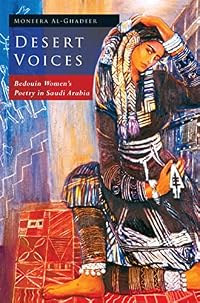
Desert Voices: Bedouin Women's Poetry in Saudi Arabia
by Moneera Al-Ghadeer
On This Page
Description
"The Bedouin, or "desert dwellers," have a rich cultural heritage often expressed through music and poetry. Here Moneera Al-Ghadeer provides us with the first comparative reading of women's oral poetry from Saudi Arabia. She examines women's lyrics of love, desire, mourning and grievance. We come to understand Bedouin mores and - most significantly - the unique description of a desert that is consistently held to be evocative, stimulating and boundless." -- Book jacket.Tags
Member Reviews
This is a poetry challenged for survival – first, being an oral poetry in Bedouin dialect, where written classical Arabic has been considered the high culture vehicle; second, being by women. Even when the ‘popular’ Bedouin poetry is attended to, women’s can slip through the safety net; this text works with the single collection of nomad women’s poetry, made in the 1950s.
It isn’t an anthology but a study, using the latest critical techniques. The author makes her argument for this in the introduction. Here a poetry unseen in English translation before – ‘marginalized’ several ways over -- is given the dignity of full critical treatment.
The poetry itself? Most poetry, everywhere, is about grief, isn’t it? The show more melancholy mood, above others, is singable. It seems to be here. I loved the yearning for the desert when the poet finds herself stranded in a town, and the intimate use of landscape and its animals:
"The khaluj [a she camel that has lost its calf] is the most compelling image of grief in the Bedouin Arabic dialect. The she camel is perceived as the animal most vulnerable to loss, displaying its reactions in extended and lingering mourning intervals. Sometimes its extreme mourning leads to death... its anguished and persistent moans haunt Bedouin poetry."
Cool cover. show less
It isn’t an anthology but a study, using the latest critical techniques. The author makes her argument for this in the introduction. Here a poetry unseen in English translation before – ‘marginalized’ several ways over -- is given the dignity of full critical treatment.
The poetry itself? Most poetry, everywhere, is about grief, isn’t it? The show more melancholy mood, above others, is singable. It seems to be here. I loved the yearning for the desert when the poet finds herself stranded in a town, and the intimate use of landscape and its animals:
"The khaluj [a she camel that has lost its calf] is the most compelling image of grief in the Bedouin Arabic dialect. The she camel is perceived as the animal most vulnerable to loss, displaying its reactions in extended and lingering mourning intervals. Sometimes its extreme mourning leads to death... its anguished and persistent moans haunt Bedouin poetry."
Cool cover. show less
Members
- Recently Added By
Author Information
1 Work 13 Members
Series
Belongs to Publisher Series
Common Knowledge
- Canonical title
- Desert Voices: Bedouin Women's Poetry in Saudi Arabia
Classifications
- Genres
- Fiction and Literature, Literature Studies and Criticism, Poetry
- DDC/MDS
- 892.710099287 — Literature & rhetoric Literatures of other languages Afro-Asiatic literatures Arabic (Egypt, Lebanon, Palestine, Saudi Arabia, Sudan) Arabic poetry History and criticism of Arabic poetry
- LCC
- PJ8000.2 .A44 — Language and Literature Oriental languages and literatures Oriental philology and literature Arabic Arabic literature
- BISAC
Statistics
- Members
- 13
- Popularity
- 1,762,783
- Reviews
- 1
- Rating
- (4.00)
- Languages
- English
- Media
- Paper, Ebook
- ISBNs
- 6
- UPCs
- 1