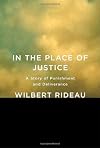
In the Place of Justice: A Story of Punishment and Deliverance
by Wilbert Rideau
On This Page
Description
Rideau brings to vivid life the world of the infamous Angola penitentiary and his long struggle for justice, giving his readers a searing expose of the failures of our legal system framed within his own dramatic tale of how he found meaning, purpose, and hope in prison.Tags
Recommendations









Member Reviews
This one is far more complex that the book jacket description. Rideau is a talented writer who was born into an unjust time and place. The circumstances that lead to his crime don't justify the crime, but make condemning him also feel unjust. This is not a feel good story as he is a murder--he murdered a completely innocent person and fired his gun randomly into the dark hoping to kill his other hostages. He rages against the injustice of being locked up for far beyond the typical life sentence in Louisiana and to me it feels tone deaf towards his victim and her family. His tendency of praising the people who believe in him and work for his freedom and criticizing those that oppose him feels transparent. He is consistently arrogant. show more Yet, his resilience to make something out of his ruined life is remarkable. He's written with great skill about the experience of being a prisoner in Angola and has surely changed many lives and situations for the better. The way he writes about his life after incarceration and in particular his cat was moving. I didn't like the person, but I needed to hear his story and I'm glad I read his work. show less
Capote-esque in its narrative, "In the Place of Justice" chronicles Wilbert Rideau's 44 year incarceration in the Louisiana penal system. Convicted at age 19 of capital murder in the Jim Crow South, Rideau's is a tale of overcoming both institutional racism and personal demons. He never shies away from the truth, including his role in his victim's death, which is a testament to his true journalistic integrity. As the NY Times Book Review stated, "Rideau is the rarest of American commodities - a man who exited a penitentiary in better shape than when he arrived."
I recommend this book to anyone interested in the pitfalls of the criminal justice system, as Rideau lays out the problems facing the incarcerated - ranging from violence, show more substandard resources, and rape - without sensationalizing the facts or falling victim to outrageous hyperbole. This book is also interesting, as it follows the evolution of capital punishment from the Jim Crow era, to the Supreme Court's 1972 Furman ruling, to present day. "In the Place of Justice" is a must read for anyone taking civil litigation because it puts a very human face to statutes governing capital punishment and the appeals process. show less
I recommend this book to anyone interested in the pitfalls of the criminal justice system, as Rideau lays out the problems facing the incarcerated - ranging from violence, show more substandard resources, and rape - without sensationalizing the facts or falling victim to outrageous hyperbole. This book is also interesting, as it follows the evolution of capital punishment from the Jim Crow era, to the Supreme Court's 1972 Furman ruling, to present day. "In the Place of Justice" is a must read for anyone taking civil litigation because it puts a very human face to statutes governing capital punishment and the appeals process. show less
This was a very difficult book to read. Having had family who lived in the South during Jim Crow I knew the truth of the racism and cruelty of the times. However, reading about it from the point of view of the recipient altered my perception of its effect. Mr. Rideau's candid confession of his crime made the consequences to both victim and perpetrator all the more disturbing. This book requires an emotional investment. It is not easy to read. Nor is it easy to put down. The easy answers to the questions of punishment to the lawbreaker, reform of the prison system, the theories of rehabilitation or punishment, the value and ethics of capital punishment just aren't there. This work makes it clear that there are no easy answers. Mr. Rideau show more himself acknowledges society's need for punishment while deploring the inhumane system of imprisonment and/or execution. And while this story is set in the south, the underlying issues are not confined to southern racism. Rather they are imbedded into the very fabric of American life touching many widely accepted societal norms. show less
In 1962, Wilbert Rideau was convicted of murder, for a killing that occurred during a bank robbery gone terribly wrong. He was sentenced to death, was given new trials on a couple of occasions which upheld that verdict, but ultimately his death sentence was commuted to life when the Supreme Court declared capital punishment as it then existed was unconstitutional.
Rideau spent most of his jail time at Angola, reputedly one of the worst state prisons in the country. A high-school dropout, he began to read widely, and became a self-educated, erudite man. While at Angola, he started a prison news magazine called 'The Angolite.' He insisted upon, and the Warden gave him, absolute freedom from censorship, and unrestricted access to sources. show more Over time, The Angolite became nationally known, and began to win national journalism prizes. Rideau became a commentator for NPR, and produced and directed documentaries about prison life, one of which was nominated for an academy award.
This book tells Rideau's story, from the scared teenager who, admittedly killed a person, to the rehabilitated prisoner he became. It tells of life in Angola, and of his relationships with the various wardens, good and bad. It tells of the ground-breaking investigative reports published in The Angolite. And underriding all this, it is the story of Rideau's attempts to have his life sentence commuted, or at least to be paroled.
In this aspect of the book, it reads like a legal thriller, as the machinations of the district attorney in Calcasieu Parish prevent Rideau's release time after time, even though he has served more than four times longer than the usual prisoner sentenced to life. Finally, his case is taken up by a group of dedicated civil rights lawyers, who are able to get him an actual trial at which real evidence is presented, and the manufactured evidence used in the earlier trials is rebutted. Calcasieu's vindictiveness continues even after Rideau wins his freedom after more than 40 years in jail, when they send him a bill for $175,000, for the court costs of his trial. show less
Rideau spent most of his jail time at Angola, reputedly one of the worst state prisons in the country. A high-school dropout, he began to read widely, and became a self-educated, erudite man. While at Angola, he started a prison news magazine called 'The Angolite.' He insisted upon, and the Warden gave him, absolute freedom from censorship, and unrestricted access to sources. show more Over time, The Angolite became nationally known, and began to win national journalism prizes. Rideau became a commentator for NPR, and produced and directed documentaries about prison life, one of which was nominated for an academy award.
This book tells Rideau's story, from the scared teenager who, admittedly killed a person, to the rehabilitated prisoner he became. It tells of life in Angola, and of his relationships with the various wardens, good and bad. It tells of the ground-breaking investigative reports published in The Angolite. And underriding all this, it is the story of Rideau's attempts to have his life sentence commuted, or at least to be paroled.
In this aspect of the book, it reads like a legal thriller, as the machinations of the district attorney in Calcasieu Parish prevent Rideau's release time after time, even though he has served more than four times longer than the usual prisoner sentenced to life. Finally, his case is taken up by a group of dedicated civil rights lawyers, who are able to get him an actual trial at which real evidence is presented, and the manufactured evidence used in the earlier trials is rebutted. Calcasieu's vindictiveness continues even after Rideau wins his freedom after more than 40 years in jail, when they send him a bill for $175,000, for the court costs of his trial. show less
Curses! I did not write a journal entry about this right after I read it! So now I have to write something rather more condensed because my memory is not that sharp.
I first heard of this book in an interview on the radio. Ordered it. I had not started it when I came across a companion book by someone who was also in the same prison with Wilbert, who worked with him on the prison newspaper for a time. Eventually there was some bad blood between the two, with the second accusing Rideau of selling out, essentially. I don't know if we will ever know the truth, but I suspect that Rideau did his best to keep the newspaper alive and the other person (I can't remember his name right now) had a tendency to see injustice everywhere. Not show more surprising for anyone caught up in this penal system.
Rideau's account of his time in various prisons is horrifying. Not only the time in prison but the trials he had to endure, the foregone conclusions. Even after he was finally exonerated from one charge he faced additional imprisonment on trumped up charges.
One lesson we learn: don't be black and be arrested in Louisiana. Clearly there are different rules there for different races. But his story goes beyond the race bias to indict the prison system itself.
Well-written and engrossing. show less
I first heard of this book in an interview on the radio. Ordered it. I had not started it when I came across a companion book by someone who was also in the same prison with Wilbert, who worked with him on the prison newspaper for a time. Eventually there was some bad blood between the two, with the second accusing Rideau of selling out, essentially. I don't know if we will ever know the truth, but I suspect that Rideau did his best to keep the newspaper alive and the other person (I can't remember his name right now) had a tendency to see injustice everywhere. Not show more surprising for anyone caught up in this penal system.
Rideau's account of his time in various prisons is horrifying. Not only the time in prison but the trials he had to endure, the foregone conclusions. Even after he was finally exonerated from one charge he faced additional imprisonment on trumped up charges.
One lesson we learn: don't be black and be arrested in Louisiana. Clearly there are different rules there for different races. But his story goes beyond the race bias to indict the prison system itself.
Well-written and engrossing. show less
Excellent read. There's some tough parts and some heart-wrenching parts.
Ratings
Members
- Recently Added By
Published Reviews
ThingScore 75
The journalist and the memoirist in Wilbert Rideau are sometimes at odds with each other. He is so dispassionate that his book never catches fire. It is a vital human document, but a less vital literary one. Jack Henry Abbott, in his 1981 book, “In the Belly of the Beast,” wrote that he wanted to convey the “atmospheric pressure” of being a long-term prisoner in America. Mr. Rideau’s show more account is a far slower-moving weather system. show less
added by Shortride
Author Information
7 Works 233 Members
Wilbert Rideau, an Award - Winning journalist who spent forty-four years in prison, delivers a remarkable memoir of crime, punishment, and ultimate triumph. After killing a bank teller in a moment of panic during a botched robbery, Wilbert Rideau was sentenced to death at the age of nineteen. He spent several years on death row at Angola before show more his sentence was commuted to life, where, as editor of the prison newsmagazine The Angolite, he undertook a mission to expose and reform Louisiana's iniquitous justice system from the inside. Vivid, incisive, and compassionate, this is a detailed account of prison life and a man who accepted responsibility for his actions and worked to redeem himself. It is a story about not giving up; finding love in unexpected places; the power of kindness; and the ability to do good, no matter where you are. show less
Awards and Honors
Awards
Distinctions
Common Knowledge
- Important places
- Louisiana, USA
Classifications
- Genres
- Nonfiction, Biography & Memoir, General Nonfiction, Politics and Government
- DDC/MDS
- 365.440923960730763 — Society, Government, and Culture Social problems and social services Punishment Institutions for specific classes of inmates Institutions for adult men
- LCC
- HV9475 .L22 .L646 — Social sciences Social pathology. Social and public welfare. Criminology Social pathology. Social and public welfare. Criminal justice administration Penology. Prisons. Corrections By region or country
- BISAC
Statistics
- Members
- 167
- Popularity
- 194,216
- Reviews
- 6
- Rating
- (4.00)
- Languages
- English
- Media
- Paper, Audiobook, Ebook
- ISBNs
- 8
- ASINs
- 2