On This Page
Description
MODERN & CONTEMPORARY FICTION (POST C 1945). Dan said he would go back out into the snowstorm to look for Ray. Instead he has spent the last few hours on a red bench in the barn, smoking cigarette after cigarette. As he replays his memories of recent months, of the dinner party that evening in Connecticut and the journey home with their wives, his heroic search for his friend turns into a trial of their friendship - one that could leave Ray to perish in the snow.Tags
Recommendations


















Member Reviews
Starting positive: Amazing book- held me pretty spellbound. Listened to it through Audible. Story of a man - set in Simenon's own CT home i understand - who goes to a winter party with wife, best friend and his wife. Man sees his best friend intimate with the host's wife in the bathroom and feels ambivalent and then bitterly jealous at the easy intimacy of his best friend. They go home to the man's house, but there is a savage blizzard - enough that one can't see one's way - and the as the group walk to the home the best friend evidently misses his way and ultimately falls off a cliff - and dies. Man can hardly search that night, but pretends too (while musing in the barn). He decides he hates this friend for his easy life style and is show more jealous about his beautiful wife and mad that his own wife is not as bed-able (i think this was the word used) and that she was uptight and sort of stand in for his own judgmental mother. He is now attracted to Mona (the best friend's wife) and helps her through her grief up to and including a long affair. His wife knows, but says nothing, just judges quietly (or so we are told by the man). Finally Mona marries another man, leaving our guy bereft- not that he wanted to marry her - no, he wanted to carry on - flouting societal conventions and being the bad boy. He is troubled, he thinks he is the only one to see through shallow society and he suffers on account of it. Finally, in a fit of insomnia (yes, really) he finally shoots his wife dead because he can't stand her quiet judgmental ways anymore. All to the good! Amazing portrait / self analysis of a man bitter at not doing the things he thinks he really wanted to do- bed women and drink and so forth. However.... (now the bad) .... i was sort of surprised / disappointed that the character ultimately can be seen as essentially having a mid life crisis played out to the extreme view. Granted, we are entirely in the head of this man- no omniscient narrator here- and Simenon perhaps just expects us to see the rather immature narcissism here. I don't say that meaning to suggest that he is ridiculous or should just "get over himself" but there is really no self awareness at all... just bravado... "i, alone saw through the empty trap of society ...." well, yes... but we have ALL felt that way right? and everyone knows that, right? right. now, i haven't gone down the road that the person is perhaps going down a rabbit hole of mental illness throughout the book- his obsessive sense that he "knows" what his wife is thinking and holding back at all time... reads a bit like Poe at time. that is new for Simenon and whole portrait of a man going crazy is just not really Simenon i think. More like portrait of how we are all on a closer edge to crazy than we realize all the time.... show less
For one philosophy course back in college, we were assigned works of social psychology: The Transparent Self by Sidney Jourard, R. D. Laing’s Sanity, Madness and the Family and Eric Fromm’s The Sane Society, all three books addressing the prevailing sickness of dishonest, inauthentic modern living and the need to express our genuine inner feelings. As if on cue, a front page headline from our city newspaper featured a group photo: husband and wife and their four little kids, all smiling for the camera, the apple pie American family. The article provided the grizzly details - at night when everybody in the family was all snuggley in bed, the husband used a pistol to shoot all four of his kids, his wife and then himself. The show more instructor and everyone else in class agreed: this gentleman, one of the pillars of his suburban town, could have benefited by the books on our reading list.
Also, as if on cue, in 1968 Georges Simenon wrote The Hand, a non-Detective Maigret existential romans durs (hard novel) set in suburban Connecticut, USA. Likewise, the protagonist of Simenon's novel might very well have profited by a careful reading of one of these social psychology books, my personal favorite, I reckon, Sidney Jourard's The Transparent Self.
I can clearly picture Georges at his desk, writing at white heat, merging into his protagonist, Donald Dodd, a forty-five year old successful lawyer and graduate of Yale Law School. The author tells the lawyer’s harrowing tale in first-person, one of the rare first-person novels Simenon wrote (he pumped out an astonishing number, over five hundred). That’s right – over five hundred novels! Guy makes Stephen King look like a slacker.
And what a tale. Not a word is wasted; literature as an exercise in stripped down economy. As a number of literary critics have noted, Simenon used language that could be easily understood and appreciated by anybody who wished to read his books. Additionally, more sophisticated vocabulary and baroque phrases would have only slowed him down.
To round out the quartet of major characters, in addition to Donald Dodd we have Donald’s wife Isabel and his best friend Ray, also a Yale Law School graduate, and Ray’s wife Mona. I suspect Simenon chose the profession of lawyer for both Donald and Ray since in 1960s America doctors and lawyers were professions held in the highest esteem, examples of shining success. Recall the number of television series starring lawyers such as Perry Mason and the father son lawyer team in The Defenders.
The opening chapter sets the stage for unfolding drama: It’s January and we join Donald, Isabel, Ray and Mona as they drive north to attend an evening party held at the home of wealthy social magnet Harold Ashbridge. The house is packed with guests, several dozen men and women drinking and talking, drinking more and talking more, on and on deep into the night.
At one point Donald goes upstairs and opens the bathroom door – he catches Ray and Harold’s beautiful young wife Patricia having sex standing up. Only Patricia notices Donald. She could care less. Donald quickly retreats back downstairs. He’s shaken and treats himself to more martinis than usual. Eventually the four of them are among the last guests to leave. They have to drive back in a blizzard. Donald is at the wheel - despite the blinding snow, he makes it nearly all the way home.
Four hundred yards from the house Donald runs into a six foot snow bank. The four of them will have to get out and walk on foot through the mounds of snow to the house. Isabel and Mona walk ahead, arm in arm, and finally make their way to the front door. Donald and Ray follow. But in the blizzard there is an unexpected happening - Donald arrives at his house to discover Ray is no longer by his side. Donald looks back; he can barely see beyond his nose. No Ray.
Although totally exhausted, Donald informs the ladies he will go back out to look for Ray. He's not good to his word - he doesn't search; rather he struggles through the raging blizzard to the barn, takes a seat on a red bench and smokes his cigarettes.
Is he a coward? Is he a liar? Does he totally betray his best friend? Has he always been secretly attracted to Mona? These are among the questions Donald poses to himself in the ensuing hours and days. One thing is certain - he vision of his life and everybody around him is completely transformed. He is not the man he supposed himself to be.
There’s a second, equally unsettling recognition: Isabel is not only his wife but his judge and jurors all rolled into one. Isabel doesn’t come right out and confront him as his new, transformed Donald Dodd. Oh, no, that would be too easy. All Isabel has to do is gaze at him in silence with her piercing, penetrating pale blue eyes.
Georges Simenon’s laser vision of one man stepping out of his social roles as husband, father, successful professional, upstanding community member to confront the stark realities of his existence. A gripping existential tale not to be missed. show less
Also, as if on cue, in 1968 Georges Simenon wrote The Hand, a non-Detective Maigret existential romans durs (hard novel) set in suburban Connecticut, USA. Likewise, the protagonist of Simenon's novel might very well have profited by a careful reading of one of these social psychology books, my personal favorite, I reckon, Sidney Jourard's The Transparent Self.
I can clearly picture Georges at his desk, writing at white heat, merging into his protagonist, Donald Dodd, a forty-five year old successful lawyer and graduate of Yale Law School. The author tells the lawyer’s harrowing tale in first-person, one of the rare first-person novels Simenon wrote (he pumped out an astonishing number, over five hundred). That’s right – over five hundred novels! Guy makes Stephen King look like a slacker.
And what a tale. Not a word is wasted; literature as an exercise in stripped down economy. As a number of literary critics have noted, Simenon used language that could be easily understood and appreciated by anybody who wished to read his books. Additionally, more sophisticated vocabulary and baroque phrases would have only slowed him down.
To round out the quartet of major characters, in addition to Donald Dodd we have Donald’s wife Isabel and his best friend Ray, also a Yale Law School graduate, and Ray’s wife Mona. I suspect Simenon chose the profession of lawyer for both Donald and Ray since in 1960s America doctors and lawyers were professions held in the highest esteem, examples of shining success. Recall the number of television series starring lawyers such as Perry Mason and the father son lawyer team in The Defenders.
The opening chapter sets the stage for unfolding drama: It’s January and we join Donald, Isabel, Ray and Mona as they drive north to attend an evening party held at the home of wealthy social magnet Harold Ashbridge. The house is packed with guests, several dozen men and women drinking and talking, drinking more and talking more, on and on deep into the night.
At one point Donald goes upstairs and opens the bathroom door – he catches Ray and Harold’s beautiful young wife Patricia having sex standing up. Only Patricia notices Donald. She could care less. Donald quickly retreats back downstairs. He’s shaken and treats himself to more martinis than usual. Eventually the four of them are among the last guests to leave. They have to drive back in a blizzard. Donald is at the wheel - despite the blinding snow, he makes it nearly all the way home.
Four hundred yards from the house Donald runs into a six foot snow bank. The four of them will have to get out and walk on foot through the mounds of snow to the house. Isabel and Mona walk ahead, arm in arm, and finally make their way to the front door. Donald and Ray follow. But in the blizzard there is an unexpected happening - Donald arrives at his house to discover Ray is no longer by his side. Donald looks back; he can barely see beyond his nose. No Ray.
Although totally exhausted, Donald informs the ladies he will go back out to look for Ray. He's not good to his word - he doesn't search; rather he struggles through the raging blizzard to the barn, takes a seat on a red bench and smokes his cigarettes.
Is he a coward? Is he a liar? Does he totally betray his best friend? Has he always been secretly attracted to Mona? These are among the questions Donald poses to himself in the ensuing hours and days. One thing is certain - he vision of his life and everybody around him is completely transformed. He is not the man he supposed himself to be.
There’s a second, equally unsettling recognition: Isabel is not only his wife but his judge and jurors all rolled into one. Isabel doesn’t come right out and confront him as his new, transformed Donald Dodd. Oh, no, that would be too easy. All Isabel has to do is gaze at him in silence with her piercing, penetrating pale blue eyes.
Georges Simenon’s laser vision of one man stepping out of his social roles as husband, father, successful professional, upstanding community member to confront the stark realities of his existence. A gripping existential tale not to be missed. show less
Bewitched by the Hand
Review of the Penguin Books paperback edition (October 2016) of a new translation* by Linda Coverdale of the French language original "La Main" (1968)
[2.5]
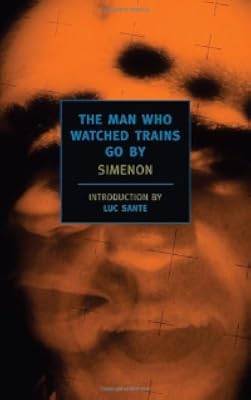
The Hand suffers in comparison to several of the previous Simenon "hard novels" that I've read recently in my 2022 deep dive into the works of the prolific Belgium novelist. In The Man from London (orig. 1934), The Man Who Watched Trains Go By (orig. 1938) and The Mahé Circle (orig. 1946), the protagonist seeks escape from a previous life which they feel has restricted them. The result is that they or others close to them often meet with fatal consequences.
In The Hand, the protagonist Donald Dodd is jealous of the life of his friend Ray Sanders, a hedonist who show more openly conducts extramarital affairs. During a visit by Sanders and his wife to Dodd's country home, Sanders becomes lost in a blizzard snowstorm as the two couples are forced to walk home after having to abandon their car. Dodd volunteers to go back out to look for Sanders, leaving his wife Isabel with Sanders' wife Mona in the house. The cowardly Dodd actually abandons Sanders to his fate and instead goes to sit in his barn for a few hours (both an early translation and a later adaptation fixate on the barn in their titles, see below).
While sitting in the barn, Dodd decides to embody the life of Sanders in his new persona. He fixates on the hand of Sanders' wife Mona when the remaining trio sleep in front of the fire in the house without power later that night. He later proceeds to pursue an affair with Mona in this new life, while under what he perceives as the judgmental eye of his own wife Isabel. The ending is again one with a fatal consequence.
The setting of The Hand in a farm house in Connecticut and also in New York City was inspired by the 1945-1955 period in Simenon's own life when he and his family lived in Canada and the U.S. after the end of the Second World War.
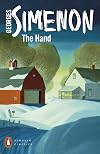
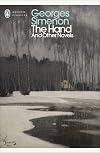
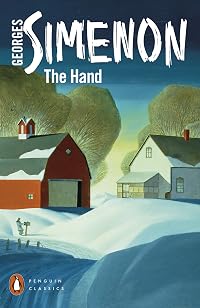
See cover image at https://i.gr-assets.com/images/S/compressed.photo.goodreads.com/books/1477529662...
Cover of the English language theatrical adapation of "The Hand" by David Hare in 2016. Image sourced from Goodreads
After reading the first dozen Simenon Maigret novels this year, I'm now reading a half-dozen or so of the non-Maigrets and several of the late Maigrets. Many of the non-Maigret books are being translated into English for the first time and it seems like there are quite a few yet to be done. I'm actually having trouble sourcing them and have only one more in the pipeline right now, The Snow Was Dirty (orig. 1948 / New Penguin translation 2016).
The Hand is the 6th of my readings of Georges Simenon's romans durs** (French: hard novels) which was his personal category for his non-Chief Inspector Maigret fiction. This is like the author Graham Greene, who divided his work into his "entertainments" and his actual "novels." Similar to Greene, the borders between the two areas are quite flexible as we are often still dealing with crime and the issues of morals and ethics. Simenon's romans durs are definitely in the noir category though, as compared to the sometimes lighter Maigrets where the often cantankerous Chief Inspector provides a solution and the guilty are brought to justice.
Trivia and Links
* Le main was previously translated into English at least once. The early translation appeared in 1970 as The Man on the Bench in the Barn.
** There is a limited selection of 100 books in the Goodreads' Listopia of Simenon's romans durs which you can see here. Other sources say there are at least 117 of them, such as listed at Art and Popular Culture and in the Library Thing "Non-Maigret Series" listing.
There is a French language plot summary for Le Main at the Tout Simenon (All of Simenon) website, which you can read here (spoilers obviously).
The Hand has been adapted once for film. The adaptation was for German TV in 1990 and titled "Das zweite Leben" (The Second Life) directed by Carlo Rola and starring Vadim Glowna as Anders (renamed from the novel's Donald Dodd). I could not find any internet posting of a trailer or of the full film.
The Hand has been adapted once for theatre. The adaptation was by David Hare and is titled The Red Barn: Adapted from the novel La Main (2016). It was performed at the National Theatre UK in October 2016 and you can read a promotional article about that in the Guardian here. show less
Review of the Penguin Books paperback edition (October 2016) of a new translation* by Linda Coverdale of the French language original "La Main" (1968)
[2.5]
The Hand suffers in comparison to several of the previous Simenon "hard novels" that I've read recently in my 2022 deep dive into the works of the prolific Belgium novelist. In The Man from London (orig. 1934), The Man Who Watched Trains Go By (orig. 1938) and The Mahé Circle (orig. 1946), the protagonist seeks escape from a previous life which they feel has restricted them. The result is that they or others close to them often meet with fatal consequences.
In The Hand, the protagonist Donald Dodd is jealous of the life of his friend Ray Sanders, a hedonist who show more openly conducts extramarital affairs. During a visit by Sanders and his wife to Dodd's country home, Sanders becomes lost in a blizzard snowstorm as the two couples are forced to walk home after having to abandon their car. Dodd volunteers to go back out to look for Sanders, leaving his wife Isabel with Sanders' wife Mona in the house. The cowardly Dodd actually abandons Sanders to his fate and instead goes to sit in his barn for a few hours (both an early translation and a later adaptation fixate on the barn in their titles, see below).
While sitting in the barn, Dodd decides to embody the life of Sanders in his new persona. He fixates on the hand of Sanders' wife Mona when the remaining trio sleep in front of the fire in the house without power later that night. He later proceeds to pursue an affair with Mona in this new life, while under what he perceives as the judgmental eye of his own wife Isabel. The ending is again one with a fatal consequence.
The setting of The Hand in a farm house in Connecticut and also in New York City was inspired by the 1945-1955 period in Simenon's own life when he and his family lived in Canada and the U.S. after the end of the Second World War.
See cover image at https://i.gr-assets.com/images/S/compressed.photo.goodreads.com/books/1477529662...
Cover of the English language theatrical adapation of "The Hand" by David Hare in 2016. Image sourced from Goodreads
After reading the first dozen Simenon Maigret novels this year, I'm now reading a half-dozen or so of the non-Maigrets and several of the late Maigrets. Many of the non-Maigret books are being translated into English for the first time and it seems like there are quite a few yet to be done. I'm actually having trouble sourcing them and have only one more in the pipeline right now, The Snow Was Dirty (orig. 1948 / New Penguin translation 2016).
The Hand is the 6th of my readings of Georges Simenon's romans durs** (French: hard novels) which was his personal category for his non-Chief Inspector Maigret fiction. This is like the author Graham Greene, who divided his work into his "entertainments" and his actual "novels." Similar to Greene, the borders between the two areas are quite flexible as we are often still dealing with crime and the issues of morals and ethics. Simenon's romans durs are definitely in the noir category though, as compared to the sometimes lighter Maigrets where the often cantankerous Chief Inspector provides a solution and the guilty are brought to justice.
Trivia and Links
* Le main was previously translated into English at least once. The early translation appeared in 1970 as The Man on the Bench in the Barn.
** There is a limited selection of 100 books in the Goodreads' Listopia of Simenon's romans durs which you can see here. Other sources say there are at least 117 of them, such as listed at Art and Popular Culture and in the Library Thing "Non-Maigret Series" listing.
There is a French language plot summary for Le Main at the Tout Simenon (All of Simenon) website, which you can read here (spoilers obviously).
The Hand has been adapted once for film. The adaptation was for German TV in 1990 and titled "Das zweite Leben" (The Second Life) directed by Carlo Rola and starring Vadim Glowna as Anders (renamed from the novel's Donald Dodd). I could not find any internet posting of a trailer or of the full film.
The Hand has been adapted once for theatre. The adaptation was by David Hare and is titled The Red Barn: Adapted from the novel La Main (2016). It was performed at the National Theatre UK in October 2016 and you can read a promotional article about that in the Guardian here. show less
Tense, taut plotting and psychodrama as doubt, dissatisfaction, and death touch the life of a previously steady lawyer in New England. The muscular male-centric Updikean sensibility renders the wives as accessories and so their role in these events, although central to the story, is all too passive. “The hand” is one of several totemic images the narrator lights upon, symbolising... something. Simply told, but unconvincing; or perhaps, if relationships back then were really so shallow, just unappealing.
I am a big fan of Georges Simenon, especially his "roman dur" novels. "The Hand" was so, so good. I sometimes forget how good these books are until I read another one.
This book is typical Simenon. A series of life changing events take place over a few days which change the lives of all the characters. It is tough. It is dark and brooding. It is bleak, violent and suffused with guilt and bitterness. But at the same time deeply analytical and not at all dated.
A deeply disturbing novel. Quite devastating.
This book is typical Simenon. A series of life changing events take place over a few days which change the lives of all the characters. It is tough. It is dark and brooding. It is bleak, violent and suffused with guilt and bitterness. But at the same time deeply analytical and not at all dated.
A deeply disturbing novel. Quite devastating.
I came to this book soon after seeing David Hare's reworking of the story as The Red Barn produced at London's National Theatre. Rather surprisingly when I entered the work I found that mine was the only copy (at the time) on LibraryThing. The book does not deserve this lack of attention. ETA...... and it didn't get it. 'The Hand' is a literal translation of Simenon's original but it was published in the USA with the rather clumsy title of ' The Man on the Bench in the Barn'.
When the car carrying two couples coming home from a dinner party gets stuck in a blizzard, they struggle on foot to the nearby home of one. One man disappears in the swirling snow. The other gets the women safely inside, and heroically goes back out to look for his friend.
But things are not quite as simple as they seem...
I had known Simenon only through his Inspector Maigret stories, but he apparently wrote a number of others well worth seeking out.
But things are not quite as simple as they seem...
I had known Simenon only through his Inspector Maigret stories, but he apparently wrote a number of others well worth seeking out.
Members
- Recently Added By
Author Information

1,335+ Works 63,161 Members
The prolific Belgian-born writer Georges Simenon produced hundreds of fictional works under his own name and 17 pseudonyms, in addition to more than 70 books about Inspector Maigret, long "the favorite sleuth of highbrow detective-story readers" (SR). More than 50 "Simenons" have been made into films. In addition to his mystery stories, he wrote show more what he called "hard" books, the serious psychological novels numbering well over 100. The autobiographical Pedigree, set in his native town of Liege, is perhaps his finest work. The publication of Simenon's intimate memoirs also attracted considerable attention. Simenon himself once said that he would never write a "great novel." Yet Gide called him "a great novelist, perhaps the greatest and truest novelist we have in French literature today," and Thornton Wilder (see Vol. 1) found that Simenon's narrative gift extends "to the tips of his fingers." The following are some of Simenon's novels, exclusive of the Maigret detective stories, that are in print. (Bowker Author Biography) Georges Simenon was born on February 13, 1903 in Liege, Belgium. He wrote more than 200 fiction works under 16 different pseudonyms. His first book, The Case of Peter the Lent led to 80 more of the like including the main character, Inspector Maigret. He published over 400 books that were translated into 50 different languages and sold by the millions. He also wrote psychological novels, including The Man Who Watched the Train Go By. He died on September 4, 1989 in Lausanne. (Bowker Author Biography) show less
Some Editions
Awards and Honors
Notable Lists
Series

Belongs to Publisher Series
Work Relationships
Common Knowledge
- Canonical title
- The Hand and Other Novels
- Original publication date
- 1968 (original French) (original French); 1969 (English: Budberg) (English: Budberg); 2016 (English: Coverdale) (English: Coverdale)
- First words*
- J'étais assis sur le banc, dans la grange.
- Original language
- French
- Disambiguation notice
- Some confusion here. Three works. The Hand is not an alternative translation of The Man on the Bench in the Barn
*Some information comes from Common Knowledge in other languages. Click "Edit" for more information.
Classifications
- Genres
- Fiction and Literature, General Fiction, Mystery
- DDC/MDS
- 843.912 — Literature & rhetoric French Literature French fiction 1900- 20th Century 1900-1945
- LCC
- PQ2637 .I53 .M — Language and Literature French, Italian, Spanish and Portuguese literatures French literature Modern literature 1900-1960
- BISAC
Statistics
- Members
- 137
- Popularity
- 241,381
- Reviews
- 10
- Rating
- (3.61)
- Languages
- 5 — Dutch, English, French, Italian, Swedish
- Media
- Paper, Audiobook, Ebook
- ISBNs
- 14
- ASINs
- 5