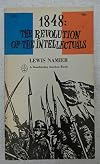
1848: the revolution of the intellectuals
by Lewis Namier
Raleigh Lecture on History (1944), Proceedings of the British Academy (30)
93 Members (3.50)
On This Page
Description
This famous essay is now republished, with a new Introduction by James Joll, at a time when its discussion of the power of nationalism in European politics seems particularly relevant. Concentrating on the revolutions in central and eastern Europe, and the relations of Germans, Poles, and Slavs, Namier explains how 1848 inaugurated a new age, not of liberalism as many revolutionaries hoped, but of a nationalism that was to destroy liberal constitutionalism. As Professor Joll demonstrates in show more his Introduction, the essay also reveals much about the prejudices and passion underlying the historical writing of one of Britain's most prominent historians. The modern reader will find in the range and cogency of this book not only many shafts of light on the year 1848 itself, but also fresh insights into historical forces still at work in our own time. show lessTags
Recommendations










































Member Reviews
Members
- Recently Added By
Lists

What A Year: Books titled with a particular year
147 works; 2 members
Author Information

28+ Works 416 Members
Born in Poland, Lewis Namier was educated in England at the London School of Economics and Oxford University. In 1931 he accepted a professorship at Manchester University, where he remained for more than 20 years. An active Zionist, he served for several years as political secretary of the Jewish Agency for Palestine. Knighted in 1952, as a show more historian Namier specialized in studies of eighteenth-century English political and diplomatic history, setting the pattern for later studies in that and other eras. For his major work, Structure of Politics at the Accession of George III (1929), he prepared detailed biographical studies of individual members of several Parliaments as a method of studying mid-eighteenth-century England. He concluded that the underlying motives behind political action were especially familial and oligarchic connections and the quest for position and place, rather than great events and issues. His method came to be called Namierism in his honor. Although criticized by some scholars, it led other historians and scholars to reevaluate much of English history. (Bowker Author Biography) show less
Series


Belongs to Publisher Series
Common Knowledge
- Canonical title
- 1848: the revolution of the intellectuals
- Original title
- 1848: The revolution of the intellectuals
- Original publication date
- 1944
- Important events
- Revolutions of 1848
Classifications
- Genres
- History, Nonfiction, General Nonfiction
- DDC/MDS
- 940.284 — History & geography History of Europe History of Europe Europe: Renaissance, Reformation, Enlightenment, Napolean 19th century 1815-1914 Revolutions of 1848
- LCC
- D387 .N3 — History of Europe, Asia, Africa and Oceania History (General) Modern history, 1453- 1789- 19th century. 1801-1914/1920 1830-1870
- BISAC
Statistics
- Members
- 93
- Popularity
- 346,917
- Rating
- (3.50)
- Languages
- English, Italian
- Media
- Paper
- ISBNs
- 2
- ASINs
- 7