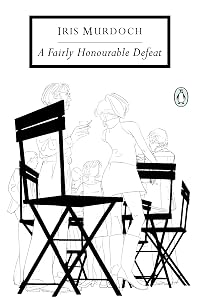
A Fairly Honourable Defeat
by Iris Murdoch 
On This Page
Description
In this dark comedy of errors, Iris Murdoch portrays the mischief wrought by Julius, a cynical intellectual who decides to demonstrate through a Machiavellian experiment how easily loving couples, caring friends, and devoted siblings can betray their loyalties. As puppet master, Julius artfully plays on the human tendency to embrace drama and intrigue and to prefer the distraction of confrontations to the difficult effort of communicating openly and honestly.Tags
Recommendations

















Member Reviews
A staple of many classic comedy plots is the malevolent genius who - usually to prove a point or settle a bet - does the author's work by manipulating other characters into betraying their partners. Eventually it's all resolved and we leave everyone at the end of Act III confused and a little bit disillusioned but otherwise unharmed. Shakespeare uses it all the time, and possibly the most perfect example is in Mozart's Così fan tutte. And we all know it's a stage convention and enjoy it, even if Mozart reminds us that this is dangerous stuff to play with. But what if it wasn't a comedy, and someone started doing that sort of thing to real people like you and me? - Or at least people like the sort Iris Murdoch knew in 1970, the senior show more civil servants, academics, students and middle-class housewives of contemporary London.
Murdoch explores the nasty things that can happen when you deliberately take people's illusions away from them and play around cynically with their emotions. The mix of psychological realism and farce is full of strange twisted variants on comedy set-pieces, like the stolen letters, the eavesdropping scene, the nude scene, the burnt-dinner scene, and even the falling-in-the-pool scene, and it can't help being funny, but it's funny in a very grim sort of way, and you know this isn't going to end well. It sometimes seems to be taking Adorno's famous dictum a step further and showing where social comedy fails us in a mid-20th century world that has to deal with the Holocaust and the threat of global nuclear destruction. Or maybe it's saying that only (black) comedy can deal with such a world...? show less
Murdoch explores the nasty things that can happen when you deliberately take people's illusions away from them and play around cynically with their emotions. The mix of psychological realism and farce is full of strange twisted variants on comedy set-pieces, like the stolen letters, the eavesdropping scene, the nude scene, the burnt-dinner scene, and even the falling-in-the-pool scene, and it can't help being funny, but it's funny in a very grim sort of way, and you know this isn't going to end well. It sometimes seems to be taking Adorno's famous dictum a step further and showing where social comedy fails us in a mid-20th century world that has to deal with the Holocaust and the threat of global nuclear destruction. Or maybe it's saying that only (black) comedy can deal with such a world...? show less
This is a tangled web set in the late 60s, concerning Rupert and Hilda; their 20 year old drop-out son Peter; Rupert’s younger brother Simon and his boyfriend Axel; Hilda’s unstable younger sister Morgan and her estranged husband Tallis and her former lover (and college friend of Rupert and Axel), Julius.
Things are intertwined from the start, but later there are strong echoes of Shakespeare’s Midsummer Night’s Dream when the stage is set for a (non magical) enchantment, leading to illusions of love and betrayal with the metaphorical puppeteer appearing to soothe, whilst actually sowing doubts and creating scenarios.
Although the story is entirely naturalistic (rather than magical realism etc), there are occasions when some of show more the characters think they sense supernatural demons or ghosts, yet none of them realise the real power that is manipulating their lives.
It opens inauspiciously with a long conversation between Rupert and Hilda, which explains the back story, but which they would not be discussing in that way between themselves. However, after that it becomes a trademark Murdoch psychological novel. In some ways her protagonists are a little like the British equivalent of Woody Allen’s shrink-addicted New Yorkers, as they endlessly analyse their relationships, interconnectedness, motives etc.
The narrative slips seamlessly between pages of pure dialogue, to more descriptive passages. In some of the dialogue sections it is not always clear who is saying what, but that is actually very effective, especially when there is a large gathering, with multiple conversations and the reader is effectively eaves-hopping between them.
The book is slightly dated in places (especially early on, when Murdoch seems embarrassed about the terminology regarding Simon and Axel: “liaison”, “association”, “his friend” and there are a couple of awkward racial comments), but mostly it reads very well and would also be good for a reading group, though probably too unfashionable to be picked – unless it rose to prominence on the back of a film. You could spend ages merely on “Both you and X are wounded people. X is the more wounded because X is the more guilty and for that reason is probably the more proud.” And “Good is dull. What novelist ever succeeded in making a good man interesting?”. Fortunately this novel devotes plenty of pages to those who are not good.
I’d love to read another book about Julius, so this one must have been excellent. show less
Things are intertwined from the start, but later there are strong echoes of Shakespeare’s Midsummer Night’s Dream when the stage is set for a (non magical) enchantment, leading to illusions of love and betrayal with the metaphorical puppeteer appearing to soothe, whilst actually sowing doubts and creating scenarios.
Although the story is entirely naturalistic (rather than magical realism etc), there are occasions when some of show more the characters think they sense supernatural demons or ghosts, yet none of them realise the real power that is manipulating their lives.
It opens inauspiciously with a long conversation between Rupert and Hilda, which explains the back story, but which they would not be discussing in that way between themselves. However, after that it becomes a trademark Murdoch psychological novel. In some ways her protagonists are a little like the British equivalent of Woody Allen’s shrink-addicted New Yorkers, as they endlessly analyse their relationships, interconnectedness, motives etc.
The narrative slips seamlessly between pages of pure dialogue, to more descriptive passages. In some of the dialogue sections it is not always clear who is saying what, but that is actually very effective, especially when there is a large gathering, with multiple conversations and the reader is effectively eaves-hopping between them.
The book is slightly dated in places (especially early on, when Murdoch seems embarrassed about the terminology regarding Simon and Axel: “liaison”, “association”, “his friend” and there are a couple of awkward racial comments), but mostly it reads very well and would also be good for a reading group, though probably too unfashionable to be picked – unless it rose to prominence on the back of a film. You could spend ages merely on “Both you and X are wounded people. X is the more wounded because X is the more guilty and for that reason is probably the more proud.” And “Good is dull. What novelist ever succeeded in making a good man interesting?”. Fortunately this novel devotes plenty of pages to those who are not good.
I’d love to read another book about Julius, so this one must have been excellent. show less
This is my third Murdoch of the summer—one of her later books, and one that feels like it's synthesized a lot of her themes. There's a large cast of characters, including a Hilda and Rupert, a bourgeois, slightly smug middle-aged couple; their spoiled Oxford dropout son Peter; the husband's sweet and insecure younger brother Simon and his slightly aloof partner Axel; Morgan, Hilda's extremely neurotic sister just back from the States and her completely hapless ex-husband Tallis; Tallis's bitter, nasty elderly father; Leonard and Julius, a manipulative, vaguely evil-but-charismatic academic who toys with everyone. Literally—he refers to himself often as a "puppet master," and the whole book centers around his attempts to break up the show more couples and manipulate everyone's lives, with varying degrees of success. There's a lot of philosophy, as with all Murdoch's work, but in this case it serves as more of an underpinning to the storyline and less of a series of thinky interludes—there's a satan and a Christ character, lots of Shakespearean machinations and crossed signals and some intensely evocative (and very deliberately doled out) settings.
I wouldn't exactly call it a feel-good novel, since bad things happen to decent people and the worst characters emerge to go on with their lives, but there's a tiny (two or three sentences, blink and you've missed it) reveal toward the end that completely changes the reader's understanding of one of the central characters. It's also notable for her portrayal of the central gay couple as the most sympathetic and stable (and, in a way, decent) of the lot, coming only three years after the decriminalization of homosexual relations in Britain. Maybe not notable for Murdoch, but I imagine it was a breath of good air for a lot of folks reading it in 1970. Anyway, this was a super entertaining, if often dark, read—a lot of intrigue, some twisty explorations of good and evil, and and as a side note, an interesting testimony to the ephemerality of words on paper. show less
I wouldn't exactly call it a feel-good novel, since bad things happen to decent people and the worst characters emerge to go on with their lives, but there's a tiny (two or three sentences, blink and you've missed it) reveal toward the end that completely changes the reader's understanding of one of the central characters. It's also notable for her portrayal of the central gay couple as the most sympathetic and stable (and, in a way, decent) of the lot, coming only three years after the decriminalization of homosexual relations in Britain. Maybe not notable for Murdoch, but I imagine it was a breath of good air for a lot of folks reading it in 1970. Anyway, this was a super entertaining, if often dark, read—a lot of intrigue, some twisty explorations of good and evil, and and as a side note, an interesting testimony to the ephemerality of words on paper. show less
This is one of my favourite Murdochs so far. Everyone in it is unbearable one way or another and they all treat each other awfully. It doesn't end especially well for most of them though the somewhat evil Julius seems fairly unscathed. The plot is ridiculous and relies on nobody ever having a sensible conversation, but it doesn't really matter, its wild and funny and outrageous.
After finishing this book, I learned in the introduction that Iris Murdoch was a philosopher who often used fiction to explore ideas. This helped explain a couple things in A Fairly Honourable Defeat – the philosophical leanings of several of the characters, the somewhat stereotypical and static characters, the dialogue that is a touch too high-flown. The plot is absorbing and sometimes bizarre or even surreal. Julius King, a cynical scientist, turns his friends against each other, breaks up relationships and generally sows chaos though his friends don’t need any help doing that. Despite the problems, I would have found this to be an overall enjoyable book except for the fact that I couldn’t stand Morgan, Julius’ ex, and her show more nonstop annoying clichéd behavior.
Hilda and Rupert Foster are a happily married, successful couple. Rupert’s younger brother, Simon, has a loving May-December relationship with Rupert’s friend Axel, but Hilda and Rupert attempt to solve the problems of their son Peter, who has dropped out of school, Hilda’s flaky sister Morgan, who left her husband Tallis for Julius, then left Julius, and the socially awkward Tallis. At the beginning of the book one notices that the characters’ conversation is more elevated that real-life discourse – exceptions being the uncommunicative Tallis and his crotchety old man-type father. There’s a bit too much information given to the reader and long, fluid conversation blocks are common though for the self-important Rupert and intellectual Julius this is not unexpected. Conversations indeed dominate the book. This is not surprising as some of the events show the ineffectual power of words, especially when they are used to talk around things or used in place of action. The book opens with Hilda and Rupert cheerily discussing their guests while awaiting their arrival. The situations of Tallis – who’s in a holding pattern as he patiently waits for Morgan and struggles to get by teaching – and Peter, who in typical teenage rebellion is rejecting materialistic Western values, are unhappy but not horrible. Everyone’s lives are changed by the simultaneous but separate arrivals of Morgan and Julius, who is an old friend of Rupert’s and Axel’s.
Murdoch takes her time in getting to the machinations of Julius. Instead, there are a series of apprehensive visits and confrontations. Simon is worried about seeing Julius – a fear of being judged and jealousy – but is pleased to reconnect with Morgan though Axel hates her. Hilda and Rupert swoop in to save Morgan from herself and worry about how she’ll behave with Julius. But their son gets a little too close to Morgan, who wants to avoid the inevitable meeting with Tallis and finds her feelings for Julius revived. It can all feel a bit incestuous as well as upper-middle-class-white-people-relationship-problems, though there are a couple hints that the real world and history affect them – WWII is not so distant (the book was published in 1970) and one scene has an overt racist incident. The close focus on relationships does make the book feel surprisingly modern (except for a couple things - an exotic dinner out is Chinese food). Peter’s worry about the modern world and attempt to drop off the grid (all while being supported by his parents) is a stereotype of college students today. People never get tired to poking fun at the self-satisfied bourgeois and creating drama is only amplified today with reality shows and social media. Axel’s dilemma over hiding his homosexuality is a lessened worry but still one that has to be faced.
Julius notes that everyone is capable of betrayal and that people are foolish when it comes to relationships and prone to lying and drama. He’s not wrong with this cast. Even some of the more grounded characters have this happen. Tallis is able to act at a couple crucial moments but he’s stuck when it comes to Morgan. He also lies to his father about his terminal illness. Axel, upright in a more thoughtful manner than Rupert, is, to his shame, living a lie by denying his identity. He’s also attracted to drama – one scene where he, Julius and Tallis interrupt a brawl has the former two pleased for hours. Morgan and Peter are more purely selfish while Hilda and Rupert act in conventional ways to avoid unpleasant topics and try to prevent anyone from getting hurt which only makes things worse.
All the characters are a bit thin – not exactly one dimensional, as their thoughts and feelings are given in detail, but each person is a type at the beginning and stays that way, though they might be exposed as hypocrites or come out somewhat worse for the wear. Hilda is the supportive good wife, mother, sister and friend and her husband the upstanding, self-satisfied, successful politician. Simon’s an emotional twink and Axel the cultivated but controlling older man. Peter is an Angry Young Man. Machiavellian Julius swings between cold disdain and scornful glee though he hides it with a smooth and sarcastic front. Morgan, unfortunately, is a seething ball of “annoying woman” stereotypes. She’s needy, clingy and weepy with Hilda and Julius. She acts like an outrageous flirt when someone loves her and she doesn’t reciprocate and quickly turns into a nagging, selfish shrew in another relationship. For some reason, people think that Tallis was lucky to have married her. They also refer to her as the smart one when comparing her to Hilda and apparently she has some academic concern, but in the one intellectual conversation she has, her field is easily dismissed by Julius. Clearly, there were some problems with the book but it was interesting enough that I’d try another Murdoch. show less
Hilda and Rupert Foster are a happily married, successful couple. Rupert’s younger brother, Simon, has a loving May-December relationship with Rupert’s friend Axel, but Hilda and Rupert attempt to solve the problems of their son Peter, who has dropped out of school, Hilda’s flaky sister Morgan, who left her husband Tallis for Julius, then left Julius, and the socially awkward Tallis. At the beginning of the book one notices that the characters’ conversation is more elevated that real-life discourse – exceptions being the uncommunicative Tallis and his crotchety old man-type father. There’s a bit too much information given to the reader and long, fluid conversation blocks are common though for the self-important Rupert and intellectual Julius this is not unexpected. Conversations indeed dominate the book. This is not surprising as some of the events show the ineffectual power of words, especially when they are used to talk around things or used in place of action. The book opens with Hilda and Rupert cheerily discussing their guests while awaiting their arrival. The situations of Tallis – who’s in a holding pattern as he patiently waits for Morgan and struggles to get by teaching – and Peter, who in typical teenage rebellion is rejecting materialistic Western values, are unhappy but not horrible. Everyone’s lives are changed by the simultaneous but separate arrivals of Morgan and Julius, who is an old friend of Rupert’s and Axel’s.
Murdoch takes her time in getting to the machinations of Julius. Instead, there are a series of apprehensive visits and confrontations. Simon is worried about seeing Julius – a fear of being judged and jealousy – but is pleased to reconnect with Morgan though Axel hates her. Hilda and Rupert swoop in to save Morgan from herself and worry about how she’ll behave with Julius. But their son gets a little too close to Morgan, who wants to avoid the inevitable meeting with Tallis and finds her feelings for Julius revived. It can all feel a bit incestuous as well as upper-middle-class-white-people-relationship-problems, though there are a couple hints that the real world and history affect them – WWII is not so distant (the book was published in 1970) and one scene has an overt racist incident. The close focus on relationships does make the book feel surprisingly modern (except for a couple things - an exotic dinner out is Chinese food). Peter’s worry about the modern world and attempt to drop off the grid (all while being supported by his parents) is a stereotype of college students today. People never get tired to poking fun at the self-satisfied bourgeois and creating drama is only amplified today with reality shows and social media. Axel’s dilemma over hiding his homosexuality is a lessened worry but still one that has to be faced.
Julius notes that everyone is capable of betrayal and that people are foolish when it comes to relationships and prone to lying and drama. He’s not wrong with this cast. Even some of the more grounded characters have this happen. Tallis is able to act at a couple crucial moments but he’s stuck when it comes to Morgan. He also lies to his father about his terminal illness. Axel, upright in a more thoughtful manner than Rupert, is, to his shame, living a lie by denying his identity. He’s also attracted to drama – one scene where he, Julius and Tallis interrupt a brawl has the former two pleased for hours. Morgan and Peter are more purely selfish while Hilda and Rupert act in conventional ways to avoid unpleasant topics and try to prevent anyone from getting hurt which only makes things worse.
All the characters are a bit thin – not exactly one dimensional, as their thoughts and feelings are given in detail, but each person is a type at the beginning and stays that way, though they might be exposed as hypocrites or come out somewhat worse for the wear. Hilda is the supportive good wife, mother, sister and friend and her husband the upstanding, self-satisfied, successful politician. Simon’s an emotional twink and Axel the cultivated but controlling older man. Peter is an Angry Young Man. Machiavellian Julius swings between cold disdain and scornful glee though he hides it with a smooth and sarcastic front. Morgan, unfortunately, is a seething ball of “annoying woman” stereotypes. She’s needy, clingy and weepy with Hilda and Julius. She acts like an outrageous flirt when someone loves her and she doesn’t reciprocate and quickly turns into a nagging, selfish shrew in another relationship. For some reason, people think that Tallis was lucky to have married her. They also refer to her as the smart one when comparing her to Hilda and apparently she has some academic concern, but in the one intellectual conversation she has, her field is easily dismissed by Julius. Clearly, there were some problems with the book but it was interesting enough that I’d try another Murdoch. show less
Silly, for the most part self-absorbed, stifling characters have their lives convulsed through the intervention of a devilish manipulator who enjoys the turmoil he sets in motion, but who can walk away unscathed at the end.
Like many of Murdoch's novels the players emerge at the end chastened, after they have learnt the hard way that the beliefs they hold about themselves and others, may not be altogether helpful.
This ranks as highly as most of the other Murdoch novels I have read. It is also mercifully not overburdened with the presence of too many characters.
Like many of Murdoch's novels the players emerge at the end chastened, after they have learnt the hard way that the beliefs they hold about themselves and others, may not be altogether helpful.
This ranks as highly as most of the other Murdoch novels I have read. It is also mercifully not overburdened with the presence of too many characters.
I have picked up and put down so many Iris Murdoch novels that it is a wonder that I actually got through this one. So many of my friends and other respected readers love Murdoch, and I do see why they do. Her novels are novels of ideas and she allows herself room to explore the big questions. But, I just cannot get past the wooden quality of her characters and her clunky, clunkity plots. Or her women, who seem to be either hysterical or earth mamas. Or her ideas of masculinity which point towards the mythic and drive me mad. All of that said, this book had some lovely moments.
Members
- Recently Added By
Lists

Booker Prize
491 works; 62 members

Llibres que he llegit el 2012
28 works; 1 member

Published in 1970
58 works; 7 members
Author Information

99+ Works 29,289 Members
Iris Murdoch was one of the twentieth century's most prominent novelists, winner of the Booker Prize for The Sea. She died in 1999. (Publisher Provided) Iris Murdoch was born in Dublin, Ireland on July 15, 1919. She was educated at Badminton School in Bristol and Oxford University, where she read classics, ancient history, and philosophy. After show more several government jobs, she returned to academic life, studying philosophy at Newnham College, Cambridge. In 1948, she became a fellow and tutor at St. Anne's College, Oxford. She also taught at the Royal College of Art in London. A professional philosopher, she began writing novels as a hobby, but quickly established herself as a genuine literary talent. She wrote over 25 novels during her lifetime including Under the Net, A Severed Head, The Unicorn, and Of the Nice and the Good. She won several awards including the James Tait Black Memorial Prize for The Black Prince in 1973 and the Booker Prize for The Sea, The Sea in 1978. She died on February 8, 1999 at the age of 79. (Bowker Author Biography) show less
Iris Murdoch has a Legacy Library. Legacy libraries are the personal libraries of famous readers, entered by LibraryThing members from the Legacy Libraries group.
Some Editions
Awards and Honors
Awards
Series
Belongs to Publisher Series
Common Knowledge
- Canonical title
- A Fairly Honourable Defeat
- Original title
- A Fairly Honourable Defeat
- Original publication date
- 1970
- People/Characters
- Hilda Foster; Rupert Foster; Morgan Brown; Tallis Brown; Peter Foster; Simon Foster (show all 8); Julius King; Axel
- Important places
- London, England, UK
- Dedication
- To Janet and Reynolds Stone
- First words
- 'Julius King.' 'You speak his name as if you were meditating upon it.'
- Original language
- English
Classifications
Statistics
- Members
- 909
- Popularity
- 29,563
- Reviews
- 20
- Rating
- (3.92)
- Languages
- 5 — Dutch, English, Norwegian (Bokmål), Spanish, Swedish
- Media
- Paper, Ebook
- ISBNs
- 16
- ASINs
- 15