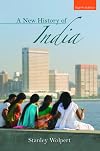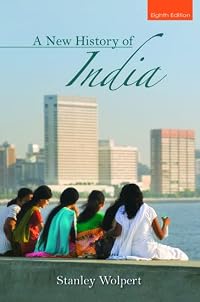
A New History of India
by Stanley Wolpert
On This Page
Description
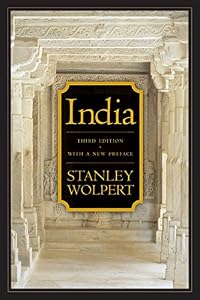
After more than twenty-five years in print, A New History of India continues to be the most readable and popular one-volume history of India available. Now in its eighth edition, this acclaimed text features updated scholarship and bibliographic material throughout and integrates new research on such incisive topics as the Indian diaspora, the economy, and the nuclear issue. In lively, accessible language, Stanley Wolpert condenses more than 4,000 years of India's history into a graceful and show more engaging narrative. He discusses modern India's rapidly growing population, industry, and economy, and also considers the prospects for India's future. From a carefully balanced perspective, Wolpert presents a fair and truthful record of India's history--he offers both a triumphant portrayal of the brightest achievements of Indian civilization as well as a sobering examination of its persistent social inequities and economic and political corruption. Enhanced with striking new images and a full-color map of India and the surrounding area, A New History of India, Eighth Edition, remains the authoritative text on the compelling--and often controversial--history of this fascinating country. show lessTags
Recommendations









Member Reviews
Standard academic survey of Indian history from ancient times to the post-independence era.
Sikhs, 121, 159 in following; demand a separate state, 346, 388; during the war, 238; emergence as martial force, 162; perils of partition for, 342; first war with the British, 222 and following; political party of, 388; ravaged by partition of Punjab, 348; represented by, 319; revolt against, 169; revolutionaries, 292; 242; and struggle against Mughal power, for invasions by the Afghans since 1748, and plunderers turn Delhi into a nightmare city of raping and carnage for more than a month of occupation, struggle against Mogul Power, 182; surrender to British, 223; under, 216; second war with the British, 223-24.
The invasion of India really was mostly from the north from the Khyber Pass and Afghanistan.
"Yet the bitter shock of such show more attacks, whatever the factual sum of their deadly impact, was even more painfully amplified in the memories of those who had watched helplessly as friends and family were slain or enslaved by invaders who claimed to kill, rape, and rob in the name of God (p. 107)."
"The severity of Turko - Afghan persecution directed against centers of Buddhist monasticism was so unrelenting that the religion of the Buddha was now sent into exile from the land of its birth, never to return again in any significant numbers until 1954 when B. R. Ambedkar, India's learned leader of Hindu untouchables, publicly converted to Buddhism with some 50,000 of his followers as a political protest (pp. 108-109)."
Divine love, devotion, and Guru Nanak, founder of the Sikhs, and other peaceful Hindu preachers opposed Islam (pp. 120-121). show less
The invasion of India really was mostly from the north from the Khyber Pass and Afghanistan.
"Yet the bitter shock of such show more attacks, whatever the factual sum of their deadly impact, was even more painfully amplified in the memories of those who had watched helplessly as friends and family were slain or enslaved by invaders who claimed to kill, rape, and rob in the name of God (p. 107)."
"The severity of Turko - Afghan persecution directed against centers of Buddhist monasticism was so unrelenting that the religion of the Buddha was now sent into exile from the land of its birth, never to return again in any significant numbers until 1954 when B. R. Ambedkar, India's learned leader of Hindu untouchables, publicly converted to Buddhism with some 50,000 of his followers as a political protest (pp. 108-109)."
Divine love, devotion, and Guru Nanak, founder of the Sikhs, and other peaceful Hindu preachers opposed Islam (pp. 120-121). show less
Ratings
Members
- Recently Added By
Author Information

29+ Works 1,263 Members
Stanley Wolpert is Distinguished Professor of South Asian History Emeritus at the University of California, Los Angeles
Classifications
Statistics
- Members
- 387
- Popularity
- 80,428
- Reviews
- 2
- Rating
- (3.75)
- Languages
- Czech, English, Italian
- Media
- Paper
- ISBNs
- 16
- ASINs
- 3