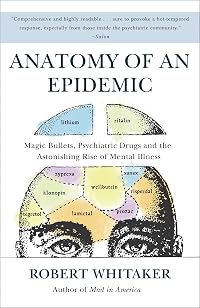
Anatomy of an Epidemic: Magic Bullets, Psychiatric Drugs, and the Astonishing Rise of Mental Illness in America
by Robert Whitaker
On This Page
Description
Presents a controversial assessment of the rise in mental illness-related disabilities and considers if drug-based care may be fueling illness rates throughout the past half century.Tags
Recommendations








































Member Reviews
ABSOLUTE MUST-READ if you or anyone in your family takes or has been prescribed antidepressants, anti-psychotics, or anti-anxiety medication. Big Pharma and the American Psychiatric Association have colluded (with malign neglect from the FDA) to CAUSE an epidemic - no, pandemic - of mental illness in our country over the last 50 years all in the name of their own profit, and prestige, respectively. I am one of the people on whose backs this has been done, and I am stunned at the evidence that the author found that was suppressed - and that the FDA allowed to be suppressed - that proves that all these medications that we've been taking as adults ARE MAKING US MORE DEPRESSED, AND LESS ABLE, LESS RESILIENT, and CHANGING THE SHAPES OF OUR show more BRAINS. They are not CURES - they are short-term masks of symptoms, and long-term illness creators. And now they are prescribing this CRAP to children as young as TWO because doctors, conveniently in the pay of Big Pharma as 'thought leaders', are changing the parameters of disease diagnoses to increase the potential consumer base. READ THIS BOOK, and GIVE IT TO EVERY PARENT YOU KNOW. show less
An entirely damning look at the psychiatric profession, Big Pharma, NIMH and the epidemic of mental illness the combination has caused. Whitaker looks at rates of diagnosis of such currently common maladies as bipolar disorder, schizophrenia, anxiety and ADHD. He cites statistic after statistic showing how much better off most of the mentally ill are without medication, and in a terrifying chapter, focuses on what anti-depressants, anti-psychotics and ADHD drugs appear to be doing to the long-term mental health of our kids.
The way the brain reacts to the medicines discussed here is fascinating. Though fascinating seems a callous word to use in this case, inasmuch as the drugs seem to be doing damage that may never be able to be undone.
I show more expect Big Pharma to lie and manipulate and be generally evil. Frankly, I don't expect much more of psychiatry as a whole. But reading this and examining the data made me so sad and so angry and (dare I say it) so depressed.
I'll leave you with a quote from The Lancet dated 2004:
"The story of research into selective serotonin reuptake inhibitor use in childhood depression is one of confusion, manipulation, and institutional failure." show less
The way the brain reacts to the medicines discussed here is fascinating. Though fascinating seems a callous word to use in this case, inasmuch as the drugs seem to be doing damage that may never be able to be undone.
I show more expect Big Pharma to lie and manipulate and be generally evil. Frankly, I don't expect much more of psychiatry as a whole. But reading this and examining the data made me so sad and so angry and (dare I say it) so depressed.
I'll leave you with a quote from The Lancet dated 2004:
"The story of research into selective serotonin reuptake inhibitor use in childhood depression is one of confusion, manipulation, and institutional failure." show less
Un estudio muy completo sobre la literatura científica sobre las enfermedades mentales y el uso y abuso de medicamentos, el ocultamiento y la tergiversación de pruebas científicas que demuestran la poca eficacia de los muchos medicamentos psiquiátricos. El tema de los diagnósticos hechos en niños, TDAH y bipolaridad, parece una prueba de que había que seguir ampliando los ratios de edad en la venta de fármacos. La creación de grupos de apoyo a enfermos psicóticos y padres de niños con TDAH con la colaboración de empresas farmacéuticas. El uso de drogas en los centros de acogida con niños negros de familias desestructuradas o padres drogadictos, para que no molesten. En fin. Un estudio muy completo de como se ha show more desarrollado esta epidemia que sólo ha conseguido el aumento de enfermos psiquiátricos en USA y la cantidad de dinero que mueve toda esta industria. show less
Here's an odd thing: I read this before. Another copy. I learned about the book and ordered it so I could read it as soon as possible after it was published. Yet I forgot that I had ordered and read it before! Even as I closed in on the last chapters I did not remember that I had read it two years ago. When I looked on my "mental health" shelf I found the other copy and looked it up on my bookcrossing page. How embarrassing!
Of course, much of the material is familiar to me. I have read many books about the psychiatric drug industry. This one, though, doesn't focus on one disorder, as, for example, Whitaker's Mad in America focused on schizophrenia and Glenmullen's Prozac Backlash focused on depression. Instead, it offers us a short show more history of all of the major "disorders" now being treated by drugs: schizophrenia, depression, bipolar disorder (and its variants), ADHD, panic disorder.
What comes through again and again is that historically persons with all of these conditions usually got over them. And in the case of children with bipolar disorder (previously called Manic-depressive), incidents of this condition were so rare that psychiatrists said it didn't exist.
But now? A much greater percentage of the population is afflicted with these disorders and a much larger percentage of those are permanently disabled by them. Is it any wonder that Whitaker had to take on this question: What is causing the epidemic of mental illness?
The increases are so great that they cannot be accounted for by simply being underdiagnosed. The differences - the worsening of the conditions - simply cannot be accounted for by "stress", for example. The science is clear: psychiatric drugs change the brain, possibly permanently. They do not correct a chemical imbalance. That theory was disproven years ago. The drugs themselves are responsible for the increases in these conditions, by different means:
Bipolar disorder follows drug treatment for depression most of the time. When you follow the science, it makes sense that antidepressants can cause manic episodes, sometimes leading to more permanent bipolar conditions. Other conditions are misdiagnosed and then the drug treatment leads to the condition that was diagnosed. The guidelines for bipolar disorder, for example, are getting looser and looser every year, so that children who are a little difficult may easily be diagnosed with it.
Speaking of children. There is no evidence that any drugs are good for children over the long haul. Stimulants may calm a child, but that child does not, statistically, do any better in school. The stimulants help the teacher, not the child.Further, these drugs frequently lead to worse outcomes for the child as she reaches adulthood.
This book is an indictment that should not have been necessary to write. The drug companies, their lobbies, and the government agencies supposedly overseeing them, joined together years ago to sell a story about mental illnesses that was simply untrue. Because reporters tend to get their news from press releases, none of them found the articles that were critical of current drug therapy, because there were no press releases about them. Thus most citizens and even most doctors have been simply unaware of the discrepancy between the stories the drug hawkers tell and the truth. And thus it was necessary to write yet another book.
I am saddened that, although this book received high praise in reviews, the information unearthed in it has yet to make its way to major news publications or television stations. I will continue to be a vocal advocate for cognitive therapy and exercise as opposed to drug treatments, but my voice does not carry far. show less
Of course, much of the material is familiar to me. I have read many books about the psychiatric drug industry. This one, though, doesn't focus on one disorder, as, for example, Whitaker's Mad in America focused on schizophrenia and Glenmullen's Prozac Backlash focused on depression. Instead, it offers us a short show more history of all of the major "disorders" now being treated by drugs: schizophrenia, depression, bipolar disorder (and its variants), ADHD, panic disorder.
What comes through again and again is that historically persons with all of these conditions usually got over them. And in the case of children with bipolar disorder (previously called Manic-depressive), incidents of this condition were so rare that psychiatrists said it didn't exist.
But now? A much greater percentage of the population is afflicted with these disorders and a much larger percentage of those are permanently disabled by them. Is it any wonder that Whitaker had to take on this question: What is causing the epidemic of mental illness?
The increases are so great that they cannot be accounted for by simply being underdiagnosed. The differences - the worsening of the conditions - simply cannot be accounted for by "stress", for example. The science is clear: psychiatric drugs change the brain, possibly permanently. They do not correct a chemical imbalance. That theory was disproven years ago. The drugs themselves are responsible for the increases in these conditions, by different means:
Bipolar disorder follows drug treatment for depression most of the time. When you follow the science, it makes sense that antidepressants can cause manic episodes, sometimes leading to more permanent bipolar conditions. Other conditions are misdiagnosed and then the drug treatment leads to the condition that was diagnosed. The guidelines for bipolar disorder, for example, are getting looser and looser every year, so that children who are a little difficult may easily be diagnosed with it.
Speaking of children. There is no evidence that any drugs are good for children over the long haul. Stimulants may calm a child, but that child does not, statistically, do any better in school. The stimulants help the teacher, not the child.Further, these drugs frequently lead to worse outcomes for the child as she reaches adulthood.
This book is an indictment that should not have been necessary to write. The drug companies, their lobbies, and the government agencies supposedly overseeing them, joined together years ago to sell a story about mental illnesses that was simply untrue. Because reporters tend to get their news from press releases, none of them found the articles that were critical of current drug therapy, because there were no press releases about them. Thus most citizens and even most doctors have been simply unaware of the discrepancy between the stories the drug hawkers tell and the truth. And thus it was necessary to write yet another book.
I am saddened that, although this book received high praise in reviews, the information unearthed in it has yet to make its way to major news publications or television stations. I will continue to be a vocal advocate for cognitive therapy and exercise as opposed to drug treatments, but my voice does not carry far. show less
I was expecting this book to be a diatribe about the dangers of psychiatric medicine, in much the way that Listening to Prozac was. My issue with that book was that it seemed to downplay the real benefits that many people receive from the (then fairly new) class of anti-depressants including Prozac. Although I know he made a disclaimer in the book that denies this, I still felt as if it would be too simple for a person who was medication-resistant to use Kramer's thesis as a reason to avoid needed medication.
I was surprised to find that this book did not have the same slant. As someone who has been on medication for depression for a number of years, I found this book disturbing and thought-provoking. Although I absolutely KNOW that the show more medication has been valuable for me, I also can completely believe Whitaker's warnings about how the drug companies have been less than forthcoming with consumers about the real effects that these medications have on patients. We have seen this focus on corporate benefits over concern for the consumer/user demonstrated in so many different areas of our corporate society--why would anyone doubt that the pharmaceutical industry would be any different.
Although I am not ready to go out and declare myself free of the tyranny of drug dependency just yet, I definitely found that this book sparked a strong interest in digging deeper into the real value of psychiatric pharmaceuticals. show less
I was surprised to find that this book did not have the same slant. As someone who has been on medication for depression for a number of years, I found this book disturbing and thought-provoking. Although I absolutely KNOW that the show more medication has been valuable for me, I also can completely believe Whitaker's warnings about how the drug companies have been less than forthcoming with consumers about the real effects that these medications have on patients. We have seen this focus on corporate benefits over concern for the consumer/user demonstrated in so many different areas of our corporate society--why would anyone doubt that the pharmaceutical industry would be any different.
Although I am not ready to go out and declare myself free of the tyranny of drug dependency just yet, I definitely found that this book sparked a strong interest in digging deeper into the real value of psychiatric pharmaceuticals. show less
This book is a disturbing expose of psychopharmaceuticals, the biological basis of mental illness, and the historical background of treatments and their efficacy or lack thereof. The author’s critique leans very much toward non-medicating mental illness (or at least short term medication) of everything from schizophrenia to depression, but he supplies compelling arguments and substantial scientific literature to back up this stand. The worst cases that he brings up are very frightening, and depressing.
In Anatomy of an Epidemic, Whitaker asks why the number of Americans who receive government disability for mental illness approximately doubled since 1987 and in the answer to that question and examines the disastrous, long-term outcomes for the mentally ill in the U.S. when started off with initially beneficial psychotropic medications. I first started hearing of this and thinking about it with Blood Money: Modern Medicine's Abuse of Power by Surendra Kelwala. Whitaker begins by reviewing the discovery of antipsychotics, benzodiazepines and antidepressants with technical, medical detail. This was a bit of a slog for me to get through. However, the author combines such details with high level views of the studies and science and show more anecdotal studies of many patients he personally interviewed. This tells a story from Meprobamate (marketed as Miltown) to Fluoxetine, also known by trade names Prozac and Sarafem among other antidepressants of the selective serotonin reuptake inhibitor (SSRI) and brain damaging stimulants of the Ritalin variety. The unfortunate trend is early success followed by dependency and physical damage. It seems there is little to know way to truly detect a chemical imbalance in purely organic psychosis, but brain damage is clear from long term usage of the pharmaceuticals. The institution trend of the 50s-70s was mated with chemical tools making patient control easier and became a foundation of pill-happy American’s approach to medicine and well-being.
These compounds were developed during a period of growth for the pharmaceutical industry bolstered by the 1951 Durham-Humphrey Amendment, giving physicians monopolistic prescribing rights thus aligning the interests of physicians and pharmaceutical companies. This also followed the industry's development of "magic bullets" that treat people with, for example, diabetes, which according to Whitaker provided an analogy to sell the idea of these drugs to the public. It was not until many years later, after the mechanisms of these drugs were determined, that the serotonergic hypothesis of depression and dopaminergic hypothesis of schizophrenia were developed to fall in line with the drug's mechanisms Whitaker's analysis of adaptive response of the amazing brain, even when imperfect to react to the assault of the drugs and this be more damaged without them is telling. Whitaker further criticizes the magic bullet theory by attacking the historical notion that the "invention of the antipsychotic Thorazine" emptied the asylums. His case begins by showing that during the late 1940s and 1950s ~75% of cases admitted.
It is literally depressing itself to read of the numerous studies that find exercise and coping mechanism or placebos trumping long-term drug use time and again. I recommend this book to anyone with a loved one starting down the road to damaging mood-managing psychotropic drugs. show less
These compounds were developed during a period of growth for the pharmaceutical industry bolstered by the 1951 Durham-Humphrey Amendment, giving physicians monopolistic prescribing rights thus aligning the interests of physicians and pharmaceutical companies. This also followed the industry's development of "magic bullets" that treat people with, for example, diabetes, which according to Whitaker provided an analogy to sell the idea of these drugs to the public. It was not until many years later, after the mechanisms of these drugs were determined, that the serotonergic hypothesis of depression and dopaminergic hypothesis of schizophrenia were developed to fall in line with the drug's mechanisms Whitaker's analysis of adaptive response of the amazing brain, even when imperfect to react to the assault of the drugs and this be more damaged without them is telling. Whitaker further criticizes the magic bullet theory by attacking the historical notion that the "invention of the antipsychotic Thorazine" emptied the asylums. His case begins by showing that during the late 1940s and 1950s ~75% of cases admitted.
It is literally depressing itself to read of the numerous studies that find exercise and coping mechanism or placebos trumping long-term drug use time and again. I recommend this book to anyone with a loved one starting down the road to damaging mood-managing psychotropic drugs. show less
Members
- Recently Added By
Lists

Non-Fiction Worth Reading
1,015 works; 261 members

The Joe Rogan Experience Library
254 works; 3 members

Tom's Bookstore
346 works; 2 members
Author Information

4+ Works 1,990 Members
Robert Whitaker is an American journalist and author, writing primarily about medicine, science, and history. He has written on and off for the Boston Globe and in 2001, he wrote his first book Mad in America about psychiatric research and medications, the domains of some of his earlier journalism. Articles that Whitaker co-wrote won the 1998 show more George Polk Award for Medical Writing and the 1998 National Association of Science Writers¿ Science in Society Journalism Award for best magazine article. A 1998 Boston Globe article series he co-wrote on psychiatric research was a finalist for the 1999 Pulitzer Prize for Public Service. In April 2011, IRE announced that his book, Anatomy of an Epidemic: Magic Bullets, Psychiatric Drugs, and the Astonishing Rise of Mental Illness in America, had won its award as the best investigative journalism book of 2010. In 2015 it became a New York Times bestseller. (Bowker Author Biography) show less
Awards and Honors
Awards
Classifications
- Genres
- Nonfiction, General Nonfiction, Science & Nature, History
- DDC/MDS
- 616.89 — Applied science & technology Medicine & health Diseases, Allergies, Skin Conditions Nervous Disorders: Autism, Anorexia, OCD Mental disorders: bi-polar/schizophrenia
- LCC
- RC443 .W437 — Medicine Internal medicine Internal medicine Neurosciences. Biological psychiatry. Neuropsychiatry Psychiatry
- BISAC
Statistics
- Members
- 731
- Popularity
- 38,676
- Reviews
- 22
- Rating
- (4.12)
- Languages
- English, Norwegian (Bokmål), Spanish, Swedish
- Media
- Paper, Audiobook, Ebook
- ISBNs
- 11
- ASINs
- 5