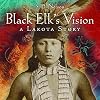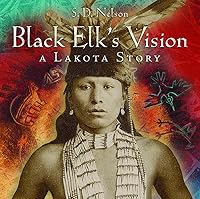
Black Elk's Vision: A Lakota Story
by S.D. Nelson
On This Page
Description
A simple biography of Lakota-Oglala medicine man Black Elk, from his childhood vision which shaped his life through his battles with the whites and his travels with Buffalo Bill's Wild West show.Tags
Recommendations





Member Reviews
Lakota picture-book author and artist S.D. Nelson turns to the story of Oglala Lakota prophet and medicine man Black Elk in this deeply moving work of biography. Born near the Little Powder River in Montana in 1863, Black Elk had visions from an early age, but kept them to himself at first, for fear that he would be misunderstood by his people. In 1872, at the age of nine, he had his Great Vision, while he lay ill. Taken to the land of the Cloud People, he met the Six Grandfathers, who were the Powers of the World, and he learnt from them about the Circle of Life, and the powers of life and destruction that had been given to all peoples. He also learned about the great tree of life, growing at the center of all things, which can only show more flourish if all peoples care for it. Waking from his illness, Black Elk returned to a world where the beauty and hope of his vision seemed to stand in stark contrast to the ugliness and suffering of life around him. Witness to the end of the nomadic freedom of his people, Black Elk fought in the Battle of the Little Big Horn (1876); traveled with Buffalo Bill's Wild West Show to New York and London, and then with the Mexican Joe show throughout Europe (1886-1889); and witnessed the massacre at Wounded Knee (1890). In 1932, he related his vision to the Euro-American author John G. Neihardt, and Black Elk Speaks was published to much acclaim. Since that time, Black Elk's vision has inspired countless others, and the wisdom it offers about the choices before humanity has remained as necessary as ever...
I was in high school when I read Black Elk Speaks, and I recall being deeply moved by it, both because of its subject's life story and experiences, and because of the spiritual wisdom that it offered. I am so very glad that Nelson has created Black Elk's Vision: A Lakota Story, as this makes the story accessible for younger readers as well. This was an intensely moving and poignant book, and I found myself tearing up on more than one occasion, as I read it. What a gift Black Elk's vision was, but what a burden it must sometimes have seemed, given the events unfolding around him. The idea of choice being central to the human experience - the choice between life and destruction - is one I find powerfully convincing, and the notion of a central tree of life, something that ties all of creation together, also speaks to me most strongly. Nelson's retelling of this story is respectful and emotionally resonant, the accompanying historical photographs fascinating, and the acrylic artwork gorgeous. The back matter, which includes an extensive note from the author/illustrator, a detailed timeline, notes, bibliography and index, provides additional information. On a very minor note, I appreciated the way that Nelson used the term "Euro-American," when he was not using the Lakota word "Wasichu," as I prefer that term myself. On a major note, I was deeply appreciative of his humane and hopeful vision, as he writes in his afterword that "Among the many lessons found in Black Elk's vision is this: All human beings have the power of choice. Through our actions we choose either to destroy life or to give life. It is no good to live our days with a blaming heart; that way leads only to suffering. We are not victims of a destiny forced upon us by others. Instead, we are the makers of our people's future. If we truly seek harmony, we will choose to carry the wooden cup of water. It alone holds the power to give life."
I loved pretty much everything about this book, from the subject matter to the telling, the beautiful artwork to the hopeful vision of both Black Elk and Nelson, and it ended up being one of my rare 5-star titles. Highly recommended to middle-school and more advanced primary school readers with an interest in Native American history and spirituality, and the story of the American West in the late 19th and early 20th centuries. show less
I was in high school when I read Black Elk Speaks, and I recall being deeply moved by it, both because of its subject's life story and experiences, and because of the spiritual wisdom that it offered. I am so very glad that Nelson has created Black Elk's Vision: A Lakota Story, as this makes the story accessible for younger readers as well. This was an intensely moving and poignant book, and I found myself tearing up on more than one occasion, as I read it. What a gift Black Elk's vision was, but what a burden it must sometimes have seemed, given the events unfolding around him. The idea of choice being central to the human experience - the choice between life and destruction - is one I find powerfully convincing, and the notion of a central tree of life, something that ties all of creation together, also speaks to me most strongly. Nelson's retelling of this story is respectful and emotionally resonant, the accompanying historical photographs fascinating, and the acrylic artwork gorgeous. The back matter, which includes an extensive note from the author/illustrator, a detailed timeline, notes, bibliography and index, provides additional information. On a very minor note, I appreciated the way that Nelson used the term "Euro-American," when he was not using the Lakota word "Wasichu," as I prefer that term myself. On a major note, I was deeply appreciative of his humane and hopeful vision, as he writes in his afterword that "Among the many lessons found in Black Elk's vision is this: All human beings have the power of choice. Through our actions we choose either to destroy life or to give life. It is no good to live our days with a blaming heart; that way leads only to suffering. We are not victims of a destiny forced upon us by others. Instead, we are the makers of our people's future. If we truly seek harmony, we will choose to carry the wooden cup of water. It alone holds the power to give life."
I loved pretty much everything about this book, from the subject matter to the telling, the beautiful artwork to the hopeful vision of both Black Elk and Nelson, and it ended up being one of my rare 5-star titles. Highly recommended to middle-school and more advanced primary school readers with an interest in Native American history and spirituality, and the story of the American West in the late 19th and early 20th centuries. show less
This author is meticulous in his factual representation with footnotes and historical images. There is a large amount of text, but the primary story is very easy to read, and the combination of illustration and photographs is very inviting. Books like these are essential in today's schools, because traditional models tend to avoid the minority account. This book is honest, it does not glorify the Wasi'chu (Lakota word for White Man), nor does victimize the Lakota people. Additionally, though it was non-fiction, the prose and design was not sterile, which is a common assumption made by and deterrent for young students with regard to "true story" texts. The inclusion of quotes from Black Elk himself were also well placed, beautiful, and show more evoked an even greater connection between reader and narrative. show less
This is a wonderful book! It is very long, too long to read all at once to young students. I wish I had known about this book last year when I taught 4th grade. It would be a great addition to the Oregon Trail unit. It offers a unique perspective on the Native American's life during westward expansion. It is a gripping tale, that seems to hit me equally as hard each time I read a story like this one of the Lakota people's.
Such a terrible story. I like the way this is written; it's very matter-of-fact about how despicable early Americans' treatment of the Native Americans was, but blame isn't the focus. Black Elk's vision is that each of us possesses the power to destroy and to give life, and the choice between them is ours to make.
Nelson, S.D. (2010). Black Elk’s Vision: A Lakota Story. New York: Abrams. 56 pp. ISBN 978-0-8109-8399-1 (Hard Cover); $16.99.
Black Elk's vision does not flinch from the truth but neither does it victimize the Lakota people. Extensive notes and references, including a detailed timeline, provide students with a rich historical document that tells the story of the Lakota people. The illustrations are gorgeous and the text is liberally sprinkled with quotes directly from Black Elk. Beginning with the cover, continuing with the endpapers, moving to the title page, and traveling through the entire book to the back cover art, we have one of the most beautifully designed books of the year. Paper quality, page design, artwork, and photography show more work together beautifully in this book. Nelson tells readers of Black Elk’s vision framed around primary source quotes from Black Elk himself. Nelson presents this vision using first person text, which will have the effect of making this story more assessable for younger readers. For students who think the term, “circle of life” is some Disney concept, they will see this term framed around the unspeakable and horrific way the Lakota were treated by whites, which should make for interesting discussions. Purchase this book for elementary, middle school, and even high school libraries. show less
Black Elk's vision does not flinch from the truth but neither does it victimize the Lakota people. Extensive notes and references, including a detailed timeline, provide students with a rich historical document that tells the story of the Lakota people. The illustrations are gorgeous and the text is liberally sprinkled with quotes directly from Black Elk. Beginning with the cover, continuing with the endpapers, moving to the title page, and traveling through the entire book to the back cover art, we have one of the most beautifully designed books of the year. Paper quality, page design, artwork, and photography show more work together beautifully in this book. Nelson tells readers of Black Elk’s vision framed around primary source quotes from Black Elk himself. Nelson presents this vision using first person text, which will have the effect of making this story more assessable for younger readers. For students who think the term, “circle of life” is some Disney concept, they will see this term framed around the unspeakable and horrific way the Lakota were treated by whites, which should make for interesting discussions. Purchase this book for elementary, middle school, and even high school libraries. show less
Books like this always make me cry. OwnVoices, as artist is member of Standing Rock Sioux. Not sure which words are Nelson's and which are actually Black Elk's own... I could (should) read [b:Black Elk Speaks: Being the Life Story of a Holy Man of the Oglala Sioux|35476|Black Elk Speaks Being the Life Story of a Holy Man of the Oglala Sioux|John G. Neihardt|https://i.gr-assets.com/images/S/compressed.photo.goodreads.com/books/1328819916l/35476._SX50_.jpg|3813941] and that might clarify. But all felt authentic, just, made accessible to young people. Not littles, though, for all that it's shaped like a toddler's picture-book. Includes rich back matter.
Told from the Native American point of view, Black Elk’s Vision provides a unique perspective on American history. From recounting the visions Black Elk had as a young boy, to his involvement in the battles of Little Big Horn and Wounded Knee, as well as his journeys to New York City and Europe with Buffalo Bill’s Wild West Show, this biographical account of Black Elk—an Oglala-Lakota medicine man (1863–1950)—follows him from childhood through adulthood. S. D. Nelson tells the story of Black Elk through the medicine man’s voice, bringing to life what it was like to be Native American in the mid-to-late nineteenth century and early twentieth century.
Members
- Recently Added By
Lists

Native American Heritage
52 works; 2 members
Author Information

12+ Works 1,481 Members
Awards and Honors
Awards
Distinctions
Notable Lists
Classifications
Statistics
- Members
- 236
- Popularity
- 136,791
- Reviews
- 23
- Rating
- (4.09)
- Languages
- English, French
- Media
- Paper, Ebook
- ISBNs
- 8
- ASINs
- 3