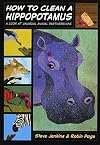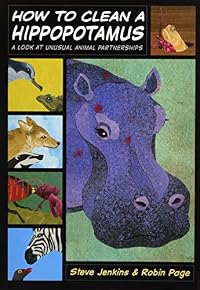
How to Clean a Hippopotamus: A Look at Unusual Animal Partnerships
by Robin Page, Steve Jenkins
On This Page
Description
Learn about the ingenious lifestyles of some of the world's most unusual animal partners.Tags
Recommendations



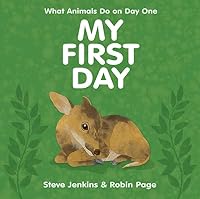
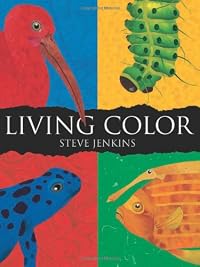

Member Recommendations
infiniteletters Bill and Pete is admittedly younger.
Member Reviews
In a series of well-designed panels, squares, and block text, Jenkins and Page present another fascinating animal fact book for preschool and elementary listeners and readers. Symbiotic relationships, from the well-know to the obscure, from marine iguanas to warthogs, are explained and illustrated in simple text.
I was a little puzzled by the apparently random bold text. Would this help early readers? I'm not sure. The art is classic Jenkins and is perfectly downsized to fit into the small panels without losing details or clarity. The end material includes a more detailed explanation of symbiosis and the size, habitat, and diet of all the animals listed. There's also a short list of further resources.
Verdict: As always, Jenkins' and show more Page's work is a necessity for the library collection
ISBN: 978-0547245157; Published May 2010 by Houghton Mifflin; Borrowed from the library; Purchased for the library show less
I was a little puzzled by the apparently random bold text. Would this help early readers? I'm not sure. The art is classic Jenkins and is perfectly downsized to fit into the small panels without losing details or clarity. The end material includes a more detailed explanation of symbiosis and the size, habitat, and diet of all the animals listed. There's also a short list of further resources.
Verdict: As always, Jenkins' and show more Page's work is a necessity for the library collection
ISBN: 978-0547245157; Published May 2010 by Houghton Mifflin; Borrowed from the library; Purchased for the library show less
Better than the other Jenkins that I read this week, but not his best imo. I learned a lot. I did have trouble following along sometimes as some of the 'units' are too concise (I'm still not clear on different goby fish and their partners). I liked the last 'unit' about dog & human, and the extra detail in the back. The focus on symbiosis is much appreciated... I'm not convinced that concept books that cover too much data are all that helpful, even for littles. This is for age 7 up I believe. Anyway, if I had used it with my boys, we would have had fun comparing the concepts Symbiosis (Mutualism) and Cooperation.
How to Clean a Hippopotamus is an illustrated non-fiction introductions to some of the interesting ways animals cooperate with each other. Formatted like a graphic novel, the book is comprised of short sections, usually only a page or two, each of which portrays a different partnership. The subjects range from predatory animals hunting together to tiny crabs using anemones to fight off big fish. Each subject is interesting, but a lack of a progressive or varied narrative structure causes the reader’s interest to wane toward the end of the book. While the limited use of text might give the impression that this book is for young readers, it is better suited to children at a higher reading level, who have been exposed to some scientific show more concepts. The language is concise and dynamic, leaving most of the description to the illustrations. The illustrations are boldly-colored, simplified realistic collages that depict each animal or pair of animals and provide detail that is absent from the text. Details about each of the animals in the book is provided in the back, along with a list of other books to allow readers to continue their exploration of the subject. How to Clean a Hippopotamus is not a serious informational text for children who are mature enough to understand it, but it is a light-hearted resource for sparking readers’ interest in science at home or in the library. Recommended. Grades 5-7 show less
Nature is full of symbiotic relationships, relationships in which both partners benefit from an alliance, and this nonfiction picture book is packed full of fascinating examples. The clear, well-researched text gives young readers a solid introduction to thirty-four partnerships, while supplementary materials provide even more information about symbiosis and about each creature mentioned in the book. The illustrations are once again in the team’s award-winning collage style, with paper, feathers and fur meticulously layered to create detailed depictions of animals and their environments. The layout resembles a comic book, with numerous captioned panels per page, and while these panels do allow the creators to include a large number of show more partnerships, the effect is sometimes overcrowded, and very young readers may have trouble following the intricate layout. Recommended for readers ages six to nine, especially budding biologists and animal-lovers. One final note: while the authors do mention hunting and killing in this book, the illustrations are reasonably non-graphic and should not trouble most readers. show less
The art is very visually engaging and interesting - it looks like it's done with paper collage and other mixed media. The book is also set up in a slightly "comic book" style with small, individualzed framed sequential panels. The subject matter is basically about "animal partnerships" - usually in the sense of a larger animal relying on small animals such as turtles and birds to do things like clean their skin or their ears. In return, those smaller animals get food! (Yucky food). I think the reading level is, like, 1st-3rd grade - it actually does provide a fairly substantial amount of information, despite its page count and the preponderance of illustration over text. Anyway - not scintillating by any means, but a good introduction show more to this aspect of animal life. show less
I love this book!! I think it is fascinating for kids and adults; even though it is geared for students. I would definitely have this in my classroom from 2nd grade and on, not only to teach with, because it matches the 3rd grade NGSS standards, but for my students to enjoy during free read. I think this would be enjoyed by all students at some point, because it genuinely is kind of cool how so many different animals work together.
Many of us know of the helpful relationship between the sea anemone and clown fish. Did you know, however, that each clown fish can only use one sea anemone? It's complicated, but readily explained by Steve Jenkins and Robin Page in this beautiful book. Additional information at the end of the book includes "More about Symbiosis"; a listing of all of the animals described in the book including size, habitat, and diet; and a bibliography.
Members
- Recently Added By
Author Information

26+ Works 7,012 Members

75+ Works 21,314 Members
Awards and Honors
Awards
Distinctions
Notable Lists
Classifications
Statistics
- Members
- 269
- Popularity
- 119,503
- Reviews
- 24
- Rating
- (4.17)
- Languages
- English, Korean
- Media
- Paper, Ebook
- ISBNs
- 9
- UPCs
- 2
- ASINs
- 3