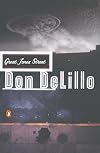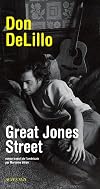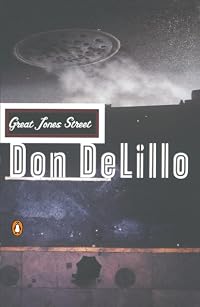
Great Jones Street
by Don DeLillo
On This Page
Description
From the author of White Noise (winner of the National Book Award) and Zero K Bucky Wunderlick, rock star and budding messiah, has hit a spiritual wall. In mid-tour he bolts from his band to hole up in a dingy East Village apartment and separate himself from the paranoid machine that propels the culture he has helped create. As faithful fans await messages, Bucky encounters every sort of roiling farce he is trying to escape. A penetrating look at rock and roll's merger of art, commerce, and show more urban decay. show lessTags
Recommendations







Member Reviews
Picked this up second hand somewhere and it sat on the shelf for a while. It's the story of the perfectly-named rock star Bucky Wunderlick who walks off stage at the height of his fame and holes up in an anonymous tenement on the titular NYC street. Although this is an early DeLillo, his trademark style seems fully developed. People talk in that staccato, disconnected, aphoristic way, and every line of dialogue is really just DeLillo delivering highbrow-subversive social commentary and postmodern quips. The main ideas seem to be (i) satire of the music biz - this works great and is very funny at times, (ii) fame vs. anonymity especially in the context of the big city - also pretty well done and maybe (iii) the nature and purpose of show more creativity - the plot hinges on a transaction involving a new wonder-drug and a lost tape of Bucky's late work. Some chapters consist of really godawful embarrassing samples of Bucky's lyrics and I wasn't sure if these were included with (i) or (iii) in mind. I hope the former. Definitely not my (or I suspect anyone's) favourite DeLillo but he's a writer who is always worth reading. show less
“Fame requires every kind of excess”
“I mean true fame, not the sombre renown of weary statesmen or chinless kings. I mean long journeys across gray space. I mean danger, the very edge of the void, the circumstance of one man imparting an erotic terror to the dreams of the republic………….
( is it clear I was a hero of Rock ‘n’ Roll)
So starts Don Delillo’s 3rd novel, Great Jones Street. The hero, Bucky Wunderlick, has left the group high & dry, by dropping out of a national tour at the height of their fame & success. His reasoning is to seek out an alternate existence, outside of his public persona, by seeking refuge in some crummy bedsit on Great Jones Street. The problem with this is everyone knows he’s there, his show more manager (the building is owned by his management company), members of a cult, fellow band members etc & they all want to or already do own a piece of him. Some are after some experimental super drug & some for some tapes of music he has made.
In trying to write this piece, I’ve checked out various resources & they make comparisons between the hero & Bob Dylan, Mick Jagger, Jim Morrison & even Kurt Cobain (amazing as the book was out in the early 70’s), discussing the relationship between self & public persona. In the book there is no division, the public perception has as much credibility as the individual, Bucky & us, as readers, constantly learn of his exploits all whilst constantly aware he hasn’t left Great Jones Street, making rumour & publicity at least as real as his private self.
Also mentioned a lot is the connection between the underground movement & rock. There's a cult called the Happy valley farm commune, who have set up home in a lower eastside tenement & seem to connect themselves with Bucky's withdrawal from society (or his perception of it). Personally I think Delillo points us elsewhere to what he perceives as the real underground, through the character of Watney(named after the English beer comp?) an old retired English rocker who says on page 232
“The presidents & prime ministers are the ones who make the underground deals & speak the true underground idiom. The corporations. The military. The banks.This is the underground network. This is where it happens. Power flows under the surface, far beneath the level you & I live on. This is where the laws are broken, way down under, far beneath the speed freaks & cutters of smack. Your not insulated or unaccountable the way a corporate force is.Your audience is not the relevant audience.It doesn’t make anything. It doesn’t sell to others.Your life consumes itself”
If this book has a message, its something like, rock & its rebel underground image has no real status, no power, it is merely a way of selling a particular commodity. That the real status,those that really stick their fingers up to the man, are the man. This was probably true then & it definitely resonates with what makes the news today.
http://parrishlantern.blogspot.co.uk/2010/06/fame-requires-every-kind-of-excess.... show less
“I mean true fame, not the sombre renown of weary statesmen or chinless kings. I mean long journeys across gray space. I mean danger, the very edge of the void, the circumstance of one man imparting an erotic terror to the dreams of the republic………….
( is it clear I was a hero of Rock ‘n’ Roll)
So starts Don Delillo’s 3rd novel, Great Jones Street. The hero, Bucky Wunderlick, has left the group high & dry, by dropping out of a national tour at the height of their fame & success. His reasoning is to seek out an alternate existence, outside of his public persona, by seeking refuge in some crummy bedsit on Great Jones Street. The problem with this is everyone knows he’s there, his show more manager (the building is owned by his management company), members of a cult, fellow band members etc & they all want to or already do own a piece of him. Some are after some experimental super drug & some for some tapes of music he has made.
In trying to write this piece, I’ve checked out various resources & they make comparisons between the hero & Bob Dylan, Mick Jagger, Jim Morrison & even Kurt Cobain (amazing as the book was out in the early 70’s), discussing the relationship between self & public persona. In the book there is no division, the public perception has as much credibility as the individual, Bucky & us, as readers, constantly learn of his exploits all whilst constantly aware he hasn’t left Great Jones Street, making rumour & publicity at least as real as his private self.
Also mentioned a lot is the connection between the underground movement & rock. There's a cult called the Happy valley farm commune, who have set up home in a lower eastside tenement & seem to connect themselves with Bucky's withdrawal from society (or his perception of it). Personally I think Delillo points us elsewhere to what he perceives as the real underground, through the character of Watney(named after the English beer comp?) an old retired English rocker who says on page 232
“The presidents & prime ministers are the ones who make the underground deals & speak the true underground idiom. The corporations. The military. The banks.This is the underground network. This is where it happens. Power flows under the surface, far beneath the level you & I live on. This is where the laws are broken, way down under, far beneath the speed freaks & cutters of smack. Your not insulated or unaccountable the way a corporate force is.Your audience is not the relevant audience.It doesn’t make anything. It doesn’t sell to others.Your life consumes itself”
If this book has a message, its something like, rock & its rebel underground image has no real status, no power, it is merely a way of selling a particular commodity. That the real status,those that really stick their fingers up to the man, are the man. This was probably true then & it definitely resonates with what makes the news today.
http://parrishlantern.blogspot.co.uk/2010/06/fame-requires-every-kind-of-excess.... show less
Objectification: This is a great postmodern novel that really examines what it means to be human through the lenses of Bucky, the superstar who has chosen to withdraw himself from the public. In this novel, DeLillo brings up issues such as one's fear of being immobile, and thus objectified and dead; the question of human space; the changeability of human beings--"structural transposition"; humanness--what is "human"? To some extent we are like the grotesque, handicapped boy in this novel: we all have an animal side, and we all bite from time to time. This is the first DeLillo novel that I read, and I have to say that it really intrigued me and got me thinking about issues that I've never thought about before; issues that are wholly show more relevant and important to our lives in this postmodern, decadent world where nothing is definite. show less
This one really deserves 3 1/2 stars and I'm also grading it somewhat relatively to Don DeLillo's other novels and it does pale a bit in comparison. The main premise of this is that a big rock star lead singer gets bogged down within the realm of the mass consciousness and retreats unexpectantly and suddenly to the realm of the private. However, instead of his mountain hideout, he actually goes to an apt. in NYC. Some of this is my speculation but I think DeLillo was making some pretty accurate statements about one's anonymity in this city and the potential, like a single frail molecule, to dissolve. As expected, he meets some shady characters and gets roped into a really wretched drug ring. Throughout all of the chaos of the novel, the show more main character stays assuredly calm and doesn't seem to manifest any great fear of death or torture, which is atypical of most protagonists put in this position. The weakness in terms of that is you don't get a sense of him as a main character and he comes off as having a real flat affect. The strengths of this book by far are within the descriptions of NYC and not within the details of his characters. Also, although I thought I would really like this plot as I'm into music, I ended up not caring for it nearly as much as Salman Rushdie's The Ground Beneath Her Feet. If you are looking for a DeLillo novel to start with, I wouldn't recommend this one as much as his classic White Noise, though I really liked Mao II much better. show less
Great Jones Street – Don DeLillo’s novel published as part of the 1980s Vintage Contemporaries series where a young rock-and-roll artist seals himself off in a Lower Manhattan down-and-out apartment. Well, there’s the occasional visit from his girlfriend and members of his rock group and hawkers connected with a Happy Valley Commune yammering about a future miracle drug, enough visits to keep his sharp edge very sharp and enough visits to possibly drive a crazy boy crazy.
And here's our man, the one and only Bucky Wunderlick, musing on the mystical nature of his girlfriend and soulmate, the incomparable Opel: "All she desired was the brute electricity of that sound. To forget everything. To be that sound. That was the only tide show more she heeded. She wanted to exist as music does, nowhere, beyond the maps of language." A batch of reasons why this novel by Don DeLillo is fab:
THE BOX MAN, AMERICAN-STYLE
Within months of publication of Great Jones Street another new novel hit the shelves addressing many of the same themes: The Box Man by Nobel winning Japanese novelist, Kōbō Abe, where the nameless protagonist surrenders his previous identity and conventional routine to live in a large cardboard box he wears over his head. Great Jones Street and The Box Man – so into yourself, so “society get out of my face.” At one point in DeLillo’s novel, girlfriend Opel tells Bucky about a new underground counterculture group: “The return of the private man, according to them, is the only way to destroy the notion of mass man.” Oh, Opel. Oh, Bucky. Oh, Box Man. This is so 70s! Sidebar: I recall watching a 1970s newscast where a university student wore a black cloth over his head down to his shoes and walked around campus calling himself “the black bag.” Actually, I thought this guy really cool.
POETRY
At one point, Bucky reflects: “Alone I lived in the emergency of minutes, in phases of dim compliance with the mind’s turning hand.” And here’s another of his rock-and-roll reveries: “Euphoric with morphine we’d be wheeled among them, noting proportions and contours, admiring the beauty of what we were.” It’s as if Bucky’s words could have been excerpts from Alan Ginsberg’s many page beatnik slam-poem “Howl.” And there are numerous other such Bucky rant-lines for fans of DeLillo’s poetic, philosophic prose.
THE WRITER IN THE APARTMENT ABOVE
“Some writers presume to be men of letters. I’m a man of numbers.” So says the novelist, essayist, poet, short story writer Fenig, who lives in the apartment on Great Jones Street right above Bucky and who is a writer obsessed with seeking fame and knowing the ups and downs of the writer’s market better than a seasoned stock broker knows Wall Street. Don DeLillo, you sly dog, putting a writer who might be the shadow side of yourself in the apartment above your protagonist.
ROCK-AND-ROLL, THE NEW MODERN ART
In an interview, Bucky pontificates how when people read a book or look at a painting, they just sit there or stand there, but through his music, he makes people move. WOW! The one and only Bucky Wunderlick, shining star, prime mover, kinesthetic force, creator of a new political-erotic-mystical art form that, as sculptor Claes Oldenburg insisted, does more than just sit on its ass in a museum.
SOCIAL COMMENTARY
Again, Don DeLillo fans will not be disappointed since many are the zingers hurled at contemporary American society. For example, how TV programs are interrupted and announcers sound close to insanity, their voices soaring, as they report on the impending snowstorm: heavy snow, deep snow, drifting snow, big fluffy white flakes are falling and will continue to fall from the sky. (I myself am always both amused and amazed at the panic snow arouses in the media). And, again: Bucky has issues with his hard-earned money having to work . . . no, no, no, he did the work; he wants his money resting in nice big green stacks in some cool bank vault. He’s told in so many words: so sorry, Bucky, like it or not, your rich ass is tied into the American financial world!
BUCKY’S MAGICAL MYSTERY TOUR
Inserted into the first-person narrative is the Superslick Mind-Contracting Media Kit featuring The Bucky Wunderlick Story told in various news clips, song lyrics and Zen-like enigmatic responses to interviewers. All very fitting since Bucky’s words have that ring of rock-and-roll truth, when he states further on in the story, “Beauty is dangerous in narrow times, a knife in the slender neck of the rational man, and only those who live between the layers of these strange days can know its name and shape.” Yea, baby! Hearing such wisdom I have to ask: What’s the sound of one Bucky turning at thirty-three and a third, second cut, side one, third album?
THE FIGURATIVE DEATH-IN-LIFE JOURNEY
Bucky wants us to know his solitary journey on Great Jones Street is only the literal way of looking at things. Figuratively, he tells us, he lived in a remote monastery with the lamas of Tibet, being guided through the mysteries of the highest levels, the most esoteric planes of death. That’s what he came to know. Death-in-life.
Oh, how cool is that! Thanks, Don D. You rock! show less
One of DeLillo's earlier novels--Great Jones Street revolves around the character of Bucky Wunderlick a rock and roll star and outrageous performance artist who drops out of sight--disappearing from public view into a gloomy New York tenement. Beyond the fact of Bucky's burning out is his desire for distance and solitude from the world. The world and his past however keep pressing in on him--themes of drug use, the decadent nature of his calling in general, his bandmates, girlfriends and his business agent. A gang of new age style drug pushers want to use his apartment to stash a new kind of narcotic. Bucky is flippant about almost everything--his transient nature boomeranging back and forth between going back on tour and suicide. He show more has a great indifference which are pushed along by conservations with his upstairs neighbor Fenig--a failed writer attempting to resucscitate his career by dabbling in children's pornography.
It's an interesting book characteristic of others by this writer. Delillo is a master at finding something ephipanic to say out of his somewhat dry and dispassionate prose. There seems to me to be as always to be quite a lot of carefully disguised social commentary for those who care to look underlying the basic story line. Having said that though his work in this and other works of his I've read seem to always feel inconclusive. But overall I still like his work and I expect I will read more of it. show less
It's an interesting book characteristic of others by this writer. Delillo is a master at finding something ephipanic to say out of his somewhat dry and dispassionate prose. There seems to me to be as always to be quite a lot of carefully disguised social commentary for those who care to look underlying the basic story line. Having said that though his work in this and other works of his I've read seem to always feel inconclusive. But overall I still like his work and I expect I will read more of it. show less
"FAME REQUIRES every kind of excess...His seemed the type of accusation aimed at those too constricted in spirit to see the earth as a place for gods to grow, a theater of furious encounters between prophets of calamity and simple pedestrians trying to make the light." DeLillo's long rap poem to decay.
Members
- Recently Added By
Published Reviews
ThingScore 50
Mr. DeLillo, also one of the great spielers, keeps so many ideas up in the air at the same time that you're not sure which one is supposed to come down in a stabilized state ("America. The whole big thing. Popcorn and killerdrugs." ? or Wunderlick's retreat from it — "Evil is movement toward void"?). But in any case there is the same brinksmanship, drastic verve and undercutting lip which show more give these concepts and abstractions (these include the characters) a surreal sense of life just as it faces extinction. show less
added by Richardrobert
Lists

Penguin Random House
458 works; 4 members

Don DeLillo books
19 works; 1 member
Author Information

53+ Works 48,976 Members
Don DeLillo was born in the Bronx, New York on November 20, 1936. He received a bachelor's degree in communication arts from Fordham University in 1958. After graduation, he was a copywriter for an advertising company and wrote short stories on the side. His first story, The River Jordan, was published two years later in Epoch, the literary show more magazine of Cornell University. His first novel, Americana, was published in 1971. His other works include Ratner's Star, The Names, Libra, Underworld, The Body Artist, Cosmopolis, Falling Man, Point Omega, and The Angel Esmeralda, a collection of short stories. He won several awards including the National Book Award for fiction in 1985 for White Noise, the PEN/Faulkner Award in 1992 for Mao II, the PEN/Saul Bellow Award for Achievement in American Fiction in 2010, and the inaugural Library of Congress Prize for American Fiction in 2013. (Bowker Author Biography) show less
Some Editions
Awards and Honors
Awards
Notable Lists
Series
Belongs to Publisher Series
Common Knowledge
- Canonical title
- Great Jones Street
- Original title
- Great Jones Street
- Original publication date
- 1972
- Important places
- Manhattan, New York, New York, USA
- First words
- La celebrità esige ogni eccesso. Intendo la celebrità vera che è una fluorescenza divoratrice e non la sobria rinomanza degli statisti sul viale del tramonto o dei sovrani dal mento sfuggente.
- Last words
- (Click to show. Warning: May contain spoilers.)Nel frattempo, le voci si moltiplicano. Rapimento, esilio, tortura, mutilazione volontaria e morte. Secondo le più seducenti, in questo momento io vivo tra vagabondi e sifilitici compiendo buone azioni, santo patrono di tutti gli individui che ascoltano il canto dei misteri delle sirene lungo il fiume e subito dopo tornano a dormire tra i fumi del vino ai confini meridionali della città.
- Blurbers
- Diane Johnson; Newsweek; Kowinski, William S.; Cleveland Plain Dealer; Harper's Bazaar; New York Times Book Review
Classifications
Statistics
- Members
- 928
- Popularity
- 28,771
- Reviews
- 15
- Rating
- (3.50)
- Languages
- 5 — English, French, Italian, Polish, Portuguese
- Media
- Paper, Audiobook, Ebook
- ISBNs
- 28
- ASINs
- 7