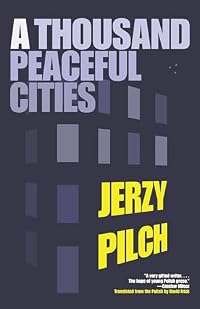
A Thousand Peaceful Cities
by Jerzy Pilch
On This Page
Description
Set in 1963, in the latter days of the Polish post-Stalinist thaw. Jerzyk, is a teenager who is keenly interested in the life of his father, a retired postal administrator and his father's closest friend, Mr Traba, a failed lutheran clergyman, alcoholic and would be Polish insurrectionist. One drunken afternoon, Mr Traba and the narrator's father decide to take charge of their lives and do one final good turn for humanity, travel to Warsaw and assassinate the Polish head of state and they show more decide to involve Jerzyk in their plan. show lessTags
Recommendations





















Member Reviews
Think about this...."The invention of stories about oneself is the duty and irresistible temptation of the true man. The made-up story is the song of his life and death. The story of the loser, the invented story of the loser, is the sign of the winner." This is the primary driving belief, in my opinion, behind the story of the Chief, Jerzy, and Mr. Traba's plot to assassinate the communist leader of Poland in 1963. Did they do it? Did they fantasize about it as they fantasized about the French woman who whispered "mille....villes.....tranquille" in the ear of her lover (thousand....peaceful...cities...the title of the novel)? I will be pondering this novel for a while. Very good!
A quirky small tale of the loss of innocence, as little Jerzyk is growing up and experiencing his first love -- and gets subsequently involved in an intricate plan by his father and his friend, Mr. Trąba, who have both decided to do something for the good of the mankind and assassinate Władysław Gomułka, the Secretary of Polish United Workers' Party. The story is, however, very little about what happens, rather than numerous small digressions, flashbacks, loops, and sideways glances at the despair and greatness of human existence.
Set in 1963. Communism, religion and family play a large role in this short fiction (143 pages). Polish author; translated work. In the story, Thomas Mann's "The Magic Mountain" is read annually and reference is made to a famous Polish tale "The Ugly Duchess" by Lion Feuchtwanga. "Ship of Fools" by Katherine Anne Porter is also mentioned. I've not read any of those works.
Ratings
Members
- Recently Added By
Author Information

31+ Works 431 Members
Awards and Honors
Awards
Distinctions
Classifications
- Genres
- Fiction and Literature, General Fiction
- DDC/MDS
- 891.8538 — Literature & rhetoric Asian Literature East Indo-European and Celtic literatures West and South Slavic languages (Bulgarian, Slovene, Polish, Czech, Slovak, Serbo-Croatian, and Macedonian) Polish Polish fiction 1989–
- LCC
- PG7175 .I49 .T9713 — Language and Literature Slavic languages and literatures. Baltic languages. Albanian language Slavic. Baltic. Albanian Slavic Polish
- BISAC
Statistics
- Members
- 74
- Popularity
- 424,607
- Reviews
- 3
- Rating
- (3.35)
- Languages
- English, Polish
- Media
- Paper, Ebook
- ISBNs
- 6