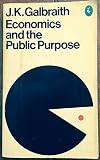
Economics and the Public Purpose
by John Kenneth Galbraith
On This Page
Description
Criticism of the present economic system of the USA and proposals for comprehensive economic policy reform - covers the general economic theory of advanced economic development, consumption, and the concept of the household, the market system in relation to the service sector and the self employed, economic planning, price policy, inflation, income distribution, fiscal policy, the environment, technological change, the role of women, etc.Tags
Recommendations

























Member Reviews
This was a strange reading experience. A very dated analysis (not therefore invalid) written from the time of my childhood (1960s) and teenage years (1970s), the time of Richard Nixon and just before (or at) the energy crisis. Women were largely presumed to be stay at home. The protests against the Vietnam War were contemporary.
Galbraith proposes that what he calls the neoclassical analysis of the economy with its focus on the market which is controlled by consumer demand and cost of production is hopelessly inadequate. This analysis ignores the power of very large corporations to control demand and price through planning. Galbraith sees two economic systems working side by side: the planning system (large corporations) and the normal show more (from neoclassical point of view) market system. The government is more easily melded with the planning system to the advantage of the planning system and the market is left to its own devices. This results in an abundance of relatively lesser needed products where the market supplies an inadequate supply of other products more useful to the public.
Beyond this I dare not go, but I am not sure I can articulate accurately. show less
Galbraith proposes that what he calls the neoclassical analysis of the economy with its focus on the market which is controlled by consumer demand and cost of production is hopelessly inadequate. This analysis ignores the power of very large corporations to control demand and price through planning. Galbraith sees two economic systems working side by side: the planning system (large corporations) and the normal show more (from neoclassical point of view) market system. The government is more easily melded with the planning system to the advantage of the planning system and the market is left to its own devices. This results in an abundance of relatively lesser needed products where the market supplies an inadequate supply of other products more useful to the public.
Beyond this I dare not go, but I am not sure I can articulate accurately. show less
Ratings
Members
- Recently Added By
Author Information

76+ Works 11,214 Members
John Kenneth Galbraith is a Canadian-born American economist who is perhaps the most widely read economist in the world. He taught at Harvard from 1934-1939 and then again from 1949-1975. An adviser to President John F. Kennedy, he served from 1961 to 1963 as U.S. ambassador to India. His style and wit in writing and his frequent media appearances show more have contributed greatly to his fame as an economist. Galbraith believes that it is not sufficient for government to manage the level of effective demand; government must manage the market itself. Galbraith stated in American Capitalism (1952) that the market is far from competitive, and governments and labor unions must serve as "countervailing power." He believes that ultimately "producer sovereignty" takes the place of consumer sovereignty and the producer - not the consumer - becomes ruler of the marketplace. (Bowker Author Biography) John Kenneth Galbraith, born in 1908, is the Paul M. Warburg Professor of Economics Emeritus at Harvard University and a past president of both the American Academy of Arts and Letters and the American Economic Association. He is the author of thirty-one books spanning five decades. He has received honorary degrees from, among others, Harvard University, Oxford University, the University of Paris, the University of Toronto, and Moscow State University. He is Commandeur de la Legion d'Honneur in France, and in 1997 he was inducted into the Order of Canada. In 2000, at a White House ceremony, he was given the Presidential Medal of Freedom. He lives in Cambridge, Massachusetts. (Publisher Provided) show less
Common Knowledge
- Canonical title*
- Nationalekonomin och samhällsintresset
- Original title
- Economics and the Public Purpose
- Original publication date
- 1973
- Dedication
- Once again for C.A.G. with love
- First words
- The purpose of an economic system would seem, at first glance, to be reasonably evident, and it is commonly so regarded.
- Last words
- (Click to show. Warning: May contain spoilers.)But for a very long while to come economists will thereby escape the fate that Keynes foresaw.
*Some information comes from Common Knowledge in other languages. Click "Edit" for more information.
Classifications
- Genres
- Economics, Nonfiction, General Nonfiction, Business, Politics and Government
- DDC/MDS
- 338.973 — Society, Government, and Culture Economics Production Economic Development And Growth North America United States
- LCC
- HC106.6 .G344 — Social sciences Economic history and conditions Economic history and conditions By region or country
- BISAC
Statistics
- Members
- 297
- Popularity
- 107,671
- Reviews
- 1
- Rating
- (3.82)
- Languages
- 9 — Danish, Dutch, English, German, Italian, Portuguese, Russian, Spanish, Swedish
- Media
- Paper
- ISBNs
- 17
- ASINs
- 8