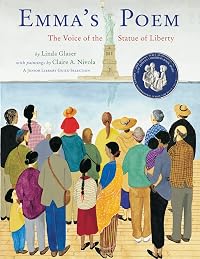
Emma's Poem: The Voice of the Statue of Liberty
by Linda Glaser, Claire A. Nivola (Illustrator)
On This Page
Description
The story of Emma Lazarus, who, despite her life of privilege, became a tireless advocate for the immigrants who arrived in New York City in the 1880s and wrote a famous poem for the Statue of Liberty.Tags
Recommendations




Member Reviews
This lovely picture-book biography of the nineteenth-century Jewish American poet Emma Lazarus, and her best-remembered work, The New Colossus, whose final lines - "Give me your tired, your poor, / Your huddled masses yearning to breathe free, / The wretched refuse of your teeming shore. / Send these, the homeless, tempest-tossed to me, / I lift my lamp beside the golden door!" - are indelibly connected to the Statue of Liberty, and to the idea (well, one of them, anyway) of the immigrant in American culture, moved me to tears this morning, as I read it on my morning commute.
Opening with Lazarus' comfortable childhood and youth, as the daughter of prosperous New Yorkers, and then moving through her gradual awakening to the realities of show more poverty and suffering, particularly amongst immigrants (many of them Jewish, like herself), her growing involvement as an educator in the immigrant community, and as an advocate for the less fortunate in the press of the day, the book concludes with her penning of her famous sonnet, as part of an effort to raise money for a base for the Statue of Liberty, and the great fame the poem has won, even down to the present day.
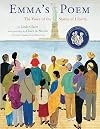
Linda Glaser's deceptively calm narrative has an emotional depth to it that will immediately draw the reader into her story - into Emma Lazarus' story. The accompanying watercolor and gouache artwork by Claire A. Nivola is incredibly beautiful, with a somewhat stylized feeling that never detracts from its emotional impact. I'm struggling to express just why it is that this title so moved me... perhaps because, through Lazarus' awakening to the world around her, and her incredible commitment to doing something about the injustices of that world, the reader too feels awakened? In any case, Emma's Poem is just a lovely, lovely book, one I recommend to anyone (teacher, parent, librarian) putting together a lesson on immigration or the Statue of Liberty, and to young readers interested in those topics, or in Emma Lazarus. show less
Opening with Lazarus' comfortable childhood and youth, as the daughter of prosperous New Yorkers, and then moving through her gradual awakening to the realities of show more poverty and suffering, particularly amongst immigrants (many of them Jewish, like herself), her growing involvement as an educator in the immigrant community, and as an advocate for the less fortunate in the press of the day, the book concludes with her penning of her famous sonnet, as part of an effort to raise money for a base for the Statue of Liberty, and the great fame the poem has won, even down to the present day.
Linda Glaser's deceptively calm narrative has an emotional depth to it that will immediately draw the reader into her story - into Emma Lazarus' story. The accompanying watercolor and gouache artwork by Claire A. Nivola is incredibly beautiful, with a somewhat stylized feeling that never detracts from its emotional impact. I'm struggling to express just why it is that this title so moved me... perhaps because, through Lazarus' awakening to the world around her, and her incredible commitment to doing something about the injustices of that world, the reader too feels awakened? In any case, Emma's Poem is just a lovely, lovely book, one I recommend to anyone (teacher, parent, librarian) putting together a lesson on immigration or the Statue of Liberty, and to young readers interested in those topics, or in Emma Lazarus. show less
This book shares the story of how the plaque at the base of the statue of Liberty came about. Emma Lazarus, along with other writers of the erra were asked to contribute writings to raise money for the base of the Statue of Liberty. Although she grew up in a wealthy family, she was determined to help the immagrants coming to the United States learn English and find jobs. The poem was engraved into the plaque and placed after Emma's death. The watercolor pictures depict the era. This book could be used in writing classes to show how Emma was inspired to write her sonnet.
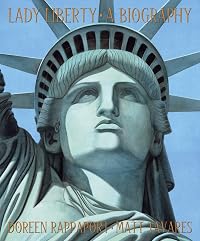
If you have Lady Liberty in your collection from 2008, you'll have to add Emma's Poem, which also in free verse (as is Lady Liberty) despite being different authors. Wealthy Emma Lazarus -- writer, humanitarian--has had a life of luxury. But when she realizes that poor immigrants have nothing, she worked with them, wrote about them -- and her sonnet "The New Colossus" honors them on the Statue of Liberty.
Emma’s Poem the Voice of the Statue of Liberty by Linda Glaser is about Emma Lazarus. The book starts by telling about Emma as a little girl. The book tells how she had become a well known writer. One day Emma visited Ward’s Island in the New York Harbor. Emma saw the ragged, tired and sad immigrants. The immigrants were Jews like herself. She then decided she wont to help them. Emma heard of the statue being built in New York Harbor. She was asked to write a poem to raise money for the statue’s pedestal. Emma decided to write about immigrants. Emma poem is now engraved on a plague at the entrance to the pedestal of the Statue of Liberty. Today, Emma’s poem is well known.
I enjoyed reading this book. I learned things about the show more Statue of Liberty that I didn’t know. This book is great for older students. The pictures are refreshing. I liked how at the end of the book it talked about Emma Lazarus and told some of the history. At the end of the book it has Emma’s actual poem. The name of the poem is The New Colossus.
I would use this book as a read-aloud for upper elementary grades. I would use this book when talking about the Statue of Liberty or immigration. I would also have a grand conversation talking about the book. We would discuss everything from the pictures to why Emma wrote of immigration. I would have this book available for students to read in class some time throughout the year. show less
I enjoyed reading this book. I learned things about the show more Statue of Liberty that I didn’t know. This book is great for older students. The pictures are refreshing. I liked how at the end of the book it talked about Emma Lazarus and told some of the history. At the end of the book it has Emma’s actual poem. The name of the poem is The New Colossus.
I would use this book as a read-aloud for upper elementary grades. I would use this book when talking about the Statue of Liberty or immigration. I would also have a grand conversation talking about the book. We would discuss everything from the pictures to why Emma wrote of immigration. I would have this book available for students to read in class some time throughout the year. show less
Summary: The book starts out as Emma as a child and how she was always rich and only knew rich people growing up. It then tells how Emma went to New York Harbor and saw many very poor people. It tells how the people were Jews like Emma but were treated very badly in Europe and that Emma hurt to see them. Emma felt she had to help so she visited them often and helped them learn English and get jobs. In that time people kept quiet about immigrants but Emma did not. She wrote in papers and poems about how they needed help. Emma heard about a statue that was being built to show the friendship for the United States but money was needed for the base of the statue to be built. Many writers were asked to write something that could be sold to show more raise money. Emmas was the only one read at the celebration. Three years later the money was raised and the statue was built. Thirty years later Emma's poem was printed in school text books.
Personal Reaction: I enjoyed reading this book. I actually did not know these specific facts about the Statue of Liberty and so it was very interesting to me. I think that this book would definitely keep the attention of a young reader.
Classroom Extensions: One thing you could do for an extension would be to print off and teach the students Emma's actual Poem now that they know the story behind it they would be more interested in learning it. Another extension you could do would be to offer the students extra credit or longer recess if they used the next week to memorize the poem and recite it to the class the following week. show less
Personal Reaction: I enjoyed reading this book. I actually did not know these specific facts about the Statue of Liberty and so it was very interesting to me. I think that this book would definitely keep the attention of a young reader.
Classroom Extensions: One thing you could do for an extension would be to print off and teach the students Emma's actual Poem now that they know the story behind it they would be more interested in learning it. Another extension you could do would be to offer the students extra credit or longer recess if they used the next week to memorize the poem and recite it to the class the following week. show less
Summary:
A story of a girl who grew up with everything and later became an woman with everything. She then met some poor immigrant people on a boat to New York harbor. That was the first time she met them and ended up helping those people read, write, and even helped with what she could. She started writing to help make people realize that these poor people were people as well. It helped some but not a lot. Until the Statue of Liberty was to be built and she wrote a poem about what the lady of the Statue of Liberty would be thinking and saying to the people she saw passing by.
Personal Reaction:
I really loved Emma's Poem. Its so great how the poem from this lady really impacted a lot of people and how they think and react to people. Its show more a great message and I would definitely love reading this story to children.
Classroom Extension:
1) History day where everyone will learn about the Statue of Liberty and make their own hats
2) Have students write a poem of what they think they would say if they were the Statue of Liberty. :) show less
A story of a girl who grew up with everything and later became an woman with everything. She then met some poor immigrant people on a boat to New York harbor. That was the first time she met them and ended up helping those people read, write, and even helped with what she could. She started writing to help make people realize that these poor people were people as well. It helped some but not a lot. Until the Statue of Liberty was to be built and she wrote a poem about what the lady of the Statue of Liberty would be thinking and saying to the people she saw passing by.
Personal Reaction:
I really loved Emma's Poem. Its so great how the poem from this lady really impacted a lot of people and how they think and react to people. Its show more a great message and I would definitely love reading this story to children.
Classroom Extension:
1) History day where everyone will learn about the Statue of Liberty and make their own hats
2) Have students write a poem of what they think they would say if they were the Statue of Liberty. :) show less
Discovered Claire A. Nivola at the Carle Museum. Read Emma's Poem to second- and third-graders at my school library, played an audio recording of part of the poem ("The New Colossus") set to music, and asked them to write their own welcome messages to new arrivals. Good for Jewish American Heritage month (May).
Members
- Recently Added By
Author Information

50 Works 5,778 Members

Awards and Honors
Awards
Common Knowledge
- Original publication date
- 2010
Classifications
Statistics
- Members
- 499
- Popularity
- 60,725
- Reviews
- 10
- Rating
- (4.06)
- Languages
- English
- Media
- Paper, Ebook
- ISBNs
- 7
- ASINs
- 7