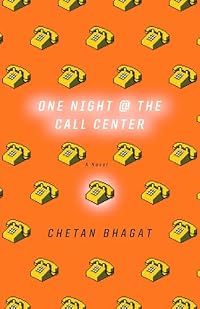
One Night at the Call Center: A Novel
by Chetan Bhagat
On This Page
Description
Press 1 for technical support. Press 2 for broken hearts. Press 3 if your life has totally crashed. . . . Six friends work nights at a call center in India, providing technical support for a major U.S. appliance corporation. Skilled in patience–and accent management–they help American consumers keep their lives running. Yet behind the headsets, everybody’s heart is on the line. Shyam (Sam to his callers) has lost his self-confidence after being dumped by the girl who just so happens to show more be sitting next to him. Priyanka’s domineering mother has arranged for her daughter’s upscale marriage to an Indian man in Seattle. Esha longs to be a model but discovers it’s a horizontal romp to the runway. Lost, dissatisfied Vroom has high ideals, but compromises them by talking on the phone to idiots each night. Traditional Radhika has just found out that her husband is sleeping with his secretary. And Military Uncle (nobody knows his real name) sits alone working the online chat. They all try to make it through their shifts–and maintain their sanity–under the eagle eye of a boss whose ego rivals his incompetence. But tonight is no ordinary night. Tonight is Thanksgiving in America: Appliances are going haywire, and the phones are ringing off their hooks. Then one call, from one very special caller, changes everything. Chetan Bhagat’s delicious romantic comedy takes us inside the world of the international call center, where cultural cross-wires come together with perfect pathos, hilarity, and spice. show lessTags
Recommendations



































Member Recommendations

Member Reviews
I was delighted to pick up a rare copy of this book in the UK and raced through it in 2 days flat. I loved it for its straightforward, humorous style, and while the synopsis threatened something uncomfortably religious, it’s not. (It’s religious in the sense that Yann Martel’s “Life of Pi” is religious I’d say).
As the title suggests, the story takes place over one night and is set in an Indian call centre, the sort of place I’ve been dealing with recently in connection with a Kodak printer I unwisely bought. It was fascinating – offshore call centres are so unpopular here it’s a positive selling point if a company doesn’t use them – and don’t get me started on the ones that cold call you with bogus show more ‘surveys’..... And yet all the time we know these are real people doing tough jobs on the other side of the world. Here in this book is their viewpoint and their world, a world of the idiot boss and nasty mother-in-law, a world of high tech and growing nationalism. They don’t like those bogus Western names any more than we do, and they are unashamedly scornful of their American “clients” (I particularly liked the ‘35-10 rule’). I’m going to be much nicer to those guys from Kodak in future but I still wish I had never bought the flipping printer. show less
As the title suggests, the story takes place over one night and is set in an Indian call centre, the sort of place I’ve been dealing with recently in connection with a Kodak printer I unwisely bought. It was fascinating – offshore call centres are so unpopular here it’s a positive selling point if a company doesn’t use them – and don’t get me started on the ones that cold call you with bogus show more ‘surveys’..... And yet all the time we know these are real people doing tough jobs on the other side of the world. Here in this book is their viewpoint and their world, a world of the idiot boss and nasty mother-in-law, a world of high tech and growing nationalism. They don’t like those bogus Western names any more than we do, and they are unashamedly scornful of their American “clients” (I particularly liked the ‘35-10 rule’). I’m going to be much nicer to those guys from Kodak in future but I still wish I had never bought the flipping printer. show less
Good light reading. As an Indian working in the US (like Ganesh!) it is interesting to read about the call center culture. If this portrayal of the Indian youth today is repressentative, then I must say a lot has changed since I last lived in India. As to the portrayal of America and Americans in a negative light, while it is quite startling, I can believe that this section of the Indian youth (those who work in call centers) predominantly has that sentiment as they only get to interact with Americans who have problems figuring out appliances and computers. I now want to read the author's other book.
Not really the right book for me; I have little patience with romantic woes to begin with, particularly from the point of view of the Nice Guy. The point of the book is that he gets his head back together in due course (and unlike most Nice Guys he actually does care about people when his head's on the right way to show it) so it was a better reading experience once I started reading on fast-forward and skipped a bunch of the flash-backs. I do like the conceit, and the parts focused on the call centre itself - and on the other problems facing their other colleagues - were a good read.
It's... okay. I didn't dislike it, but I can't think of anyone to whom I'll be recommending it either.
The framing of the story was interesting - while on an overnight train, a mysterious, beautiful woman tells the author the story of the call center, but only after he agrees to the woman's terms: if she tells the story, he must use it for his next book. But despite the reality-blurring frame, the story itself is average. The characters, all of whom work at the call center of the title, go to work, gossip, take breaks, and worry about the impending 'rightsizing.' Their boss speaks in impenetrable business jargon, and his incompetence may be a leading factor in the upcoming layoffs.
Shyam, the narrative character of the interior story, show more apologizes at the outset for his plain speech. As well he should, honestly. I assumed that the apology would turn out to be false modesty or a foil to underscore the brilliance of his insights, but the language of the novel is straight-forward and workaday to the point of becoming boring and the brilliant insights never materialized. The flat language use may be a problem with the translation... but I somehow doubt it. Shyam is paralyzed with self-doubt and hung up on Priyanka, whom he works with and used to date. The night is broken up by his reminisces about dates with Priyanka and her phone conversations with her prospective groom from America. He hates that she's moving on, but he feels he doesn't quite deserve her. As a reader, he nearly convinced me that he doesn't.
Oh, and it's Thanksgiving in America. And God calls. (Neither of these plot points is as interesting as it sounds.)
I've read much worse books, but there are better books out there. Skip this one. show less
The framing of the story was interesting - while on an overnight train, a mysterious, beautiful woman tells the author the story of the call center, but only after he agrees to the woman's terms: if she tells the story, he must use it for his next book. But despite the reality-blurring frame, the story itself is average. The characters, all of whom work at the call center of the title, go to work, gossip, take breaks, and worry about the impending 'rightsizing.' Their boss speaks in impenetrable business jargon, and his incompetence may be a leading factor in the upcoming layoffs.
Shyam, the narrative character of the interior story, show more apologizes at the outset for his plain speech. As well he should, honestly. I assumed that the apology would turn out to be false modesty or a foil to underscore the brilliance of his insights, but the language of the novel is straight-forward and workaday to the point of becoming boring and the brilliant insights never materialized. The flat language use may be a problem with the translation... but I somehow doubt it. Shyam is paralyzed with self-doubt and hung up on Priyanka, whom he works with and used to date. The night is broken up by his reminisces about dates with Priyanka and her phone conversations with her prospective groom from America. He hates that she's moving on, but he feels he doesn't quite deserve her. As a reader, he nearly convinced me that he doesn't.
Oh, and it's Thanksgiving in America. And God calls. (Neither of these plot points is as interesting as it sounds.)
I've read much worse books, but there are better books out there. Skip this one. show less
A somewhat enjoyable though predictable novel focusing on six employees and their relationships while working the evening shift at one of India’s technology call centers. Shymal, who uses the name Sam when talking to American consumers, works at a generic call center on the outskirts of Dehli. Working alongside a lonely old man, an aspiring model, a neglected wife, an angry idealist, and his ex – girlfriend Shymal is at his wit’s end as the firm looks to layoffs to save costs.
Shymal finds himself contending with Priyanka, his ex – girlfriend newly engaged through an arranged marriage to an overseas Indian. His coworkers have their own difficulties, and they find themselves dominated by an incompetent and self – serving boss. show more With the threat of losing their jobs, the colleagues trade barbs and complain incessantly about their American consumers. Over the course of the night they scheme and prod each other wondering if they will be employed in the morning, and if their various relationships can be salvaged.
The last fifth of the novel falls flat as Bhagat employs his Deus Ex Machina to wrap the story and provide its characters with life altering perspectives. The ending is picture perfect Bollywood and is never in doubt while also providing The Life of Pi type profundity. Although the novel’s onset is entertaining, and Bhagat has a good sense of dialogue, the ending feels rushed and forced. show less
Shymal finds himself contending with Priyanka, his ex – girlfriend newly engaged through an arranged marriage to an overseas Indian. His coworkers have their own difficulties, and they find themselves dominated by an incompetent and self – serving boss. show more With the threat of losing their jobs, the colleagues trade barbs and complain incessantly about their American consumers. Over the course of the night they scheme and prod each other wondering if they will be employed in the morning, and if their various relationships can be salvaged.
The last fifth of the novel falls flat as Bhagat employs his Deus Ex Machina to wrap the story and provide its characters with life altering perspectives. The ending is picture perfect Bollywood and is never in doubt while also providing The Life of Pi type profundity. Although the novel’s onset is entertaining, and Bhagat has a good sense of dialogue, the ending feels rushed and forced. show less
The synopsis tells you enough about the plot that I won't go into the details. This is such a quirky read and linking it to `The Office' (as Amazon has done) is not bad actually, it has that feel. I picked this up on a recommendation from a friend; she was spot on. When I read the opening chapter I thought yeah right, this isn't going to be that good but Bhagat's writing style is so easy you are soon swept along with the narrative.
In the opening page we are asked to do a task - think about something you fear, that makes you angry and one thing you don't like about yourself. I had a think, came up with an idea and plodded on with the reading. When you reach the end of the novel you find yourself thinking about what you said in the show more beginning and viewing it in a different way. Clever stuff!
God calling the characters who work in the call centre is a brilliant modern way of asking you not to find religion or allow Him into your heart but really just to trust and know you are watched over. It gave me a nice warm feeling! The characters are funny, they do some good things and some dreadful things all of which we are allowed to view through our own eyes and through the eyes of different characters.
Overall a great read that is well written with funny characters. show less
In the opening page we are asked to do a task - think about something you fear, that makes you angry and one thing you don't like about yourself. I had a think, came up with an idea and plodded on with the reading. When you reach the end of the novel you find yourself thinking about what you said in the show more beginning and viewing it in a different way. Clever stuff!
God calling the characters who work in the call centre is a brilliant modern way of asking you not to find religion or allow Him into your heart but really just to trust and know you are watched over. It gave me a nice warm feeling! The characters are funny, they do some good things and some dreadful things all of which we are allowed to view through our own eyes and through the eyes of different characters.
Overall a great read that is well written with funny characters. show less
The author worked for a horrible boss and cited him as an inspiration for this book. If only all bad working experiences could be translated into bestsellers.
I was surprised this was getting an American release, as Americans aren't exactly shown in a flattering light here. The 35=10 rule just about made me spit up. The Indian call center teaches all call agents that a 35-year-old American is as intelligent as a 10-year-old Indian. I wonder how Americans will take this saying. I suppose you sort of have to insult the people who call all night long to complain about idiotic problems now and then to stay sane and not end up screaming at them after one stupid question too many. The author does acknowledge that inspite of the vast show more intelligence Indians have, the country is plagued by corruption and thus very behind America.
The call center narrative is woven into the flashbacks the protagonist has of his past dates with his dream girl, now about to be whisked away by an Indian-American suitor to an American life. I didn't get too attached to the romance aspect of it, mostly I liked the insight into the life of the average 20-something Indian, trying to make a good living but not selling out. show less
I was surprised this was getting an American release, as Americans aren't exactly shown in a flattering light here. The 35=10 rule just about made me spit up. The Indian call center teaches all call agents that a 35-year-old American is as intelligent as a 10-year-old Indian. I wonder how Americans will take this saying. I suppose you sort of have to insult the people who call all night long to complain about idiotic problems now and then to stay sane and not end up screaming at them after one stupid question too many. The author does acknowledge that inspite of the vast show more intelligence Indians have, the country is plagued by corruption and thus very behind America.
The call center narrative is woven into the flashbacks the protagonist has of his past dates with his dream girl, now about to be whisked away by an Indian-American suitor to an American life. I didn't get too attached to the romance aspect of it, mostly I liked the insight into the life of the average 20-something Indian, trying to make a good living but not selling out. show less
Members
- Recently Added By
Published Reviews
ThingScore 100
"I first read it and wrote about it when I was in India last year, and it’s stayed in my head ever since."
added by jodi
Author Information

32+ Works 6,606 Members
Work Relationships
Is contained in
Common Knowledge
- Alternate titles
- හලෝ හලෝ; One night @ the call center
- Original publication date
- 2005
- People/Characters
- Krish, Ananya; Shyam Mehra (Sam Marcy); Esha; Vroom; Radikha; Military Uncle (show all 8); Priyanka; Bakhti
- Related movies
- Hello (IMDb)
- Dedication
- To my twin baby boys
and the wonderful woman
who created them*
*with a little bit of help from me
Classifications
Statistics
- Members
- 1,305
- Popularity
- 18,442
- Reviews
- 24
- Rating
- (2.40)
- Languages
- 5 — English, Gujarati, Hindi, Italian, Marathi
- Media
- Paper, Audiobook, Ebook
- ISBNs
- 20
- ASINs
- 9