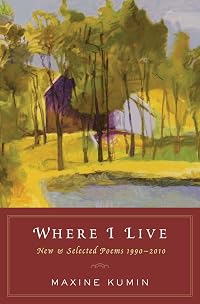
Where I Live: New & Selected Poems 1990-2010
by Maxine Kumin
On This Page
Description
"Where I Live is a collection celebrating the remarkable poetic range of one of America's greatest living poets. Where I Live gathers poems from Maxine Kumin's five previous books. The poems take as their concern rural life, family, and poetic legacy, and they wrestle with political and social causes. Also included is a generous selection of twenty-three new poems, which expand upon themes that have preoccupied Kumin and bring her record of poetic mastery up to the present." "Kumin's rare show more kinship with the natural world is again seen in this collection."--BOOK JACKET. show lessTags
Recommendations



Member Reviews
Maxine Kumin seems like a sweet older woman. Harmless, it would appear. After all, she begins her book of poetry with a focus on nature, and makes insightful observations on little things that are often overlooked. For example, in "Lore", she talks about a book she's read about blue jays, and how many acorns they ingest each season. She describes the oak trees that result from the blue jays losses, but takes notice of an even more interesting thought: who is the person, "an aspiring Ph.D." that actually counts these and compiles such data? It's that little bit of twist, from observing nature to questioning a source that make her unique, and makes you realize this is not a simple collection of pretty words. Most of all, as you continue show more reading Where I Live, you see that she isn't as harmless as you might suspect.
Her topics vary greatly and her observations are often are anything but sweet. In talking about Iraq, she doesn't back away from revealing the discrepancies between the suffering caused by liberators and a religious leader claiming there is a "spiritual value of suffering". She concludes that the sun comes up, "staining the sky with indifference". She also contrasts the ideals of the Geneva Convention with vice-presidents and Supreme Court justices who engage in what she calls "canned hunting". In "Please Pay Attention as the Ethics Have Changed", she wonders what kind of Humane Society (a word play on "human" society) would permit such cruelty to an animal (or moreso, to a person). From Daniel Pearl's tragic death to contaminated drinking water, she reveals her heart in her words.
She also speaks of stray dogs and abandoned cats with great feeling, and you get the impression that it isn't simply the immediate sadness that she's getting at...she's driving at the attitudes that make people shut their heart up to others. And while sometimes we may stereotype a poet as distant and focused on things beyond real life, she shows she's firmly planted in the here and now. In "The Chambermaids in the Marriot in Midmorning", she finds another life in their chatter:
"Behind my "Do not disturb" sign I go wherever they go
sorely tried by their menfolk, their husbands, lovers or sons,
who have jobs or have lost them, who drink and run around,
who total their cars and are maimed, or lie idle in traction...
I think how static my life is with its careful speeches and classes
and how I admire the women who daily clean up my messes,
who are never done scrubbing..."
The contents are divided into sections: New Poems, Looking for Luck, Connecting the Dots, The Long Marriage, Jack and Other New Poems, and Still to Mow. Simple chores, farm work, famous women authors, childbirth, the Red Sox, misbehaving pets, redemption, corporate greed, and travel all are portrayed as she sees them, not sugar-coated nor politicized. The collection as a whole feels like a book of sage advice from a favored aunt-the feisty one-the one that sometimes says what you don't want to hear but who you listen to anyway. And while they are considered poetry, the verses often read with the detail you'd find in a short story. show less
Her topics vary greatly and her observations are often are anything but sweet. In talking about Iraq, she doesn't back away from revealing the discrepancies between the suffering caused by liberators and a religious leader claiming there is a "spiritual value of suffering". She concludes that the sun comes up, "staining the sky with indifference". She also contrasts the ideals of the Geneva Convention with vice-presidents and Supreme Court justices who engage in what she calls "canned hunting". In "Please Pay Attention as the Ethics Have Changed", she wonders what kind of Humane Society (a word play on "human" society) would permit such cruelty to an animal (or moreso, to a person). From Daniel Pearl's tragic death to contaminated drinking water, she reveals her heart in her words.
She also speaks of stray dogs and abandoned cats with great feeling, and you get the impression that it isn't simply the immediate sadness that she's getting at...she's driving at the attitudes that make people shut their heart up to others. And while sometimes we may stereotype a poet as distant and focused on things beyond real life, she shows she's firmly planted in the here and now. In "The Chambermaids in the Marriot in Midmorning", she finds another life in their chatter:
"Behind my "Do not disturb" sign I go wherever they go
sorely tried by their menfolk, their husbands, lovers or sons,
who have jobs or have lost them, who drink and run around,
who total their cars and are maimed, or lie idle in traction...
I think how static my life is with its careful speeches and classes
and how I admire the women who daily clean up my messes,
who are never done scrubbing..."
The contents are divided into sections: New Poems, Looking for Luck, Connecting the Dots, The Long Marriage, Jack and Other New Poems, and Still to Mow. Simple chores, farm work, famous women authors, childbirth, the Red Sox, misbehaving pets, redemption, corporate greed, and travel all are portrayed as she sees them, not sugar-coated nor politicized. The collection as a whole feels like a book of sage advice from a favored aunt-the feisty one-the one that sometimes says what you don't want to hear but who you listen to anyway. And while they are considered poetry, the verses often read with the detail you'd find in a short story. show less
Ratings
Members
- Recently Added By
Author Information

60+ Works 1,490 Members
Maxine Kumin was born in Philadelphia in 1925. She received a BA and a MA from Radcliffe College. In the 1950s, she enrolled in a poetry writing course at the Boston Center for Adult Education. The course led to the publication of poems in Harper's and The New Yorker. Her first collection of poems, Halfway, was published in 1961. Her other poetry show more collections include Where I Live: New and Selected Poems 1990-2010, Still to Mow, and And Short the Season. She received several awards including the Ruth Lilly Poetry Prize, the Robert Frost Medal, and the Pulitzer Prize for Up Country: Poems of New England. She also wrote four novels, short stories, a memoir entitled Inside the Halo and Beyond: The Anatomy of a Recovery, essay collections, and children's books. She died of natural causes on February 6, 2014 at the age of 88. (Bowker Author Biography) show less
Awards and Honors
Awards
Classifications
Statistics
- Members
- 65
- Popularity
- 478,621
- Reviews
- 1
- Rating
- (4.25)
- Languages
- English
- Media
- Paper
- ISBNs
- 2